
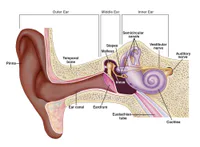
Ear Anatomy

Presentation
•
Science
•
6th - 8th Grade
•
Hard

James Gonzalez
FREE Resource
7 Slides • 3 Questions
1
The Middle Ear
2
pgs. 32-33
3
Multiple Choice
What is the function of the ossicles in the middle ear?
To increase the pressure in the middle ear
To transmit soundwaves to the inner ear
To prevent middle ear infections
To narrow the eustachian tube
4
Ossicles: Middle Ear Protectors
The ossicles in the middle ear play a crucial role in preventing middle ear infections. They form a chain of three tiny bones - the malleus, incus, and stapes - that transmit soundwaves from the eardrum to the inner ear. By amplifying and transmitting sound, they help protect the delicate structures of the inner ear and maintain optimal hearing health. Without these ossicles, the risk of middle ear infections would significantly increase, leading to potential hearing loss and discomfort.
5
The Inner Ear
The inner ear consists of the cochlea and semicircular canals. The cochlea is responsible for transducing sound, while the semicircular canals help with balance. These structures are found inside the labyrinth, a protective bony structure. The cochlea has a spiral shape and is encased in bone, with the stapes pushing sound vibrations into the fluid-filled cochlea.
6
Multiple Choice
What is responsible for transducing sound in the inner ear?
Cochlea
Semicircular canals
Labyrinth
Stapes
7
The Cochlea
The cochlea is responsible for transducing sound in the inner ear. It is a spiral-shaped, fluid-filled structure that contains thousands of tiny hair cells. These hair cells convert sound vibrations into electrical signals that are sent to the brain for interpretation. Without the cochlea, we would not be able to hear!
8
The Cochlea: Structure and Function
9
Multiple Choice
Which chamber of the cochlea separates Scala Tympani from Scala Media?
Scala Vestibuli
Basilar Membrane
Organ of Corti
Scala Tympani
10
Basilar Membrane
Trivia: The Basilar Membrane is the chamber of the cochlea that separates Scala Tympani from Scala Media. It plays a crucial role in the process of hearing by vibrating in response to sound waves, allowing the hair cells in the Organ of Corti to detect different frequencies. Without the Basilar Membrane, our ability to perceive different pitches would be greatly impaired.
The Middle Ear
Show answer
Auto Play
Slide 1 / 10
SLIDE
Similar Resources on Wayground

8 questions
Watsons go to birmingham chap 7
Presentation
•
6th - 8th Grade
9 questions
Direct and Indirect Object
Presentation
•
6th - 8th Grade
10 questions
MS-ESS2-3 Plate Tectonics and Seafloor Spreading
Presentation
•
7th Grade
9 questions
Magnetic Force
Presentation
•
6th - 8th Grade
9 questions
Genetic engineering
Presentation
•
6th - 8th Grade
7 questions
Bacteria Paradise
Presentation
•
6th - 8th Grade
11 questions
Identifying Variables In Experiments
Presentation
•
6th - 8th Grade
9 questions
Scientific Method Review
Presentation
•
6th - 8th Grade
Popular Resources on Wayground
10 questions
How much do you know about our Portrait of an Eagle?

Quiz
•
10th Grade
10 questions
Fast Food Slogans
Quiz
•
6th - 8th Grade
21 questions
Continents and Oceans
Quiz
•
6th Grade
20 questions
Parts of Speech
Quiz
•
5th Grade
16 questions
Subject & Predicate
Quiz
•
5th Grade
25 questions
Multiplication Facts
Quiz
•
5th Grade
12 questions
Map Skills
Quiz
•
3rd Grade
22 questions
Continents and Oceans
Quiz
•
5th Grade
Discover more resources for Science
17 questions
7.6D Aqueous Solutions
Quiz
•
7th Grade
20 questions
Scientific Method and Variables
Quiz
•
8th Grade
20 questions
Scientific method and variables
Quiz
•
8th Grade
27 questions
Counting Atoms - Subscripts
Quiz
•
8th Grade
10 questions
6.6D - Relative Density Review
Quiz
•
6th Grade
20 questions
Claim, Evidence and Reasoning (CER)
Quiz
•
6th - 8th Grade
18 questions
Counting Atoms
Quiz
•
7th - 8th Grade
20 questions
Density
Quiz
•
6th Grade