
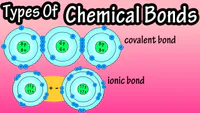
Types of Bonds

Presentation
•
Science
•
9th Grade
•
Hard

James Gonzalez
FREE Resource
10 Slides • 8 Questions
1
Chemical Bonding

2
Ions
Ions are atoms that have lost or gained electrons.

3

4
What will they do?
Metals are elements that will lose electrons and will form cations.
Nonmetals are elements that will gain electrons and will form anions.

5
Multiple Select
Which of the following are examples of anions?
K+
S-2
Cl-
Mg+2
6
Multiple Select
Which of the following are cations?
Cr+3
O-2
S-2
Ba+2
7
Multiple Choice
Potassium (K) is a group 1 element. Elements in this group are _____.
metals and form anions
nonmetals and form cations
metals and form cations
nonmetals and form anions
8
Multiple Choice
Iodine (I) is a group 17 element. Elements in this group are _____.
metals and form anions
nonmetals and form cations
metals and form cations
nonmetals and form anions
9
transfer of electrons
Think about it:
What happens when potassium (K) and iodine (I) atoms form chemical bonds?

10
Answer
Potassium
is a group 1 element with 1 VE
When potassium bonds with iodine it will lose a valence electron
Iodine
is a group 17 element with 7 VE
it will gain 1 electron on its outer ring (shell) from potassium.
In this case the electrons are TRANSFERRED, not shared.
11

12
Ionic Bonds
These are formed when valence electrons are transferred from one atom to another.
ionic bonds are formed between metals and nonmetals

13
Superscripts
The charges that you see written next to ions after they have gained or lost electrons are called superscripts.
Superscript means "written above."
Superscripts tell us:
how many electrons were gained or lost
if it is an anion or a cation

14
Multiple Choice
Magnesium is a group 2 element. When it bonds with a nonmetal in group 16 what will the superscript be and what does it mean?
+2; meaning it has gained electrons
-2; meaning it has gained electrons
+2; meaning it has lost electrons
-2; meaning it has lost electrons
15
Fill in the Blanks
Type answer...
16
Covalent Bonds
These types of bonds happen when valence electrons are shared between atoms.
Covalent bonds are formed between 2 or more nonmetals
Molecules are the result of atoms sharing electrons to form neutral atoms

17
Multiple Choice
Covalent bonds are formed between what types of elements?
metals and nonmetals
transition elements
nonmetals
metals
18
Multiple Select
Which of the following are examples of covalent bonds?
LiF
NH3
NaBr
CO
Chemical Bonding
Show answer
Auto Play
Slide 1 / 18
SLIDE
Similar Resources on Wayground

15 questions
Covalent Compounds
Presentation
•
9th Grade
14 questions
CAST Atoms and Periodic Table Practice
Presentation
•
8th Grade
16 questions
Chemical Reactions: Exploring the World of Molecules
Presentation
•
9th Grade
17 questions
Elements, Compounds, & Molecules
Presentation
•
8th Grade
14 questions
The Atom
Presentation
•
8th Grade
18 questions
Unit 03 - Chemical Bonding - Types of Bonds
Presentation
•
9th Grade
11 questions
Appositive Phrases
Presentation
•
9th Grade
15 questions
Electron configuration
Presentation
•
9th - 10th Grade
Popular Resources on Wayground
15 questions
Grade 3 Simulation Assessment 1

Quiz
•
3rd Grade
22 questions
HCS Grade 4 Simulation Assessment_1 2526sy
Quiz
•
4th Grade
16 questions
Grade 3 Simulation Assessment 2
Quiz
•
3rd Grade
19 questions
HCS Grade 5 Simulation Assessment_1 2526sy
Quiz
•
5th Grade
17 questions
HCS Grade 4 Simulation Assessment_2 2526sy
Quiz
•
4th Grade
20 questions
Equivalent Fractions
Quiz
•
3rd Grade
24 questions
HCS Grade 5 Simulation Assessment_2 2526sy
Quiz
•
5th Grade
20 questions
Math Review
Quiz
•
3rd Grade
Discover more resources for Science
20 questions
Earth Day Trivia
Quiz
•
9th - 12th Grade
100 questions
Biology EOC Review
Quiz
•
9th - 12th Grade
20 questions
Earth Day
Quiz
•
3rd - 12th Grade
20 questions
Human Impact on the Environment Review #2
Quiz
•
9th Grade
10 questions
Exploring Natural Selection Concepts

Interactive video
•
6th - 10th Grade
20 questions
Balancing Chemical Equations
Quiz
•
9th Grade
10 questions
Exploring Air Masses and Weather Fronts
Interactive video
•
6th - 10th Grade
42 questions
Practice Missouri Biology EOC Test
Quiz
•
9th Grade