

BASIC FINANCIAL PLAN FOR BUSINESS START-UP

Presentation
•
Business
•
University
•
Practice Problem
•
Easy

SHARON BTU
Used 10+ times
FREE Resource
40 Slides • 0 Questions
1

24
Dr. Sharon Ong

2
24
Learning Objectives (1 of 2)
1. Describe how to prepare the basic financial statements
and use them to manage a small business.
2. Create financial statements.
3. Understand the basic financial statements through ratio
analysis.
4. Explain how to interpret financial ratios.
5. Conduct a break-even analysis for a small company.
3

4

5
24
The Importance of a Financial Plan
• Common mistake among business owners: Failing to
collect and analyze basic financial data.
• Many entrepreneurs run their companies without any kind
of financial plan.
• About 75% of business owners do not understand or fail to
focus on the financial details of their companies.
• Financial planning is essential to running a successful
business and is not that difficult!
6

7
8

9

10

Financial Plan
•A basic financial plan includes the
following:

11

12

Step 1: Project Implementation Cost and Sources of Fund
13

Step 1: Project Implementation Cost and Sources of Fund
14

Step 1: Project Implementation Cost and Sources of Fund
15
24

Step 2: Loan Amortization Table
16
Step 3: Depreciation of Asset

17
24
Step 3: Depreciation of Asset

18
Step 4: Cash Flow Statement

19
Step 4: Cash Flow Statement
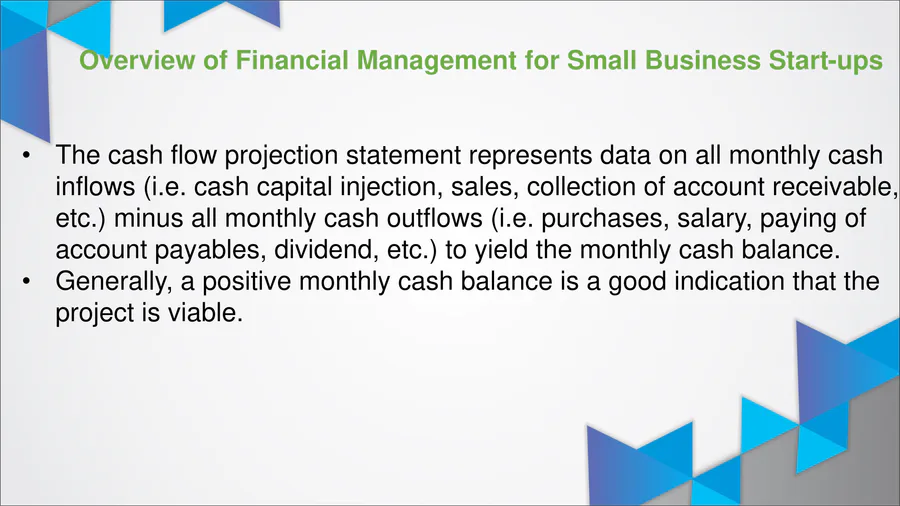
Cash flow is the estimated total cash inflow, cash outflow and balance of cash at the end of the day, week or month. It is done for an accounting period (e.g. one month or one year).
20

Step 2: Cash Flow Projection
15
Purpose? The purpose of the cash flow statement is to show where an entities cash is being generated (cash inflows), and where its cash is being spent (cash outflows), over a specific period of time (usually quarterly and annually).
21
Step 4: Cash Flow Statement


22
Step 4: Cash Flow Statement

23

Step 5: Financial Statement
Based on the projected income
statement,
Profit margin on sale
= Net profit/Sale ×100%
= 2,600/6,000 × 100%
= 43.33%
The projected financial statement
shows the projected overall
results of each step that has been
discussed before. Table 8.6
shows the projected income
statement which gives the
expected financial performance
for the financial periods on total
sale, cost of goods sold, gross
profit, expenses and net profit.
24

Step 6: Balance Sheet
•The balance sheet shows the
balance for asset, liability, and
equity at the end of the financial
period.
Asset = Liability + Equity
25

• Assets
• Non-current assets
• Fixed assets are used and depreciated by a company
for more than a year, and thus, they are considered
non-current assets.
• Current assets
• Current assets are short-term assets that can be
converted into cash within a year. Examples of these
assets are cash, stock (raw materials), account
receivables and other short-term investments.
Step 6: Balance Sheet
26

• Owners’ Equity
• Owners’ equity refers to the original capital contributions from the
owners or shareholders in terms of cash or assets plus the
accumulated amount of net profit. However, if the company suffers
a loss, the amount of loss will be deducted from the original equity
contribution.
• Liabilities
• Liabilities are the amounts owed by the company to outsiders.
They are categorized as current liabilities and non-current liabilities
(long-term liabilities).For example, accounts payable.
• Non-current liabilities or Long-term liabilities refer to the long-term
obligations of the company that mature in a period of more than
one year. For example, bank loan.
Step 6: Balance Sheet
27

The balance sheet shows the balance
for cash, asset, liability and equity at the
end of the financial period.
Return on investment (ROI) per month:
= Net profit/Project implementation cost (total cost
of the investment)
×100%
= 2,600/2,700×100% = 96.3%
Return on asset per month:
= Net profit/Total asset ×100%
= 2,600/4,300 ×100% = 60.5%
Asset = Liability + Equity
Step 6: Balance Sheet
28
Ratio Analysis
• Ratio analysis:
– A method of expressing the relationships between any
– A method of expressing the relationships between any
two elements on financial statements.
– Important barometers of a company’s health.
• Studies indicate few small business owners compute
financial ratios and use them to manage their businesses.
29

30

31

32

33

34

35

36

37


Copyright © 2019, 2016, 2014 Pearson Education Ltd. All Rights Reserved.
Basic Financial Statements (3 of 3)
• Statement of Cash Flows:
– Shows the change in the firm's working capital over a
period of time by listing the sources and uses of
funds.
38

39

40

24
Dr. Sharon Ong
Show answer
Auto Play
Slide 1 / 40
SLIDE
Similar Resources on Wayground

36 questions
EV3U11
Presentation
•
University
35 questions
SYNCHRONOUS SESSION WEEK 9 - BME 3
Presentation
•
University
38 questions
GEd 109 STS Finals Reviewer
Presentation
•
University
37 questions
Writing Essays - Peer Editing p21-24
Presentation
•
University
31 questions
CIM Lecture 1 - How Has Marketing Changed
Presentation
•
University
31 questions
Chapter 4: Concepts and Terms in Transport
Presentation
•
University
39 questions
MGMT 453 - Managing HR Globally
Presentation
•
University
38 questions
APA6 Reference List
Presentation
•
University
Popular Resources on Wayground
10 questions
Safety Day 2026 – Student Review

Quiz
•
9th Grade
21 questions
Continents and Oceans
Quiz
•
6th Grade
20 questions
Parts of Speech
Quiz
•
5th Grade
16 questions
Subject & Predicate
Quiz
•
5th Grade
25 questions
Multiplication Facts
Quiz
•
5th Grade
12 questions
Map Skills
Quiz
•
3rd Grade
22 questions
Continents and Oceans
Quiz
•
5th Grade
15 questions
Rounding Decimals
Quiz
•
5th Grade