untitled
Presentation
•
Physics
•
11th Grade - University
•
Practice Problem
•
Hard
Mr. Poyser
Used 1+ times
FREE Resource
22 Slides • 27 Questions
1
Topic Review:
Circular Motion
​
2
3-1: The Gravitational Field
ALL objects attract each other with a force of gravitational attraction.
The force depends on the mass of the objects and the distance between their centers.
3
Multiple Choice
Force of gravity is inversely proportional to
Mass
Weight
Distance
Time
4
Multiple Choice
5
Multiple Choice
If I double the mass of one object without changing anything else, What would happen to the gravitational force between that object and any other object?
Doubles
Quadruples
Cut in Half
41 as much
6
Multiple Choice
What happens to Gravitational force if I double both of the masses but don't change their distance?
doubles
half as big
4 times bigger
41 as much or 4 times smaller
7
Multiple Choice
Find the distance between two objects whose masses are m1 = 4,500 kg, and m2 = 8,700 kg; if the gravitational force between them is F = 2.0 x 10⁻⁸ N.
130565.25 m
361.34 m
0.19575 m
0.783 m
8
3-2: Angular Velocity & Centripetal Acceleration
There are "circular" variables that correspond to linear variables.
Change in Angle, Angular Velocity, and Centripetal Acceleration.
There is also a Linear Velocity for objects in circular motion!
9
Multiple Choice
The rotational equivalent to x (displacement), v (velocity) and a (acceleration) are?
m, m/s, m/s2
θ, ω, α
x, x/t, α
μ, Σ, τ
10
Multiple Choice
Which of the following is NOT a unit of angular velocity?
Meters per second
Revolutions per minute
Revolutions per second
Rotations per second
11
Multiple Choice
A bug on a spinning record will make more turns per minute if it is located toward the center of the record.
True
False
12
Multiple Choice
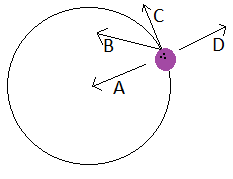
Which represents the acceleration of the ball? The ball is moving counter-clockwise.
A
B
C
D
13
Multiple Choice
Where should you go on a merry go round to go fastest?
Into the middle!
Out to the edge!
Doesn't matter- rotational speed and linear speed are the same everywhere!
Jump up to go fastest!
14
3-3: Centripetal Force
This is the name given to a force moving an object in uniform circular motion.
If you lost the centripetal force the object would stop revolving and continue in a straight line tangent to the circumference of the circle.
Time Period is the number of seconds it takes for one cycle, and the inverse is Frequency.
15
Multiple Choice
If mass increases force will....
increase because they have a direct relationship
increase because they have a inverse relationship
decrease
both
16
Multiple Choice
If radius increases force will....
decrease because they have a direct relationship
decrease because they have a inverse relationship
increase
both
17
Multiple Choice
If velocity increases force will....
increase because they have a direct relationship
increase because they have a inverse relationship
decrease
both
18
Multiple Choice
19
Multiple Choice
20
Multiple Choice
A dog sits 1.50 m from the center of a merry-go-round and revolves at a tangential speed of 1.80 m/s. If the dog’s mass is 18.5 kg, what is the magnitude of the centripetal force on the dog?
56 N
21 N
40 N
98 N
21
3.4 Applications of Circular Motion
All planetary orbits are ellipses.
Planets cover equal areas in equal time periods.
Satellites move faster when closer to the sun, and slower when further away.
22
Multiple Choice
23
Multiple Choice
24
Multiple Choice
25
Multiple Choice
Earth will travel fastest in its orbit when
the earth is closest to the sun (January 3rd)
the earth is farthest from the sun (July 3rd)
26
Multiple Choice
27
Planetary Motion & Gravitation (Physics 7.1)
​

28
29
30
31
32
33
34
35
36
37
38
39
40
41
42
43
44
Multiple Choice
Kepler's _____ Law states that the paths of the planets are ellipses, with the Sun at the center.
1st
2nd
3rd
4th
45
Multiple Choice
"An imaginary line from the Sun to a planet sweeps out equal areas in equal time intervals" is...
Kepler's 1st Law
Newton's 2nd Law
Kepler's 2nd Law
Newton's 3rd Law
46
Multiple Choice
"the square of the ratio of the periods of any two planets revolving about the Sun is equal to the cube of the ratio of their average distances from the Sun" is ________, also written as
(TBTA)2 = (rBrA)3Newton's 2nd Law
Kepler's 2nd Law
Kepler's 1st Law
Kepler's 3rd Law
47
Fill in the Blanks
Type answer...
48
Fill in the Blanks
Type answer...
49
Fill in the Blanks
Type answer...
Topic Review:
Circular Motion
​
Show answer
Auto Play
Slide 1 / 49
SLIDE

Similar Resources on Wayground
47 questions
Dynamics Review
Presentation
•
11th - 12th Grade
42 questions
Introduction to Medical Terminology
Presentation
•
12th Grade
44 questions
Waves
Presentation
•
KG - University
47 questions
Electricity & Magnetism Review
Presentation
•
10th - 12th Grade
44 questions
SKP M5 อัตราเร็วแสง ดวงตาและการผสมสีแสง
Presentation
•
12th Grade
47 questions
PH13.4 Wave behaviors
Presentation
•
11th - 12th Grade
44 questions
Topics (4.6 & 4.7) Cell Cycle & Regulation
Presentation
•
11th Grade - University
43 questions
Unit 11 NOTES - Polar-Ecosystems-The-Arctic-and-Antarctic (1)
Presentation
•
12th Grade
Popular Resources on Wayground
11 questions
Hallway & Bathroom Expectations
Quiz
•
6th - 8th Grade
10 questions
HCS SCI 03 Summer School Assessment 2
Quiz
•
3rd Grade
11 questions
Home Scope
Quiz
•
7th - 8th Grade
12 questions
2026 TAP Technology in the Classroom
Presentation
•
Professional Development
15 questions
HCS SCI 05 Summer School Assessment 2 Review
Quiz
•
5th Grade
15 questions
HCS SCI 04 Summer School Review 2
Quiz
•
4th Grade
59 questions
Geometry Unit 3 Review
Quiz
•
9th - 12th Grade
14 questions
FAST ELA READING SMAPLE TEST MATERIALS
Passage
•
3rd Grade