

The Achaemenid Persian Empire: Rise and Fall

Presentation
•
Social Studies
•
7th Grade
•
Easy

Joshua Booker
Used 12+ times
FREE Resource
23 Slides • 40 Questions
1

2

3
Multiple Choice
Who founded the Achaemenid Empire?
Darius the Great
Xerxes I
Cyrus the Great
Alexander the Great
4
Multiple Choice
What was the Achaemenid Empire known for?
Military conquests
Religious and cultural toleration
Architectural achievements
Trade and commerce
5

6
Multiple Choice
What was one of the policies implemented by Cyrus the Great?
Policies of religious intolerance
Policies of religious tolerance
Policies of economic isolation
Policies of military withdrawal
7
Multiple Choice
Who did Cyrus the Great defeat to expand his empire?
His father, Cambyses
His uncle, Darius
His grandfather, Astyages
His brother, Bardiya
8

9
Multiple Choice
What title did Darius I introduce during his reign?
Emperor of the World
Shahanshah (King of Kings)
Pharaoh of the East
Lord of the Lands
10
Multiple Choice
From which god did Darius I claim the divine right to rule?
Zeus
Odin
Ahura Mazda
Ra
11

12
Multiple Choice
What was the standard currency introduced by Darius I?
Silver coin
Gold daric
Copper penny
Bronze drachma
13
Multiple Choice
Which of the following was a benefit of the standardized currency under Darius I?
Decreased economic activity
Made goods harder to transport
Allowed for centralized tax collection
Discouraged construction projects
14
15
Multiple Choice
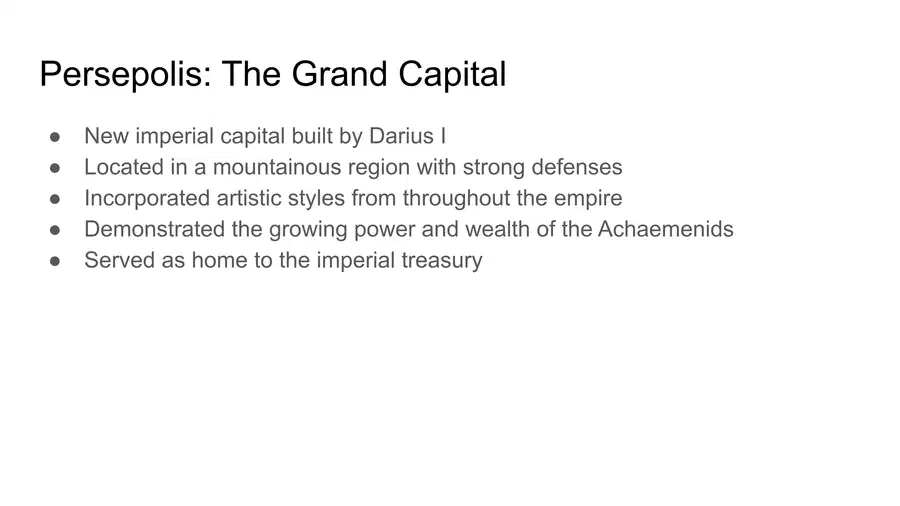
Who built the new imperial capital of Persepolis?
Cyrus the Great
Darius I
Xerxes I
Alexander the Great
16
Multiple Choice
What was one of the purposes of Persepolis?
It was a military training ground
It served as a religious center
It was home to the imperial treasury
It was a marketplace
17

18
Multiple Choice
What was one of the main benefits of the Royal Road?
It facilitated trade across the empire.
It was used for religious ceremonies.
It was a place for public gatherings.
It was a site for royal palaces.
19
Multiple Choice
Which of the following was supported by the Royal Road?
A network of schools
A spy network to monitor satraps
A series of temples
A chain of marketplaces
20


21
Multiple Choice
In which year was Darius I defeated at the Battle of Marathon?
499 BCE
490 BCE
480 BCE
479 BCE
22
Multiple Choice
What was the outcome of Xerxes I's campaign against Greece between 480-479 BCE?
Xerxes I successfully conquered Greece
Xerxes I was initially successful but ultimately failed to conquer Greece
Xerxes I did not attempt to conquer Greece
Xerxes I formed an alliance with Greece
23

24
Multiple Choice
What was one of the reasons for increased taxation in the Achaemenid Empire?
Successful Greek campaigns
Failed Greek campaigns
Expansion of the empire
Decrease in trade
25
Multiple Choice
Who invaded the Persian Empire in 334 BCE?
Julius Caesar
Genghis Khan
Alexander the Great
Napoleon Bonaparte
26

27
Multiple Choice
How long did the Achaemenid Empire last?
Over one century (559-459 BCE)
Over two centuries (559-330 BCE)
Over three centuries (559-259 BCE)
Over four centuries (559-159 BCE)
28
Multiple Choice
Which of the following was a contribution of the Achaemenid Empire?
Development of modern democracy
Introduction of effective systems of imperial governance
Invention of the printing press
Establishment of the Roman Empire
29

30

31
Multiple Choice
Which countries does the region of Kurdistan span?
Iran, Iraq, Turkey, and Syria
Iran, Iraq, Saudi Arabia, and Syria
Turkey, Syria, Jordan, and Iraq
Iran, Jordan, Turkey, and Lebanon
32
Multiple Choice
Approximately how many Kurds live in the region of Kurdistan?
10-20 million
20-30 million
30-40 million
40-50 million
33

34
Multiple Choice
Where is Kurdistan located?
In the southern part of Africa
In the north-central area of the Middle East
In the western part of Europe
In the eastern part of Asia
35
Multiple Choice
Which mountain ranges are included in Kurdistan?
Himalayas and Andes
Rockies and Alps
Zagros and Taurus
Pyrenees and Carpathians
36

37
Multiple Choice
How long has archaeological evidence shown human habitation in Kurdistan?
Over 5,000 years
Over 10,000 years
Over 1,000 years
Over 500 years
38
Multiple Choice
Which ancient civilization is mentioned as having been present in Kurdistan?
Roman
Egyptian
Mesopotamian
Greek
39

40
Multiple Choice
What percentage of Turkey's population is made up of Kurds?
5-10%
15-20%
25-30%
35-40%
41
Multiple Choice
What is one of the reasons the mountainous terrain of Kurdistan is significant?
It has no impact on the culture.
It provides no natural defenses.
It has influenced traditional nomadic herding.
It is irrelevant to trade routes.
42

43
Multiple Choice
Which of the following is a major ethnic group in Kurdistan?
Kurds
Japanese
Russians
Germans
44
Multiple Choice
What has Kurdistan been described as in terms of its ethnic groups?
A place of isolation
A battleground and a place of coexistence
A land of uniformity
A region of economic prosperity
45

46
Multiple Choice
Which group invaded Kurdistan from the west?
Ancient Persians
Alexander the Great
Muslim Arabs
Seljuk Turks
47
Multiple Choice
In which century did the Mongols invade Kurdistan?
7th century
11th century
13th century
16th century
48

49
Multiple Choice
Why did the Kurds often retreat to the mountains?
To find new trade routes
For safety
To establish new settlements
To cultivate crops
50
Multiple Choice
What has the Kurdish pursuit of independence and autonomy led to?
Peaceful relations with neighboring countries
Increased trade with Europe
Conflicts with Turks, Arabs, and Iranians
Alliances with Western nations
51

52
Multiple Choice
Under which rule did the Kurds adopt Sunni Islam?
Arab conquest
Ottoman rule
Persian influence
British mandate
53
Multiple Choice
What significant political development did the Kurds achieve in the 1990s?
Formed the PKK and KDP
Developed Kurdish nationalism
Became freedom fighters (Peshmerga)
Established the Kurdistan Regional Government (KRG)
54

55
Multiple Choice
What was the purpose of the Sykes-Picot Agreement of 1916?
To establish peace in the Middle East
To divide the region between Britain and France
To grant independence to the Kurds
To cancel Kurdish independence plans
56
Multiple Choice
Which treaty canceled Kurdish independence plans in 1923?
Treaty of Sèvres
Treaty of Versailles
Treaty of Lausanne
Treaty of Paris
57

58
Multiple Choice
What significant event in Iraqi Kurdistan occurred in 1991?
Establishment of the Kurdistan Regional Government (KRG)
Kurdish Civil War
No-fly zone gave Kurds some autonomy
Kurds helped overthrow Saddam Hussein
59
Multiple Choice
When was the Kurdistan Regional Government (KRG) established?
1991
1992
1994
2005
60

61
Multiple Choice
What is one of the main economic resources for Kurdistan?
Agriculture
Oil
Tourism
Technology
62
Multiple Choice
Why is Kurdistan dependent on its neighbors for trade?
It is a coastal region
It is a landlocked region
It has abundant natural resources
It has a large population
63

Show answer
Auto Play
Slide 1 / 63
SLIDE
Similar Resources on Wayground

60 questions
Chapter 8 The American Revolution
Presentation
•
7th Grade
57 questions
Constantinople
Presentation
•
7th - 8th Grade
56 questions
Simple and Extended Structures
Presentation
•
7th Grade
54 questions
Eleutheran Adventurers 2024
Presentation
•
7th Grade
60 questions
Dividing Integers
Presentation
•
7th Grade
59 questions
Latin America: Poverty, War on Drugs, Migration Slides
Presentation
•
6th - 8th Grade
58 questions
Chapter 13 Section 4: North and South 1820m- 1860
Presentation
•
7th Grade
55 questions
Meiosis
Presentation
•
7th Grade
Popular Resources on Wayground
10 questions
HCS SCI 03 Summer School Assessment 1

Quiz
•
3rd Grade
15 questions
HCS SCI 05 Summer School Assessment 1 Review
Quiz
•
5th Grade
22 questions
Day 9 Equations and Inequalities Review
Quiz
•
9th Grade
10 questions
Writing and Identifying Ratios Practice
Quiz
•
5th - 6th Grade
7 questions
PYRAMID PERSPECTIVES part 1
Presentation
•
9th - 12th Grade
12 questions
Understanding the Fourth of July
Quiz
•
9th Grade
15 questions
Soccer World Cup Quiz Questions
Quiz
•
7th Grade