
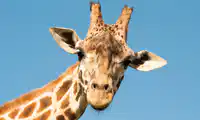
Physical Adaptations Lesson
Presentation
•
Science
•
5th Grade
•
Easy
+5
Standards-aligned
Carili Rubiera
Used 21+ times
FREE Resource
23 Slides • 21 Questions
1
2
3
Multiple Choice
What is a physical adaptation?
A physical adaptation is a temporary change in an organism's behavior.
A physical adaptation is a genetic mutation that occurs in an organism.
A physical adaptation is a mental strategy used by organisms.
A physical adaptation is a structural feature of an organism's body that helps it to survive and reproduce in its environment.
4
5
6
Multiple Choice
Several different types of beaks are shown in the image below. Which of the following is most likely true?
The birds need different types of beaks depending on the temperature where they live.
The birds need different types of beaks depending on what kind of food they eat.
The birds with bigger beaks are always more likely to survive.
The birds with smaller beaks are always more likely to survive.
7
Multiple Choice
Josie likes to visit the park in her neighborhood to watch hummingbirds. Based on the beak of the hummingbird, what does it most likely eat?
Fish
Nuts
Insects
Flower Nectar
8
Multiple Choice
A wren is a bird that eat nuts. What type of beak structure would be best?
A long skinny beak
A large scooping beak
A hard beak
A sharp pointed beak
9
10
11
Multiple Choice
What adaptation is useful for herbivores?
smooth fur
claws
flat teeth
12
13
14
Multiple Choice
Bullfrogs are Florida’s largest frog. Frogs spend part of their life cycles in water and part on land. Which physical characteristic is most useful for a water environment?
Thin skin
Large eyes
Webbed feet
Long, strong legs
15
16
17
Multiple Choice
18
19
20
Multiple Choice
The color of an arctic rabbit changes throughout the year. The fur is white in the winter and brown in the summer. What is the best explanation of this adaptation?
Brown fur only grows on males
The fur helps with the camouflaged during the winter months
The fur changes based on what the rabbit eats
White fur is keeps the animal cool during the winter months
21
Multiple Choice
Two rabbits are shown in the snow. In their environment, snow covers the ground throughout most of the year. Which of the following is most likely a true statement about how their variations help them survive?
Since the rabbits are the same size, they have the same likelihood of survival.
The rabbit with the white fur is more likely to be able to survive because it is camouflaged.
The rabbit with the dark fur is more likely to survive because it reflects more heat so it will stay cool.
The rabbit with the white fur is more likely to survive because it is better at finding food.
22
23
24
Multiple Choice
What is mimicry?
looking or sounding like another living organism, for protection or to hunt prey
blending in with your environment because it looks cool
Sleeping throughout the winter
storing food for the wither
25
26
27
28
29
30
31
32
33
34
Multiple Choice
Which of these describes the things that an organism DOES in order to survive?
Physical Adaptation
Behavioral Adaptation
35
Multiple Choice
An example of a behavioral adaptation is
the long neck of a giraffe.
a camel's hump used to store water.
a polar bear's white fur used for camouflage.
a squirrel storing nuts for the winter.
36
Multiple Choice
What is the word to describe an animal traveling to find food and water.
For example, birds flying south for the winter
Camouflage
Migration
Hibernation
Predator
37
Multiple Choice
Which is an example of a behavioral adaptation?
a black bear hibernating during the winter
a snail's shell protecting it from predators
38
Multiple Choice
Which is a behavioral adaptation of penguins?
Penguins have a layer of blubber to stay warm.
Penguins huddle together to stay warm.
39
Multiple Choice
How does hibernating help an animal survive?
They can skip the stressful winter months and only deal with the easier seasons.
It helps them move to a better area.
It helps them find a mate.
It helps them find a good habitat.
40
Multiple Choice
An artic fox is seen here with its summer and winter coats. How does changing its coat help the fox survive?
It keeps it warmer during the summer and cooler during the winter
it can hide from predators and prey easier with the summer and winter coats
it can stay above the snow in the winter and swim better during the summer
it can camouflage in the grass it eats during each season
41
Multiple Choice
A peacock is seen here displaying its feathers. Why does it do this behavior?
it is cooling itself down
it is finding food
it is flying south for the winter
it is finding a mate
42
Multiple Choice
Which is NOT a reason animals migrate?
to find better weather
the weather is too nice where they are
to mate and raise offspring
to find food
43
Multiple Choice
Why are these smaller fish gathering together this way?
They are hunting the larger fish
staying together keeps them warm
They can breathe better when they are close together
staying together makes them harder to catch
44
Multiple Choice
Which choice is behavior the alligator uses to survive?
a strong tail
powerful jaws
eyes and nose on top of its head
lunging at prey from beneath the water
Show answer
Auto Play
Slide 1 / 44
SLIDE

Similar Resources on Wayground
40 questions
Physical Properties of Matter
Presentation
•
5th Grade
38 questions
5.8 Energy and Earth Processes Review Lesson
Presentation
•
5th Grade
38 questions
VA Watersheds
Presentation
•
6th Grade
41 questions
Motion
Presentation
•
6th Grade
37 questions
Physical Properties of Matter
Presentation
•
6th Grade
39 questions
CIRCULATORY SYSTEM
Presentation
•
5th Grade
39 questions
Modes of Reproduction in Plants
Presentation
•
5th Grade
43 questions
FOSSIL FUELS AND SEDIMENTARY ROCKS
Presentation
•
5th Grade
Popular Resources on Wayground
15 questions
Grade 3 Simulation Assessment 1
Quiz
•
3rd Grade
22 questions
HCS Grade 4 Simulation Assessment_1 2526sy
Quiz
•
4th Grade
16 questions
Grade 3 Simulation Assessment 2
Quiz
•
3rd Grade
19 questions
HCS Grade 5 Simulation Assessment_1 2526sy
Quiz
•
5th Grade
17 questions
HCS Grade 4 Simulation Assessment_2 2526sy
Quiz
•
4th Grade
20 questions
Equivalent Fractions
Quiz
•
3rd Grade
24 questions
HCS Grade 5 Simulation Assessment_2 2526sy
Quiz
•
5th Grade
20 questions
Math Review
Quiz
•
3rd Grade
Discover more resources for Science
20 questions
Food Chains and Food Webs Review
Quiz
•
5th Grade
20 questions
Earth Day
Quiz
•
3rd - 12th Grade
50 questions
5th Grade Science TCAP Review
Quiz
•
5th Grade
15 questions
Human Body Systems
Quiz
•
5th Grade
21 questions
Solar System Review
Quiz
•
5th Grade
118 questions
5th Grade SSA Review_Mr. Hite
Quiz
•
3rd - 5th Grade
50 questions
5th Grade Science EOG Review
Quiz
•
5th Grade
25 questions
instinct vs learned behavior
Quiz
•
5th Grade