
Ch. 9 Section 3

Presentation
•
Religious Studies
•
9th Grade
•
Practice Problem
•
Easy

Madeleine Wertz
Used 2+ times
FREE Resource
15 Slides • 15 Questions
1

Ch. 9 Sections 3 & 4
2
The Book of Signs
Memorize the blanks.
Fill in the blanks: The main focus of the Book of Signs is Jesus’ miracles—called works or signs in John’s Gospel—and their implications. They reveal his identity, explain his reason for coming to earth, display his heavenly glory, and reveal his relation to his heavenly Father.
3
Dropdown
4

The miracle Jesus performed at the Wedding at Cana marked the first time Jesus revealed his glory. In her concern for others, Mary intercedes on behalf of the wedding hosts. This first sign helped the disciples to believe, revealed his power over nature, and foreshadowed his ministry by helping others by acting with authority.
Wedding at Cana
5
Dropdown
6
Memorize the Response
What did Jesus mean when he said, “My hour has not come?”
When he mentioned, “My hour has not come,” Jesus was referring to his Passion, Death, Resurrection, and Ascension, the full manifestation of his glory.
7
Drag and Drop
8
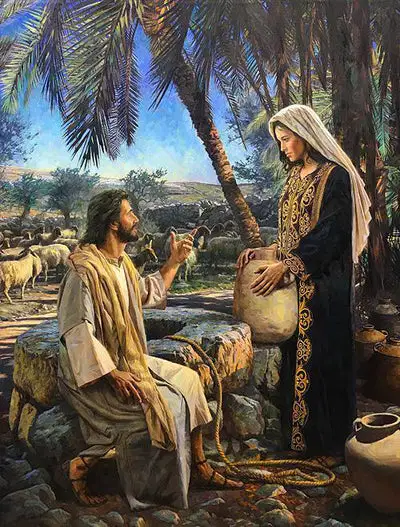
He spoke in public to a woman and, even more scandalously, to a hated Samaritan who was also a notorious sinner.
What did Jesus do in Samaria that would have offended his contemporaries?
9
Drag and Drop
He spoke in
10
What distinction, or “first,” does the Samaritan woman enjoy?
This Samaritan woman was really the first missionary to spread the word about Jesus.
11
Dropdown
12
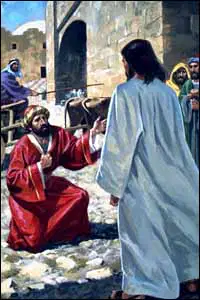
The father’s faith moved Jesus to act.
What moved Jesus to perform a second sign in Cana on behalf of the court official?
13
Multiple Choice
What moved Jesus to perform a second sign in Cana on behalf of the court official for his son?
The father's faith moved Jesus to act.
The court official's impressive fasting moved Jesus to act.
The father's love of the law moved Jesus to act.
The court official's ambition for the Kingdom of God moved him to act.
14
Who did the Jews that oppose Jesus tend to be?
Those who opposed him tended to be powerful men who carefully followed the Law and did not appreciate what Jesus said, those with whom he associated, and how he interpreted the Law
15
Drag and Drop
16

To the Pharisees who advocated perfect obedience to the Law, Jesus said that he did not come to abolish the law or the prophets, but to fulfill them. However, they advocated perfect obedience to the Law which led them to judge others. Jesus, however, interpreted the Law in a divine way, “upgrading” people’s understanding of the Law.
Remember the Underlined!
17
Dropdown
18
Memorize the Blanks!
Of all of the issues that disturbed Jewish religious leaders, Jesus’ professed role in the forgiveness of sins was the greatest stumbling block. Jesus’ merciful relationship with sinners and his forgiveness of sins led the leaders to see Jesus as a man who was trying to make himself equal with God or claim to be God, since only God could forgive sins.
19
Drag and Drop
20
Jesus Claimed to be God
First, Jesus indicated that the unique Son, like the Father, actively works on the Sabbath.
He said that like his Father, the Son also gives life to whomever he wants.
Finally, he asserted that the Father gave his Son the right to judge.
21
Multiple Choice
Which of these is not a way Jesus claimed to be God?
Jesus indicated that the unique Son, like the Father, actively works on the Sabbath.
He said that like his Father, the Son also gives life to whomever he wants.
He asserted that the Father gave his Son the right to judge.
He said that his father was Moses, implying he was the Chosen Messiah.
22
Multiple Choice
True or False? Jesus’ claim of divine authority enraged those who opposed him.
True
False
23
Multiple Choice
True or False? In John’s Gospel a mention of “the Jews” refers to all those who practiced Judaism as well as those people who continued to reject Jesus and persecuted the Jewish Christians.
True
False
24
False
In John’s Gospel a mention of “the Jews” does not refer to all those who practiced Judaism but to those people who continued to reject Jesus and persecuted the Jewish Christians.
25
Multiple Choice
True or False? The miracle story of the multiplication of the loaves appears in the synoptic Gospels, but the miracle of walking on the water does not.
True
False
26
False
False. The miracle story of the multiplication of the loaves appears in the synoptic Gospels, as well as the miracle of walking on the water.
27
Multiple Choice
True or False? The miracle stories of the multiplication of the loaves and walking on water appear together in John because they recall the six day of creation in the first chapter of Genesis.
True
False
28
False
False. The miracle stories of the multiplication of the loaves and walking on water appear together in John because they recall God’s miracles in the desert from the Book of Exodus: manna in the desert and the walk through the Red Sea.
29
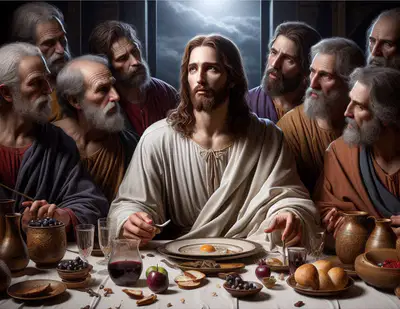
In the Bread of Life Discourse Jesus teaches about his identity, claiming that he replaces the manna in the Exodus. He explains this teaching in conjunction with the sign of the multiplication of loaves. Jesus is the new bread God has given to his disciples and their source of eternal life, a shocking teaching that caused many to abandon him.
Memorize the blanks!
30
Drag and Drop
Ch. 9 Sections 3 & 4
Show answer
Auto Play
Slide 1 / 30
SLIDE
Similar Resources on Wayground

24 questions
Imparfait
Presentation
•
9th Grade
24 questions
Biotechnology Test Review
Presentation
•
9th Grade
22 questions
Rock-paper-scissors (microbit)
Presentation
•
9th Grade
22 questions
Cell Cycle, DNA Replication, and Cancer
Presentation
•
9th Grade
22 questions
Intro to Mythology
Presentation
•
9th Grade
22 questions
Mendelian Genetics
Presentation
•
9th Grade
22 questions
Biogeochemical Cycles Lesson
Presentation
•
9th Grade
23 questions
procedure text
Presentation
•
9th Grade
Popular Resources on Wayground
6 questions
Secondary Safety Quiz
Presentation
•
9th - 12th Grade
10 questions
MyPath Diagnostic Overview
Presentation
•
6th - 8th Grade
20 questions
Lab Safety Quiz

Quiz
•
6th Grade
21 questions
Continents and Oceans
Quiz
•
6th Grade
20 questions
Adding and Subtracting Decimals
Quiz
•
5th Grade
20 questions
Parts of Speech
Quiz
•
5th Grade
16 questions
Subject & Predicate
Quiz
•
5th Grade
21 questions
Lab Safety
Quiz
•
10th Grade
Discover more resources for Religious Studies
6 questions
Secondary Safety Quiz
Presentation
•
9th - 12th Grade
10 questions
Fact Check Ice Breaker: Two truths and a lie
Quiz
•
5th - 12th Grade
12 questions
Lab Safety Quizizz
Quiz
•
9th Grade
20 questions
Characteristics of Life
Quiz
•
9th - 10th Grade
10 questions
Scientific Method (The scientific method)

Interactive video
•
9th Grade
20 questions
REGULAR Present tense verbs
Quiz
•
8th - 9th Grade
9 questions
Scientific method
Interactive video
•
9th - 12th Grade
10 questions
Lab Safety Essentials
Interactive video
•
6th - 10th Grade