Search Header Logo
  1. Resource Library
  2. Science
  3. Biology
  4. Energy Flow
  5. Energy Flow Exit Ticket
Energy flow exit ticket

Energy flow exit ticket

Assessment

Presentation

•

Science

•

6th - 8th Grade

•

Easy

•
NGSS
MS-LS2-4, MS-LS2-3, MS-LS1-6

+2

Standards-aligned

Created by

Benevolence Yangsi

Used 1+ times

FREE Resource

1 Slide • 12 Questions

1

Ecosystems & Energy Flow Practice

​

media

2

Multiple Choice

Question image

What is the definition of "Ecology"?

1

the study of protecting the Earth

2

the study of animals and their eating habits

3

the study of organisms and how they interact with other organisms and their environment

3

Multiple Select

Question image

Check the objects below that would be considered part of this ECOSYSTEM. (check all that apply)

1

animals

2

plants

3

water

4

soil

5

air

4

Multiple Choice

Question image

The Indian River Lagoon

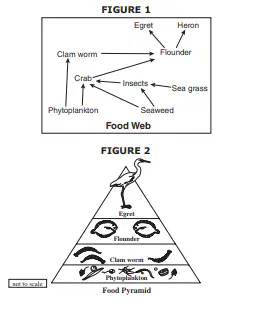
An estuary is a body of water in which fresh water draining from the land mixes with salt water from the ocean. The result of this mixture is an environment with abundant plant and animal life. The Indian River Lagoon is a 156-mile-long estuary on Florida’s east coast. It is a diverse estuary, supporting thousands of species of plants and animals. The food web in Figure 1 and food pyramid in Figure 2 are examples of the relationships that exist in the Indian River Lagoon ecosystem.

Which of the following has the largest population in the Indian River Lagoon ecosystem?

1

crab

2

egret

3

flounder

4

sea grass

5

Multiple Choice

Question image

What is the PRODUCER?

1

sun

2

rain

3

snake

4

grass

6

Multiple Choice

Question image

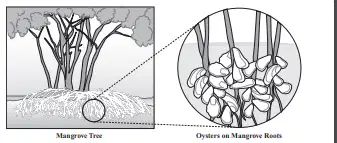
In the Florida Everglades oysters can be found growing on the roots of mangrove trees, as shown in the illustrations. The oysters are protected from predators as they grow on the underwater roots.

The oysters do not harm the trees nor do they provide any benefit to the trees. Which of the following relationships is most similar to the relationship between the mangrove trees and the oysters?

1

African ants living in acacia trees feed on leaf-eating insects found on the tree.

2

Spider crabs are camouflaged by the green-brown algae living on their shells.

3

A whale is unaffected by the attached remora fish feeding on the whale’s leftover food.

4

Bees fly from one flowering plant to another gathering nectar and pollinating the flowers.

7

Multiple Choice

Question image

The diagram below shows some of the organisms within a marine food web. How does the diagram provide evidence that living systems follow the Law of Conservation of Energy?


1

Energy is destroyed after the organism uses it for growth.

2

The amount of energy decreases as it is used by each organism.

3

Energy from one organism moves to another organism but is not destroyed.

4

The amount of energy produced by each organism increases through the food web.

8

Multiple Choice

Question image

Which of these is NOT a producer in the food chains?

1

corn

2

lion

3

carrot

4

grass

9

Multiple Choice

Which of the following statements most accurately describes the energy transfer between the levels of the food pyramid in the Indian River Lagoon?

1

Energy stays in the phytoplankton at the lowest level

2

Energy is released into the environment only from the egret.

3

Energy travels up from the phytoplankton to the clam worm.

4

Energy moves from the flounder to both the clam worm and egret.

10

Multiple Choice

In 1906, there were an estimated 4,000 deer on the Kaibab Plateau. The government decided to create a preserve for them. Livestock had overgrazed the food on the plateau. The Forest Service chose to move the horses, sheep, and cows off of the preserve. They also decided to remove the deers' natural predators. In 1920, the Forest Service discovered that the number of deer in the preserve was very large. By 1923, most of the deer were starving from a lack of food. Which statement best describes what happened on the Kaibab Preserve?

1

Overgrazing by livestock caused the deer on the Kaibab Plateau to starve.

2

Because there were no natural predators, the deer population grew too large.

3

The natural predators could not keep up with the growth of the deer population.

4

The large growth and starvation of the deer population was simply a natural event.

11

Multiple Choice


In the early 1900's, government officials wanted to convert parts of the Everglades into farmland. They wanted to drain parts of the Everglades to make the land suitable for agriculture and development. The loss of water changed features of the marsh, making it impossible for alligators to dig their burrows on the water's edge. How would these changes to the Everglades affect biodiversity?

1

The available ecosystem will become larger for the animals in the Everglades.

2

Animals will improve their migratory patterns.

3

migratory patterns.

Animals will be exposed to less pollution than before.

4

Animals will be cut off from the resources important to their survival.

12

Multiple Choice

Some organisms live in areas where many individuals share the same space. Certain species of fish travel in schools in this way. They live and move very closely together. Which of these statements describes a negative impact of living so closely together?

1

Searching for food is more difficult.

2

Keeping young safe takes more effort.

3

Avoiding predators is more challenging.

4

Spreading diseases between individuals is more likely.

13

Multiple Choice

Manatees are an endangered mammal species that lives in bodies of water in Florida. Manatees eat plants that grow in the water. They know where to find fresh drinking water in their environment. Manatees migrate from summer habitats to winter habitats and look for safe areas to feed and raise their young.  People in boats need to give space to manatees to protect them from harm. 

What might conservationists do to reduce the limiting factors and increase manatee populations?  


1

Increase the number of boats.

2

Increase the local fish population.

3

Increase the dissolved oxygen available.

4

Increase the amount of habitat available.

pattern-tertiary
Ecosystems & Energy Flow Practice

​

media

Show answer

Auto Play

Slide 1 / 13

SLIDE