Search Header Logo
Rock Layers and Continental Drift 26

Rock Layers and Continental Drift 26

Assessment

Presentation

Science

8th Grade

Medium

NGSS
MS-ESS1-4, MS-ESS1-1, MS-LS4-1

+9

Standards-aligned

Created by

Marc Frank

Used 17+ times

FREE Resource

22 Slides • 14 Questions

1

Reviewing: Continental drift and relative dating.

Warm Up: Create what if, why, or how questions about the following diagram.

media
media

​Laptops

2

Review: Relative Dating and Continental Drift.

By Teacher at IS 93

media
media

3

media

4

media

5

media

6

media

7

The earth moves!

Our earth moves! We have many pieces of evidence for this some we can even feel; like earthquakes. So what is causes the movement? Magma! Deep in the Earth, molten rock churns as it heats and cools in convection currents. This moves the crustlike plates on top, and even creates and new and destroys old plates. *VIDEO TIME*

media

8

media

9

media
media

​If an intrusion or a fault cuts through existing rocks, the intrusion/fault must be YOUNGER than the rock it cuts through.

Think About it: Can you cut a cake or put icing on before the cake is made?

10

Layers of the Earth show us:

  • its history

  • fossils of animals and plants from long ago

media

11

media

Rock layers in different places can be correlated, or matched up, by matching the rocks and fossils in the layers.

Correlation

12

Multiple Choice

Question image
Which rock layer most likely contains fossils of the most recently evolved organisms?
1
1
2
2
3
3
4
4

13

Multiple Choice

Question image
Which of the following organisms formed last on Earth?
1
Jellyfish
2
Shark
3
Lizards
4
Horses

14

Multiple Choice

Question image
Which layer formed first?
1
Rock Layer W
2
Rock Layer X
3
Rock Layer Y
4
Rock Layer Z

15

Multiple Choice

Question image
The diagram shows the fossils in two different sections of rock found in opposite sides of a canyon. Which layer in rock section one is approximately the same age as layer X in rock section two?
1
layer 1
2
layer 2
3
layer 3
4
layer 4

16

Multiple Choice

Question image

The picture shows four different rock layers in a hillside. What is the best evidence that one of these layers of rock was formed under an OCEAN?

1

The thickness of the sedimentary rock layers.

2

The type of fossils found in the sedimentary rock layers.

3

The texture of the sedimentary rock layers.

4

The height of the sedimentary rock layers.

17

Multiple Choice

Question image

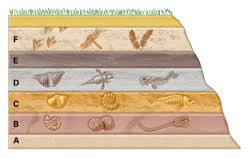
Which rock layer is probably the youngest?

1

A

2

B

3

C

18

Multiple Choice

Question image

A fish fossil was found in layer A. What does this tell us about the possible history of this area?

1

Fish used to live on land there

2

This area has always been land

3

That area used to be underwater

4

Layer A is currently covered in water

19

Multiple Choice

Question image

Which rock layer contains the newest fossils?

1
F
2
E
3
B
4
C

20

media

21

Continental Drift

media

22

Alfred Wegener

German meteorologist who first proposed the theory of continental drift.

media

23

media

Pangea

The large
landmass

that

included

all of

Earth’s
present-

day

continents

24

media

Evidence for

Continental Drift

25

media

1. Shape of the Continents

The continents fit together like puzzle pieces.
1858: Antonio Pelligrini depicted Africa & South

America connected.

26

media

2. Fossils

Fossils of the same organisms were found on

different continents.

Mesosaurus found in Africa & South America,

but couldn’t swim across the ocean.

27

media

3. Rock Evidence

Existing mountain

ranges separated by
oceans had identical
mineral content.

Example: Appalachian

mountains in US &
Caledonian mountains in
British Isles

28

media

5. Coal Deposits

Coal deposits found in temperate & polar regions

even though coal is formed in tropical regions.

29

Evidence #6 - Glacial Scars in Africa!

media
media
media

30

Theory:

The reason for Continental Drift: Convection Currents in the Mantle

media

31

Multiple Choice

The movement of the plates is caused by ___.

1

Magnets

2

Asteroids

3

Changes in the mantle

32

Multiple Choice

Question image

Name the type of heat transfer shown in the picture.

1

convection

2

conduction

3

radiation

33

Multiple Choice

What does the theory of continental drift state?
1
The continents were once joined in a super-continent and have moved over time
2
Continents are stationary and do not move
3
The Earth is broken into lithospheric plates that move due to convection currents
4
none of the above

34

Multiple Choice

Question image
What is represented by the picture? 
1
Sea-floor spreading
2
Pangea
3
How the continents are arranged today
4
Volcanoes

35

Multiple Choice

Alfred Wegener thought which 2 continents looked like puzzle pieces that could fit together?

1

Antarctica and Asia

2

South America and Africa

3

South America and Australia

4

Africa and Pangaea

36

Multiple Choice

What does the presence of coal beds in Antarctica indicate?

1

A warmer and wetter past climate in Antarctica

2

A colder and drier past climate in Antarctica

3

The presence of ancient forests in Antarctica

4

The absence of any past climate change in Antarctica

Reviewing: Continental drift and relative dating.

Warm Up: Create what if, why, or how questions about the following diagram.

media
media

​Laptops

Show answer

Auto Play

Slide 1 / 36

SLIDE