

Force and Velocity

Presentation
•
Science
•
8th Grade
•
Practice Problem
•
Medium
Standards-aligned

Barbara White
Used 145+ times
FREE Resource
12 Slides • 19 Questions
1

Middle School

2
Define the essential concepts of force, velocity, and acceleration.
Explain Newton's Three Laws of Motion with real-world examples.
Differentiate between balanced and unbalanced forces and their effects on motion.
Analyze the effects of friction on an object's motion.


3
Key Vocabulary

Force
A push or a pull on an object, which can change its motion, direction, or shape.

Velocity
The rate an object changes position in a specific direction, combining both speed and direction.

Speed
The measure of how fast an object is moving, calculated as distance traveled over a time period.

Mass
The amount of matter in an object, determining its inertia and the force needed to accelerate it.

Friction
A force that opposes the motion of two objects that are in direct contact with each other.

Collision
An event where two or more objects exert powerful forces on each other in a short time.
4
Key Vocabulary

Net Force
The overall force on an object, which is the sum of all individual forces acting on it.

Acceleration
The rate of change of velocity of an object, which can be a change in speed or direction.
5
Speed

Velocity

Velocity is a vector quantity, meaning it includes both an object's speed and its direction.
Velocity changes if the object's speed, direction, or both change.
A car driving 50 mph east has a velocity, not just a speed.
6
Multiple Choice
What is the primary difference between speed and velocity?
Velocity includes direction, while speed does not.
Speed is a vector quantity, while velocity is a scalar quantity.
Speed is calculated by multiplying distance and time.
Velocity and speed are the same thing.
7
Multiple Choice
Under which of the following conditions would an object's velocity change, even if its speed remains constant?
When the object moves in a straight line.
When the object stops moving completely.
When the object changes its direction of travel.
When the object's mass increases.
8
Multiple Choice
A race car is driving around a circular track at a constant 100 mph. Which statement best describes the car's motion?
The car's speed remained constant, but its velocity changed.
The car's velocity remained constant, but its speed changed.
Both the car's speed and velocity remained constant.
Both the car's speed and velocity changed.
9
What is a Force?
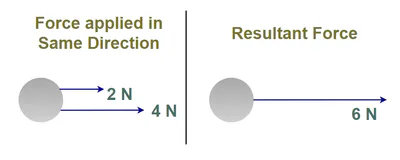
A force is a push or a pull that can change an object's motion.
Every force has a specific strength, also known as magnitude, and a direction.
The net force is the total of all forces acting on an object.
Add forces in the same direction and subtract forces in opposite directions.

10
Multiple Choice
What is a force?
A push or a pull that can change an object's motion.
The speed at which an object is moving.
The amount of matter that makes up an object.
The energy an object has when it is at rest.
11
Multiple Choice
What is the relationship between two forces that are applied to an object in the same direction and the resulting net force?
The net force is the sum of the two individual forces.
The net force is the difference between the two individual forces.
The net force on the object becomes zero.
The net force is equal to the larger of the two forces.
12
Multiple Choice
If a toy car is being pushed to the right with a force of 15 Newtons and also being pushed to the left with a force of 5 Newtons, what is the net force on the car?
25 Newtons to the right
10 Newtons to the left
10 Newtons to the right
15 Newtons to the left
13
Balanced vs. Unbalanced Forces
Balanced forces have a net force of zero, causing no change in motion.
Unbalanced forces have a non-zero net force, causing the object to accelerate.
The object can speed up, slow down, or change its direction of motion.
14
Multiple Choice
What is the direct result of balanced forces acting on an object?
The object begins to accelerate.
There is no change in the object's motion.
The object's mass decreases.
The object changes its direction.
15
Multiple Choice
What is the relationship between an unbalanced force and an object's motion?
It causes the object to accelerate.
It makes the object's net force equal to zero.
It stops the object's motion instantly.
It maintains the object's current speed and direction.
16
Multiple Choice
An object is moving at a constant speed in a straight line. What must happen for the object to change its direction?
The forces acting on it must become balanced.
It must continue moving without any new forces.
An unbalanced force must be applied to it.
Its speed must be increased, but not its direction.
17
Newton's Second Law: Force, Mass, and Acceleration
Acceleration results from a net force acting on an object.
The more force you apply, the greater the object's acceleration.
The more mass an object has, the less it accelerates.
18
Multiple Choice
What causes an object to accelerate?
Its mass being reduced
A net force acting on it
Its speed remaining constant
The friction acting against it
19
Multiple Choice
What happens to an object's acceleration if the net force applied to it is increased?
The acceleration will decrease
The acceleration will increase
The acceleration will stay the same
The object's mass will increase
20
Multiple Choice
If the same amount of force is used to push two carts, one with a large mass and one with a small mass, what is the most likely outcome?
The cart with more mass will accelerate more.
The cart with less mass will accelerate more.
Both carts will have the same acceleration.
Neither cart will accelerate at all.
21
Newton's Third Law: Action and Reaction
Every action has an equal and opposite reaction.
A car hits a wall, and the wall pushes back equally.
A rocket pushes gas down, and the gas pushes the rocket up.
22
Multiple Choice
Which statement correctly describes Newton's Third Law?
For every action, there is an equal and opposite reaction.
An object in motion will stay in motion.
The force of an object is equal to its mass times its acceleration.
An object at rest will stay at rest.
23
Multiple Choice
According to Newton's Third Law, when a rocket pushes gas downward, what is the "opposite reaction"?
The gas pushes the rocket upward.
The rocket's engine heats up.
The Earth's gravity pulls the gas down.
The rocket becomes lighter.
24
Multiple Choice
If a car hits a wall, which statement provides the best conclusion about the forces involved?
The force exerted by the wall on the car is equal to the force exerted by the car on the wall.
The wall exerts a greater force on the car because the car sustains more damage.
The car exerts a greater force on the wall because the car is in motion.
There is no force exerted by the wall, only by the car.
25
What Is the Force of Friction?
Friction is a contact force that opposes motion between two touching surfaces.
It always acts in the direction opposite to the object's movement.
This force causes moving objects to slow down and eventually stop.
Rougher surfaces, like carpet, create more friction than smoother surfaces like ice.


26
Multiple Choice
What is the primary role of the force of friction?
To oppose motion between two touching surfaces.
To cause objects to move faster.
To hold two surfaces together permanently.
To generate heat without any movement.
27
Multiple Choice
What is the relationship between friction and a moving object?
It acts in the same direction as movement, causing the object to speed up.
It acts in the opposite direction of movement, causing the object to slow down.
It only acts when an object is completely still.
It changes the mass of the moving object.
28
Multiple Choice
If you push a box with the same amount of force across a carpet and then across a patch of ice, which situation involves more friction?
The box pushed across the carpet.
The box pushed across the ice.
The box pushed across a smooth tile floor.
The box pushed across a polished wood floor.
29
Misconception | Correction |
|---|---|
Motion requires a constant force. | An object in motion stays in motion unless a net force acts on it. |
An object at rest has no forces acting on it. | An object at rest has balanced forces, resulting in a net force of zero. |
Heavier objects fall faster than lighter objects. | Without air resistance, all objects accelerate at the same rate, regardless of mass. |
In a collision, the bigger object exerts a bigger force. | Both objects in a collision exert equal and opposite forces on each other. |
30
An object's motion is described by its velocity, which includes speed and direction.
A change in motion, or acceleration, is caused by unbalanced forces.
Newton's First Law: An object's motion does not change unless a net force acts on it.
Newton's Second Law: A larger force causes a larger acceleration.
Newton's Third Law: For every action, there is an equal and opposite reaction force.
Friction is a force that opposes motion and causes objects to slow down.
31
Poll
On a scale of 1-4, how confident are you about applying Newton's Laws to explain the motion of objects?
1 - Not confident at all
2 - A little confident
3 - Mostly confident
4 - Very confident
Middle School
Show answer
Auto Play
Slide 1 / 31
SLIDE
Similar Resources on Wayground

25 questions
Atomic Structure Lesson
Presentation
•
8th Grade
26 questions
Rotation and Revolution
Presentation
•
8th Grade
24 questions
Notes: Eclipses and Seasons
Presentation
•
8th Grade
27 questions
Introduction to Waves
Presentation
•
8th Grade
27 questions
Balanced and Unbalanced Forces
Presentation
•
8th Grade
24 questions
7.8C Watershed
Presentation
•
7th - 8th Grade
24 questions
Chemical Formulas, Equations, & Reactions Post Review
Presentation
•
8th Grade
24 questions
Classification of matter
Presentation
•
8th Grade
Popular Resources on Wayground
21 questions
Continents and Oceans

Quiz
•
6th Grade
20 questions
Parts of Speech
Quiz
•
5th Grade
16 questions
Subject & Predicate
Quiz
•
5th Grade
25 questions
Multiplication Facts
Quiz
•
5th Grade
12 questions
Map Skills
Quiz
•
3rd Grade
22 questions
Continents and Oceans
Quiz
•
5th Grade
15 questions
Rounding Decimals
Quiz
•
5th Grade
20 questions
Brand Labels
Quiz
•
5th - 12th Grade
Discover more resources for Science
20 questions
Newton's Laws of Motion
Quiz
•
8th Grade
20 questions
Scientific Method and Variables
Quiz
•
8th Grade
20 questions
Scientific method and variables
Quiz
•
8th Grade
20 questions
Claim, Evidence and Reasoning (CER)
Quiz
•
6th - 8th Grade
21 questions
Newton's Laws of Motion
Quiz
•
8th Grade
20 questions
Elements, Compounds and Mixtures
Quiz
•
8th Grade
10 questions
Exploring Chemical and Physical Changes

Interactive video
•
6th - 10th Grade
26 questions
Force - Net Force, Balanced and Unbalanced Forces
Quiz
•
8th Grade