Search Header Logo
  1. Resource Library
  2. Science
  3. Earth & Space Science
  4. Geological Time
  5. Geological Time Scale And Mass Extinctions

Geological Time Scale and Mass Extinctions

Geological Time Scale and Mass Extinctions

Assessment

Presentation

Science

8th - 11th Grade

Hard

Created by

Joseph Anderson

FREE Resource

19 Slides • 19 Questions

1

Geologic Time Scale

2

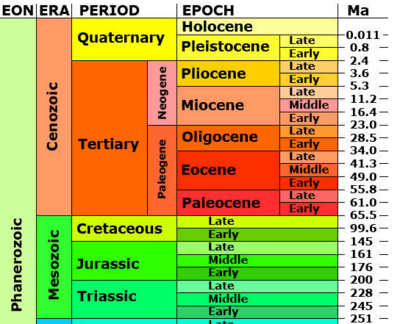
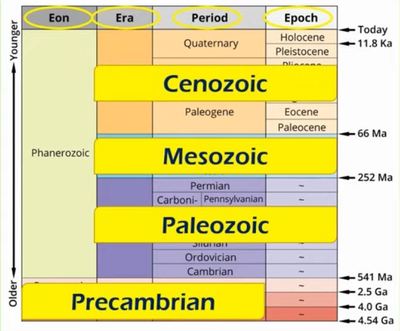
Eon, Era, Period, Epoch

  • ​The Geographic time scale HAS to be organized, therefore we organize it by dividing them into fractions of time (Some are larger then others).

media

3

Multiple Choice

What is the largest unit of time on the geologic time scale

1

Era

2

Eon

3

Epoch

4

Period

4

Multiple Choice

What Eon, Era, Period and Epoch are you living in today?

1

Phanerozoic, Cenozoic, Quaternary, Holocene

2

Triassic, Jurassic, and Cretaceous

3

The Cambrian period

5

Multiple Choice

What are the fractions of time in order from LEAST to GREATEST?

1

Epoch, Eon, Era, Period

2

Eon, Era, Period, Epoch

3

Period, Epoch, Eon, Era

4

Epoch, Period, Era, Eon

6

Uniformitarianism

  • Earth is about 4.6 Billion years old

  • ​The principle of uniformitarianism states that geologic events (Like mountain building or erosion) that happened in the past can be explained by current geologic events.

  • Summarized: Its the idea that Earth's features are always changing and the present is an indication to what happened in the past.

7

media

8

Gradualism

  • ​Gradualism shows that fossils change very slowly over time.

  • Many fossils show that many present day organisms possess similar features to their past ancestors.

  • Brontosaurus

​Giraffe

9

media

10

Catastrophism

  • ​the theory that changes in the earth's crust during geological history have resulted chiefly from sudden violent and unusual events.

Examples:

  • ​Meteor Impacts (Dinosaur Extinction)

  • Ice Age​

  • Hurricanes, Tornados, ​Blizzards, Droughts

  • MASS EXTINCTION​

11

media
media
media
media

12

Multiple Choice

The geologic time scale is a record of....

1

the history of fossils only

2

the history of rocks

3

the history of rock layers and fossils

4

geologist notes

13

Multiple Choice

Paleontologists infer that the earth is approximately how many years old?

1

4.5 million years

2

450 billion years

3

4.5 billion years

4

450 million years

14

Multiple Choice

Question image

Which Rock Layer is the oldest?

1

A

2

B

3

C

4

D

15

Multiple Choice

Question image

Which Rock layer is the youngest?

1

A

2

B

3

C

4

D

16

Multiple Choice

Question image

What Period are we currently in?

1

Triassic

2

Cenozoic

3

Quaternary

4

Jurassic

17

Multiple Choice

Question image

What does this picture represent

1

Uniformitarianism

2

Gradualism

3

Catastrophism

18

Multiple Choice

Question image

What does this picture represent?

1

Gradualism

2

Catastrophism

3

Uniformitarianism

19

Multiple Choice

Question image

What does this represent

1

Catastrophism

2

Gradualism

3

Uniformitarianism

20

Multiple Choice

Paleozoic, Mesozoic & Cenozoic are all ________.

1

Epochs

2

Eras

3

Periods

4

Eons

21

Multiple Choice

Describe how geologists separate time periods.

1

By special events that have happened in that period.

2

By looking at the Relative Time of a Fossil

3

By counting the years a fossil has been preserved

4

By the animals in the time period.

22

Precambrian Era

  • Earth's first era of time

  • Began 4.6 mya: Creation of Earth

  • Began with simple life forms such as bacteria and simple algae

  • A rise of simple organisms such as jellyfish and sea worms by the end of the era

  • Few fossils from era

media

23

Precambrian Era

  • Earth's first era of time

  • Began 4.6 mya: Creation of Earth

  • Began with simple life forms such as bacteria and simple algae

  • A rise of simple organisms such as jellyfish and sea worms by the end of the era

  • Few fossils from era

media

24

Multiple Choice

How old do Paleontologists believe the Earth is?

1

2021 years old

2

4.6 million years old

3

4.6 billion years old

4

3.6 billion years old

25

Paleozoic Era

  • Began with the early invertebrates (trilobites and brachiopods) --> early vertebrate fish --> arachnids and insects ---> first amphibians --> reptiles became dominant near end

  • Early land plants included simple mosses, ferns, and then cone-bearing plants

  • By the end of the era, seed plants were common

media

26

Era Mass Extinction

  • The mass extinction that ended the era caused most marine invertebrates as well as amphibians to disappear

media

27

Mesozoic Era

  • Reptiles were the dominant animals of this era, including dinosaurs

  • Small mammals and birds appeared

  • Toward the end of the era, flowering plants appeared and the kinds of mammals increased

media

28

Era Mass Extinction

  • The mass extinction that ended the era caused the dinosaurs to become extinct

media

29

media

30

Cenozoic Era

  • New mammals appeared while others became extinct

  • The diversity of life forms increased

  • Flowering plants became most common

  • Humans are also part of the most recent period of this era

media

31

Multiple Choice

Name the 4 time frames in order from oldest to youngest.

1

Precambrian Time, Paleozoic Era, Mesozoic Era, Cenozoic Era

2

Mesozoic Era, Precambrian time, Cenozoic Era, Paleozoic Era

3

Paleozoic Era, Mesozoic Era, Precambrian Time, Cenozoic

32

Open Ended

What era are we living in now?

33

Multiple Choice

The time span that lasted the longest was the...

1

Precambrian

2

Mesozoic

3

Paleozoic

4

Cenozoic

34

media

35

​GEOLOGIC TIME SCALE

media
media

36

Multiple Choice

Question image

Which is the longest unit in the Gelogic time scale?

1

Eon

2

Era

3

Period

4

Epoch

37

Multiple Choice

Question image

Which is the shortest unit in the Gelogic time scale?

1

Eon

2

Era

3

Period

4

Epoch

38

media

Geologic Time Scale

Show answer

Auto Play

Slide 1 / 38

SLIDE