Search Header Logo
Electromagnetic

Electromagnetic

Assessment

Presentation

Physics

10th - 12th Grade

Easy

Created by

Joseph Anderson

Used 1+ times

FREE Resource

13 Slides • 28 Questions

1

ELECTROMAGNETIC WAVES CXC

Electromagnetic waves are waves that contain an electric field and a magnetic field and carry energy. They travel at the speed of 3.0 x 10 8 m/s in a vacuum. There are seven types of electromagnetic wave which form the electromagnetic spectrum (EMS)

Slide image

2

Common properties of all electromagnetic waves

  •  Transfer energy from one place to another.

  •  Can be emitted and absorbed by matter.

  •  Do not need a medium to travel through.

  •  Travels at 3.0 x 10⁸ m/s in a vacuum.

  • Are transverse waves and can be polarized.

3

Common properties of all electromagnetic waves

  • They interfere with each other.

  • They obey the laws of reflection and refraction.    

  •  They can be diffracted.

  •  They carry no charge.

  •  They are unaffected by electric or magnetic field

4

Range of Electromagnetic Waves

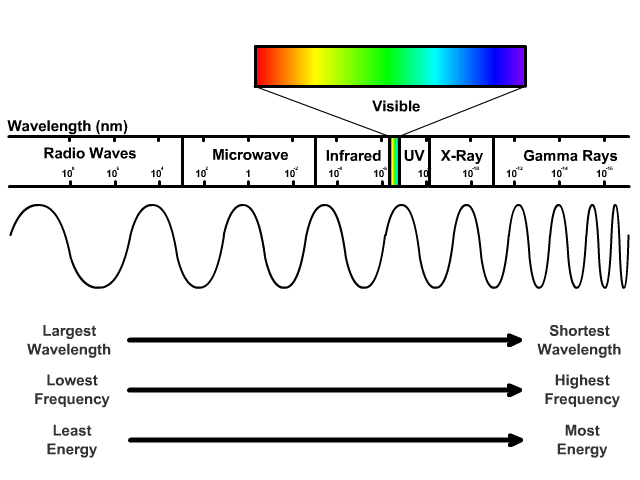
The types of electromagnetic waves from longest wavelength to shortest are RadioInfrared (IR), Visible LightUltraviolet (UV), X-Ray, and Gamma Ray waves. Frequency of a wave is inversely proportional. So from highest frequency to lowest frequency would be reverse of the order above.  Higher frequency contain more energy so gamma rays have the most energy and radio waves have the least. The more energy contained in the wave the more penetrating power. Ultraviolet through gamma rays these EM waves become increasingly penetrating and dangerous.
Slide image

5

Radio Waves

  • How produced

  • How detected

  • Major uses

Slide image

6

Microwaves

  • How produced

  • How detected

  • Major uses

Slide image

7

Infrared Waves

  • How produced

  • How detected

  • Major uses

Slide image

8

Visible Light Waves

  • How produced

  • How detected

  • Major uses

Slide image

9

Ultra Violet Waves

  • How produced

  • How detected

  • Major uses

Slide image

10

X-Ray Waves

  • How produced

  • How detected

  • Major uses

Slide image

11

Gamma Ray Waves

  • How produced

  • How detected

  • Major uses

Slide image

12

13

HOMEWORK

Complete the table.

Slide image

14

Multiple Choice

Which of the following lists the electromagnetic waves in order of increasing wavelength?
1
X-rays, visible light, radio waves
2
gamma rays, microwaves, UV rays
3
infrared rays, radio waves, x-rays

15

Multiple Choice

Which electromagnetic waves help doctors detect broken bones inside your body?
1
gamma rays
2
x-rays
3
ultraviolet rays

16

Multiple Choice

Which electromagnetic waves allow us to diagnose & treat cancer?
1
Gamma rays
2
X-rays
3
Ultraviolet rays

17

Multiple Choice

Which of the following has wavelengths longer than microwaves?
1
Infrared waves
2
Radio waves
3
Visible light

18

Multiple Choice

How much of the electromagnetic spectrum is made up of visible light?
1
only a small portion
2
a very l;arge portion
3
about half

19

Multiple Choice

Which electromagnetic waves are used in ovens and cell phone communications?
1
Infrared rays
2
ultraviolet rays
3
microwaves

20

Multiple Choice

Which type of waves are used in broadcasting?
1
radio waves
2
infrared rays
3
x-rays

21

Multiple Choice

Electromagnetic waves that help your body produce vitamin D are called?
1
ultraviolet rays
2
x-rays
3
gamma rays

22

Multiple Choice

High frequency in EM waves equals

1

high energy and short wavelength

2

high energy and long wavelength

3

low energy and short wavelength

4

low energy and long wavelength

23

Multiple Choice

Question image

Wavelength and Frequency are related in that...

1

they are always the same

2

when one increases, the other decreases (inversely proportional)

3

there is no correlation

4

they both vary in an irregular pattern

24

Multiple Choice

Question image

Which is true about the speed of radio waves compared to light waves? They are...

1

less energy & frequency, but still the SAME speed as the speed of light (300,000,000 m/s)

2

less energy & frequency, so LESS than the speed of light (300,000,000 m/s)

3

smaller wavelength, so LESS than the speed of light (300,000,000 m/s)

4

more energy & frequency, so MORE than the speed of light (300,000,000 m/s)

25

Multiple Choice

Which of the following electromagnetic waves has the lowest frequency?

1

gamma ray

2

infrared wave

3

visible light wave

4

microwave

26

Multiple Choice

Question image

How are Electromagnetic waves different from Mechanical waves?

1

EM waves have very short wavelengths

2

EM waves transmit energy instead of matter

3

EM waves can travel through the vacuum of space (without particles)

4

EM waves can change direction by reflection

27

Multiple Choice

Select the correct order of waves on the EMS from low to high energy

1

Radio, Micro, Infra, Visible, Ultra, X-ray, Gamma

2

Gamma, X-ray, Ultra, Vis, Infra, Micro, Radio

3

Vis, Micro, Infra, Ultra, X-ray, Gamma, Radio

4

Micro, Radio, Vis, Infra, Ultra, X-ray, Gamma

28

Multiple Choice

Which has the LONGEST wavelength and, therefore, the LOWEST frequency/energy

1

Gamma Rays

2

Ultraviolet

3

Visible Light

4

Infrared rays

29

Multiple Choice

Which is an example of a radio wave

1

television

2

heat lamp

3

vision

4

sun light

30

Multiple Choice

A communications satellite transmits a radio wave at a frequency of 5.0 x 10⁹ Hz. What is the signal’s wavelength? Assume the wave travels in a vacuum.

1

(5.0 x 10^9 Hz) x (3.0 x 10^8 m/s)

2

(5.0 x 10^9 Hz) / (3.0 x 10^8 m/s)

3

(3.0 x 10^8 m/s) / (5.0 x 10^9 Hz)

4

(5.0 x 10^9 Hz) + (3.0 x 10^8 m/s)

31

Multiple Choice

Cellular telephones utilize

1

radar waves.

2

very high frequency waves.

3

very low frequency waves.

4

microwaves.

32

Multiple Choice

The visible light spectrum ranges between

1

radar waves and X-rays.

2

television waves and infrared rays.

3

infrared rays and ultraviolet rays.

4

ultraviolet rays and gamma rays.

33

Multiple Choice

The waves with the longest wavelengths in the electromagnetic spectrum are

1

Infrared rays.

2

radio waves

3

gamma rays

4

X-rays

34

Multiple Choice

The full range of frequencies of electromagnetic radiation is called

1

visible light.

2

radio waves.

3

the electromagnetic spectrum.

4

invisible radiation.

35

Multiple Choice

Infrared rays have a shorter wavelength than

1

Ultraviolet ray.

2

X-rays.

3

radar waves.

4

gamma rays

36

Multiple Choice

Light acts like

1

a wave.

2

a particle.

3

Both a wave and a particle

4

neither a wave nor a particle.

37

Multiple Choice

An electromagnetic wave in a vacuum has a wavelength of 0.07m. What is its frequency?

1

f= 3.0x 10^8 m/s

2

f= 3.0x 10^9Hz

3

f=4.3x 10^9Hz

4

f=4.3x 10^8m/s

38

Multiple Choice

To calculate the frequency of an electromagnetic wave, you need to know the speed of the wave and its

1

wavelength.

2

intensity.

3

refraction.

4

amplitude.

39

Multiple Choice

Electromagnetic waves vary in

1

the speed they travel in a vacuum.

2

wavelength and frequency.

3

the way they reflect.

4

the orientation of their electric and magnetic fields.

40

Multiple Choice

What is the frequency of an AM radio station who produces radio waves that 499.5 meters long?

1

500,000 Hz

2

600,000 Hz

3

700,000 Hz

4

800,000 Hz

41

Multiple Choice

All of the following waves are longer than visible light waves, EXCEPT:

1

infrared waves

2

microwaves

3

TV waves

4

ultraviolet waves

ELECTROMAGNETIC WAVES CXC

Electromagnetic waves are waves that contain an electric field and a magnetic field and carry energy. They travel at the speed of 3.0 x 10 8 m/s in a vacuum. There are seven types of electromagnetic wave which form the electromagnetic spectrum (EMS)

Slide image

Show answer

Auto Play

Slide 1 / 41

SLIDE