Search Header Logo
Weathering by Water

Weathering by Water

Assessment

Presentation

Science

11th Grade

Hard

Created by

Joseph Anderson

FREE Resource

11 Slides • 37 Questions

1

Weathering, Erosion, Deposition

and Mass Movements

2

Multiple Choice

Question image

The chemical or mechanical process of breaking down rock is called _____.

1
Weathering
2
Exfoliation
3
Frost wedging
4
Soil

3

Multiple Choice

Process that breaks down rocks and minerals into smaller pieces but doesn't change composition.
1
Gully erosion
2
Deposition
3

Chemical Erosi

4
Mechanical weathering

4

Multiple Choice

Question image
Process that occurs when water repeatedly freezes and thaws. 
1
Residual soil
2
Frost wedging
3
Erosion
4
Oxidation

5

Multiple Choice

Question image

Process where outer rock layers

are stripped away. 

1
Soil horizon
2
Deposition
3
Exfoliation
4
Rill erosion

6

Multiple Choice

Question image

Process where rock and minerals undergo

changes in composition.

1
Chemical weathering
2
Frost wedging
3

Mechanical Weathering

4
Exfoliation

7

Multiple Choice

Question image
Chemical reaction of Oxygen with other substances. 
1
Weathering
2
Erosion
3
Oxidation
4
Transported soil

8

Multiple Choice

Question image
What factor causes a mudslide? 
1
the amount of CO2 in the area
2
the amount of pollution in an area
3
the amount of wind in an area
4
the amount of rain in an area 

9

Multiple Choice

Question image
This image show an example of a 
1
Rock fall
2
Slump
3
Creep
4
Mudflow

10

Multiple Choice

Question image
Removal and transport of weathered materials from one location to another.
1
Erosion
2
Deposition
3
Weathering
4
Chemical weathering

11

Multiple Choice

Question image
This image show an example of a 
1
Rock fall
2
Slump
3
Creep
4
Mudflow

12

Multiple Choice

Question image
This image show an example of a 
1
Rock fall
2
Slump
3
Creep
4
Mudflow

13

Multiple Choice

Question image

Occurs when eroded materials are dropped in another location.

1
Weathering
2
Exfoliation
3
Deposition
4
Frost wedging

14

Multiple Choice

Question image
Loose covering of weathered rock and decayed organic matter
1
Frost wedging
2
Erosion
3
Deposition
4
Soil

15

media

16

media

​Erosion

17

Multiple Choice

Question image
Trees, walls, and fence posts leaning downhill are a sign of ______. 
1
Rockfalls
2
Mud Flow
Mud Flows
3
Creep
4
Slump

18

Multiple Choice

Which of the following is NOT a type of chemical weathering?
1
water
2
carbon dioxide
3
ice wedging
4
living organisms secreting acid to break down rocks

19

Multiple Choice

Which of the following is NOT a type of physical weathering?
1
burrowing plants
2
ice wedging
3
plant roots
4
acid rain

20

Multiple Choice

A marble statue is left exposed to the weather.  Within a few years, the details on the statue have begun to weather away.  This weathering probably is caused by...
1
oxygen in the air
2
carbonic acid in rainwater
3
lichens
4
abrasion

21

Multiple Choice

Which of the following is an example of mechanical weathering?
1
Acidic groundwater dissolving limestone
2
frost wedging
3
Paper being burned

22

Multiple Choice

Question image
How do plants weather rocks?
1
during photosynthesis
2
when roots grow into cracks of rocks and expand the rock
3
when the plant moves water from the roots to the leaves

23

Multiple Choice

Question image

Wind erosion forms what type of landform?

1
meander
2
drumlin
3
sand dune
4
sand bar

24

media

25

Multiple Choice

Question image

What type of erosion causes landslides?

1
wind
2
waves
3
water
4
gravity

26

Multiple Choice

Which of the following is not a form of erosion?
1
Frost Wedging
2
Wind
3
Glacial
4
Water

27

Multiple Choice

The most important factors in determining the rate of weathering are - 
1
carbon dioxide and acid rain
2
abrasion and acids from plant roots
3
animal actions and oxygen
4
rock type and climate

28

Open Ended

What are the main agents of erosion? 

29

Multiple Choice

What is the major cause of weathering and erosion to form canyons?
1
wind
2
ice
3
glaciers
4
moving water

30

media

31

Multiple Choice

With a steeper slope, we would expect to see_____.

1

less erosion

2

more erosion

3

the same amount of erosion

4

no erosion at all

32

Multiple Choice

When a stream or river starts to slow down, it _____.

1
Picks up more sediment
2
Erodes more rapidly
3
Deposits fine sediments, but continues carrying larger rocks
4
Deposits larger rocks, but continues carrying finer sediment

33

Multiple Choice

The steeper the slope, the ________ the stream.
1
Slower
2
Broader
3
Faster
4
Curvier

34

Multiple Choice

Question image
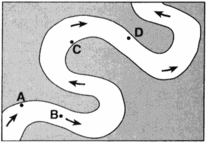
At which location is the greatest amount of sediment most likely being deposited?
1
A
2
B
3
C
4
D

35

Multiple Choice

Question image

________________ are streams that flow together to make a river.

1

source

2

tributaries

3

mouth

4

drainage basin

36

Multiple Choice

Question image

What landform can you see in the picture?

1

U shaped valley

2

V Shaped Valley

3

Floodplain

4

Waterfall

37

​Mass

Wasting

38

media

39

Multiple Choice

Question image

What is the land next to the river called and how would you describe it?

1

Floodplain, steep land next to the river.

2

Floodplain, flat land next to the river.

3

Floodplain, flat land away from the river.

4

Floodplain, flat land on top of the river.

40

Multiple Choice

Question image

This river located in Africa is considered to be the longest river

1

The Mississippi

2

The Amazon

3

The Nile

4

The Ganges

41

What is Chemical Weathering?

the transformation of rock into one or more new compounds.

media

42

Multiple Choice

Question image

The best known and most common wind deposits are called

1

deflations

2

saltation

3

dunes

4

loess

43

Multiple Choice

Question image
The diagrams  shows a natural process that weathers rock.
 Which statement best explains why this process results in weathering?
1
frozen water acts as a solute
2
water expands when it freezes
3
the mass of water increases when it freezes
4
frozen water dissolves most types of rock

44

Chemical Weathering: Oxygen

Oxygen in atmosphere combines with iron in rocks & minerals.This results in rust (red rocks).

media

45

Multiple Choice

Question image
What kind of weathering causes the mineral composition of rocks to change?
1
mechanical weathering
2
permeable weathering
3
chemical weathering
4
physical weathering

46

Multiple Choice

Question image

A rock containing iron becomes soft and crumbly and reddish-brown in color.  It probably has been chemically weathered by _____.

1
abrasion
2
carbon dioxide
3
oxygen
4
acid rain

47

Erosion by Wind & Waves

Kangaroo Island, Australia


Rocks shaped by wind and waves


media

48

media

Replace this with a header

Weathering, Erosion, Deposition

and Mass Movements

Show answer

Auto Play

Slide 1 / 48

SLIDE