Search Header Logo
Integrated Science

Integrated Science

Assessment

Presentation

•

Science

•

9th Grade

•

Hard

Created by

Joseph Anderson

FREE Resource

4 Slides • 66 Questions

1

Integrated Science Final Review
Slide image

2

Unit 4: Earth's Processes

  • Boundary Types

  • Convection Currents

  • Cause and Effects

3

Multiple Choice

Question image

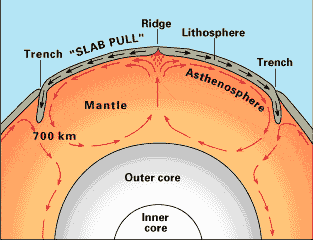
What is the source of energy that drives plate movement?

1

the subducton of the sea floor

2

the different densities of the oceanic and crustal plates

3

convection currents in the asthenosphere

4

the friction force between the plates that move past each other

4

Multiple Choice

Question image

New oceanic crust (sea floor) is created at this boundary.

1

Divergent Oceanic

2

Divergent Continental

3

Convergent Oceanic

4

Transform

5

Multiple Choice

Two plates spread or move apart at what boundary?

1

Convergent

2

Divergent

3

Transform

6

Multiple Choice

Two plates come together or collide at what boundary?

1

Convergent

2

Divergent

3

Transform

7

Multiple Choice

What geologic feature/event would you most likely to find at a convergent boundary between two pieces of continental crust?

1

Volcano

2

Mountain

3

Rift

4

Island Arc

8

Multiple Choice

What geologic feature/event would you most likely to find at a divergent boundary between two pieces of oceanic crust?

1

Rift Valley

2

Mid-Ocean Ridge

3

Island Arc

4

Flat land

9

Multiple Choice

What geologic feature/event you be most likely to find at a transform boundary?

1

Earthquakes

2

Volcanoes

3

Mountains

4

Rift Valleys

10

Multiple Choice

Question image

What kind of plate boundary is shown here?

1

divergent

2

convergent

3

transform

4

submergent

11

Multiple Choice

Question image

What is occurring at the Nazca Plate?

1

Trasformation

2

Subduction

3

Lithification

4

Compaction

12

Multiple Choice

Question image

Use the diagram to answer the question. What results as the two oceanic plates converge?

1

formation of a deep sea trench and island volcanoes

2

earthquake activity and appearance of a transform fault

3

volcanic eruption along both oceanic plate edges

4

formation of a continental mountain range

13

Multiple Choice

Question image

The diagram shows a landform on Earth. How did the movement of Earth’s plates form the landform?

1

Two oceanic plates slid past each other.

2

Two continental plates collided.

3

One continental plate slid past an oceanic plate.

4

One continental plate subducted beneath an oceanic plate.

14

Multiple Choice

Question image

The diagram shows a cross section of a portion of the Earth. Which letter represents a mid-ocean ridge?

1

W

2

X

3

Y

4

Z

15

Multiple Choice

Molten rock from Earth's mantle

1

lava

2

magma

16

Multiple Choice

A theory of how Earth's continents move over its surface.

1

Pangea

2

Contintntal Drift

3

Yesterday

4

Pandemonium

17

Multiple Choice

Melted rock at Earth's surface is called

1

lava

2

the mantle

3

the lithosphere

4

magma

18

Multiple Choice

Is the Outer core solid or liquid?

1

solid

2

liquid

19

Multiple Choice

which one is hotter?

1

the crust

2

mantle

3

Inner core

20

Multiple Choice

Question image

Who developed the theory of Continental Drift?

1

Harry Hess

2

Mrs. Mott

3

Alfred Wegner

21

Multiple Choice

Question image
Which type of crust is more dense?
1
Oceanic Crust
2
Lithospheric Crust
3
Continental Crust
4
Convection Crust

22

Multiple Choice

Question image
What was the name of the super continent that Wegner believed once existed?
1
Ice Age
2
Wegner Land
3
Triassic 
4
Pangaea

23

Multiple Choice

Question image
Which layer is the thinnest layer of the Earth?
1
Outer Core
2
Crust
3
Mantle
4
Inner Core

24

Multiple Choice

Question image

Which part of the Earth’s crust is less dense and makes up the continents?

1

Oceanic Crust

2

Lithosphere

3

Continental Crust

4

Crust

25

Multiple Choice

Question image

Which layer of the Earth is SOLID iron and nickel?

1

Mantle

2

Outer Core

3

Inner Core

4

Crust

26

Multiple Choice

Question image
Which is the hot liquid layer of iron and nickel?
1
Outer Core
2
Inner Core
3
Mantle
4
Asthenosphere

27

Multiple Choice

Question image

In which layer do convection currents occur?

1

Outer Core

2

Crust

3

Inner Core

4

Mantle

28

Multiple Choice

Question image

Which is the thickest layer found between the crust and the core?

1

Lithosphere

2

Crust

3

Outer Core

4

Mantle

29

Unit 6 Water Cycle, Energy and Sustainabilty

  • Renewable and Nonrenewable Energy

30

Multiple Select

Advantages of Non-renewable energy...

1

they can be stored for use at later time

2

they are cheap

3

they are not easily replaced

4

they cause pollution to the environment

31

Multiple Select

Disadvantages of fossil fuels...

1

they are not easily replaced

2

they create pollution in the environment

3

they are cheap

4

they can be stored for later use

32

Multiple Choice

What is needed for all fossil fuels to form?

1

Heat

2

Pressure

3

A lot of time

4

All of these

33

Multiple Choice

In the United States, what percent (%) of our energy comes from fossil fuels?

1

85%

2

30%

3

75%

4

99%

34

Multiple Select

What are the main fossil fuels?

1

Coal

2

Oil

3

Natural Gas

4

Nuclear Energy

35

Multiple Choice

Fossil fuels are considered nonrenewable because they

1

do not produce pollution

2

are no longer used by humans

3

are created so quickly

4

take millions of years to form, so once they're gone, they're gone

36

Multiple Choice

Which one of these is NOT a type of renewable energy?

1

solar

2

wind

3

biomass

4

nuclear

37

Multiple Choice

Energy created from wood, peat moss, and manure is called __________________ energy.

1

biomass

2

geothermal

3

natural

4

solar

38

Multiple Choice

____________________ energy is created by transforming radiant energy from the sun.

1

geothermal

2

biomass

3

solar

4

nuclear

39

Multiple Choice

____________________ is energy that can be replaced as quickly as it is used.

1

nonrenewable

2

renewable

3

nuclear

4

kinetic

40

Multiple Choice

Water begins to evaporate when you add _______ to it.

1

cold

2

ice

3

water cycle

4

heat

41

Multiple Choice

Question image

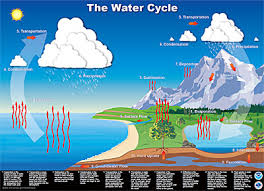
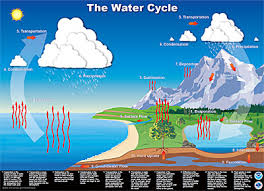
Which stage does ground water try to return to the ocean or soak into the ground?

1

condensation

2

evaporation

3

precipitation

4

run off

42

Multiple Choice

Question image
During which stage do clouds form?
1
condensation
2
evaporation
3
precipitation

43

Multiple Choice

The water cycle has no start or end

1

true

2

false

44

Multiple Choice

After condensation, the droplets of water in the clouds fall to the earth in different forms
1
precipitation 
2
condensation
3
evaporation 
4
ground water

45

Multiple Choice

When water is heated in the ocean by the sun and turns into water vapor
1
condensation
2
evaporation
3
transpiration
4
runoff

46

Multiple Choice

Question image
During which stage do clouds form?
1
condensation
2
evaporation
3
precipitation

47

Multiple Choice

What is the energy source for the water cycle?
1
the sun
2
the earth
3
water
4
the moon

48

Multiple Choice

Question image

What is it called when plants give off water vapor as a waste product?

1

condensation

2

evaporation

3

sublimation

4

transpiration

49

Multiple Choice

Snow, sleet, hail, and rain are all examples of ________________.

1

evaporation

2

condensation

3

accumulation

4

precipitation

50

Multiple Choice

Which is the opposite of condensation?

1

runoff

2

evaporation

3

precipitation

4

transpiration

51

Multiple Choice

What is the water cycle?

1

the 3 forms of water

2

the movement of water on, above, or below the surface of the Earth

3

when water melts

4

when clouds form

52

Unit 5: Weather and Climate

  • Climate Factors

  • Where should they live?

53

Multiple Choice

The biggest factor in determining climate is?

1

elevation

2

an ocean

3

latitude

4

mountain

54

Multiple Choice

Question image

Which side of a mountain is the driest?

1

Windward

2

Leeward

3

Desert

55

Multiple Choice

The data is averaged on a monthly or annual basis for a period of at least ______ years to determine the normals, which are the standard values for a location's climate.

1

5

2

10

3

30

4

100

5

300

56

Multiple Choice

Near what latitude(s) is angle of sunlight highest?

1

Equator

2

The Poles

57

Multiple Choice

The _______ of a mountain range is the side that receives a lot of precipitation.

1

windward side

2

leeward side

58

Multiple Choice

Two factors to determine climate are

1

precipitation and temperature

2

hurricanes and tornadoes

3

humidity and pressure

59

Multiple Choice

Question image

Elevation (Altitude) affects the climate of an area.

1

True

2

False

60

Multiple Choice

Question image

Latitude affects the climate of an area.

1

True

2

False

61

Multiple Choice

The _______ of a mountain range is the side that receives a lot of precipitation.

1

dry side

2

leeward/dry side

3

windward/wet side

4

cloudy side

62

Multiple Choice

As altitude _____________ temperature ___________.

1

decreases, decreases

2

increases, increases

3

increases, decreases

4

decreases, increases

63

Multiple Choice

Question image

Ocean currents circulate the sun's heat.

1

True

2

False

64

Multiple Choice

Winds that blow from the west are called ____.

1

Easterlies

2

Polars

3

Westerlies

4

Temperates

65

Multiple Choice

As you go to the top of a mountain, what happens to temperature?

1

Nothing

2

It increases

3

It decreases

4

It goes up and down

66

Multiple Choice

What is weather over a long period of time?

1

A tropical vacation

2

Weather

3

Climate

4

Science

67

Multiple Choice

Question image

The planetary winds on Earth are indicated by the curving arrows in the diagram.

The curved paths of the planetary winds are a result of

1

changes in humidity.

2

changes in temperature.

3

Earth's rotation on its axis

4

Earth's gravitational force

68

Multiple Choice

What effect does a large body of water usually have on a nearby landmass?

1

The water causes cooler summers and colder winters.

2

The water causes cooler summers and warmer winters.

3

The water causes hotter summers and warmer winters.

4

The water causes warmer summers and colder winters.

69

Multiple Choice

What is the best explanation for these two statements?

1. Some mountains located near the Earth's Equator have snow-covered peaks.

2. Icecaps exist at the Earth's poles.

1

High elevation and high latitude have a similar effect on climate.

2

Both mountain and polar regions have arid climates.

3

Mountain and polar regions receive more energy from the Sun than other regions.

4

An increase in snowfall and an increase in temperature have a similar effect on climate.

70

Multiple Choice

How does the average annual surface temperature compare from latitude to latitude?

1

As latitude increases, the average annual surface temperature decreases.

2

As latitude increases, the average annual surface temperature increases.

3

As latitude increases, the average annual surface temperature remains the same.

4

Well, it's not this one.

Integrated Science Final Review

Slide image

Show answer

Auto Play

Slide 1 / 70

SLIDE