

Basic Waves

Presentation
•
Science
•
8th Grade
•
Hard

Joseph Anderson
FREE Resource
54 Slides • 30 Questions
1

2

3
Where did it go wrong?
Quizizz Review was not practiced outside of the classroom.
Vocabulary Practice was not practiced outside the classroom.
Reminders were given in class and reminder emails were sent 2x.
Retakes: Unit Test Questions were broken down to give retake scores.
Test 1 (PS2.3 1st Law) and Test 2 (PS2.3 & PS2.4 2nd/3rd Law)
Correction Opportunity:
Located in Schoology in the "Remediation/REDO/Replacement" folder.
Due this Friday, Oct 4!! The grading period ends Friday.
4
Open Ended
Which graph describes the likely change in the speeds of the ice skater and rollerblader after pushing on the wall? And why?
5

Waves Unit
Waves Phenomenon
Inquiry Question: What type of energy and forces
caused the Tacoma bridge to be destroyed and how do we
use these same noncontact forces today?
Galloping Gertie
Tacoma Bridge
6

Standard: PS4.1
Develop and use models to represent basic properties of waves including frequency, amplitude, wavelength, and speed.
Learning Intention
•Develop and use
mathematical
models to show
the basic
properties of
waves
highlighting that
patterns exist
between waves.
Success Criteria
•I can be a
communicator by
using critical
thinking skills in
identifying all the
parts of a
transverse and
longitudinal
wave.
•I can be a
problem solver in identifying all the parts of a mechanical wave.
I can identify the difference between pitch and volume
Focus Question: What type of properties do waves contain?
7

Activator
Read the event described below, identify on the back of your bellwork sheet how many different waves were present. List all the waves.
Imagine that your family has just
returned home from a day at the beach.
You had fun playing in the ocean under
a hot sun. You put some cold pizza in
the microwave for dinner, and you turn
on the radio. Just then, the phone rings.
It’s your friend calling to ask about
homework.
This Photo by Unknown author is licensed under CC BY.
8

9

10

What are Waves?
Rhythmic disturbances that carry
energy without carrying matter
11

2 Types of Waves
• Mechanical Waves – need matter (or medium) to
transfer energy
• A medium is the substance through which a wave
can travel. Ex. Air; water; particles; strings; solids;
liquids; gases
• Electromagnetic Waves – DO NOT NEED matter (or
medium) to transfer energy
• They do not need a medium, but they can go
through matter (medium), such as air, water, and
glass
12
13

Mechanical
Waves
Waves that need matter
(medium) to transfer
energy:
Examples: Sound
waves, ocean waves,
ripples in water,
earthquakes, wave of
people at a sporting
event
14

15


Transverse
(Mechanical) Waves
• Energy causes the matter in the
medium to move up and down or
back and forth at right angles to
the direction the wave travels.
• Examples: waves in water
16
Multiple Choice
17
Multiple Choice
18

19


Parts of a
Transverse Wave
The crest is
the highest
point on a wave
20


Parts of a
Transverse Wave
The trough is
the valley
between two
waves, is the
lowest point.
21


Parts of a Transverse Wave
The wavelength is the horizontal
distance, either between the crests or
troughs of two consecutive waves.
22


Parts of a Transverse Wave
The amplitude is the peak (greatest) value
(either positive or negative) of a wave. The
distance from the undisturbed level to the trough or crest.
23
An ocean wave is an example of
a mechanical transverse wave.


24

25
26
Multiple Choice
27
Multiple Choice
Sound travels in which kind of wave?
Longitudinal waves
Transverse waves
28

29

30


Compressional Wave (longitudinal)
• A mechanical wave in which matter in the medium moves foward and backward along the same direction that the wave travels.
• Ex. Sound waves
A slinky is a good illustration
of how a compressional wave moves.
31

32

33
Multiple Choice
34
Multiple Choice

35
Multiple Choice
36

answer ready,
but do not write
anything today.
2. Review Wave
Parts- Transverse
and Longitudinal.
You have a quiz!
37
38

Are P-Waves Transverse or Longitudinal?
Hint: How do they travel?
Are S-Waves Transverse or Longitudinal?
Hint: How do they travel?
39
Direction
Cut out the foldable along the dotted lines.
Fold in half (hotdog style)
Add the words from the next slide to the correct section on the foldable and draw a picture for word group.
40

Glue Foldable
Page 35
41
Wave Height
Trough
Wavelength
Rest Position
Crest
Amplitude
Transverse Wave Parts
Rarefaction
Compression
Wavelength
42

1. Schoology ->
2. Links Folder ->
3. Link to Join PBS
Learning Media
4. Complete the Mechanical Waves Interactive Lesson

43


44

Draw
Draw
45


46
As wavelength increases, the frequency decreases.
Inversely related!

47

48


Wave
Speed
•WS – wave speed – units
m/s
•F – frequency - units
hertz
•WL – wavelength - units
m, cm
49

Wave
Speed
Practice
b
a
50
The PITCH of a wave is how high or low a note sounds.
High Pitches vibrate quicker (high frequency)
Low Pitches vibrate slower (lower frequency)
The Volume of sound waves is the intensity of the sound.
The lower the amplitude, the quieter the sound.
The higher the amplitude, the louder the sound.
51


52

53

Low Frequency = Lower pitch
High Frequency = higher pitch
Low Amplitude = low volume
High Amplitude = high volume
54

55
Bellwork 10-4
Which statement correctly compares the force applied by the student on the box to the force applied by the box on the student?
A When the student applies a 5 N force on the box, the box does not apply a force on the student.
B When the student applies a 10 N force on the box, the box applies a 3 N force on the student.
C When the student applies a 10 N force on the box, the box applies a 10 N force on the student.
D When the student applies a 15 N force on the box, the box applies a 2 N force on the student.
56


Draw waves to complete the chart.
Use the information on the right to
help you.
57
-Amplitude
-Wavelength
-Frequency
-Energy
With your pair/group as instructed, sort the cards using the conditions given, record the number of the cards on your answer sheet. Each person will turn in their own answer sheet.
58
Following all instructions, you will watch, listen, and complete your demo lab sheet as waves are created with the slinky.

59
Multiple Choice
60
Multiple Choice
Waves carry ________.
Matter, Energy, and Particles
matter only
energy and matter
energy only
61
Multiple Choice
When you jump faster on the trampoline, the frequency ________, creating _________ wavelengths.
increases; shorter
increases; longer
decreases; shorter
62
Multiple Choice
Particles in a solid are arranged very close together and vibrate passing the energy from particle to particle ________.
fast
slow
63
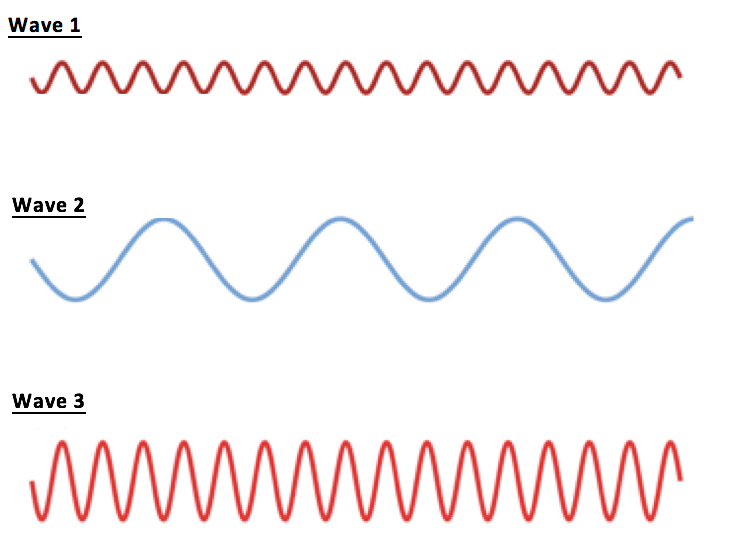
Multiple Choice

What is true of the two waves pictured?
They have the same wavelength but different frequencies.
They are both longitudinal waves.
They have the same frequencies and wavelength
The top waves is transverse and the bottom wave is longitudinal.
64
Multiple Choice
How would you describe the movement of the particles of a transverse wave?
Up and down; perpendicular to the wave energy
back and forth; perpendicular to the wave energy
back and forth; parallel to the wave energy
up and down; parallel to the wave energy
65
Multiple Choice

What causes a sound to be quiet or loud?
Wavelength
frequency
amplitude
66
Multiple Choice
What causes a sound to be high pitched?
high frequency
low frequency
high amplitude
low amplitude
67
Multiple Choice

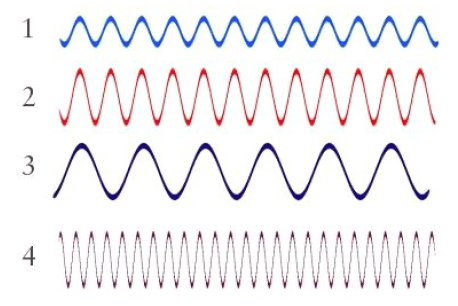
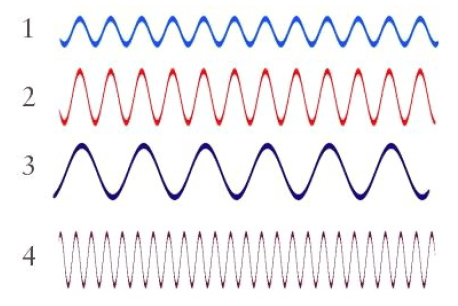
The wave pictured would be____.
loud, low pitched
loud, high pitched
quiet, low pitched
quiet, high pitched
68
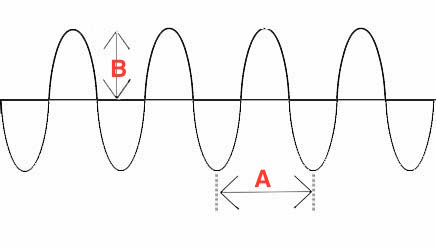
Multiple Choice

What part of the wave is labeled X?
69
Multiple Choice

What is a wavelength?
How many waves pass a certain point
The distance from one point on a wave to the next identical point on the next consecutive wave
The entire length of a wave
70
Multiple Choice
71
Multiple Choice
The number of waves that pass a certain point in a second is:
amplitude
frequency
wavelength
72
Multiple Choice

73
Multiple Choice
74
Multiple Choice
75
Multiple Choice

76
Multiple Choice
77
Multiple Choice
78
Multiple Choice
79
Multiple Choice
80
Multiple Choice
81
PS4.1
15 questions.
25 minutes.
Mastery Connect

82
As the video plays, answer the questions on the front side of your Watch It paper.
83

84

Show answer
Auto Play
Slide 1 / 84
SLIDE
Similar Resources on Wayground

75 questions
Rocks and Minerals Identification
Presentation
•
8th Grade
79 questions
Molecular genetics
Presentation
•
KG
78 questions
Chapter 9 Understanding the Atom
Presentation
•
7th Grade
79 questions
American Revolution
Presentation
•
8th Grade
78 questions
American Revolution Part 2
Presentation
•
8th Grade
78 questions
8.3.2 - Electric Current & Simple Circuits
Presentation
•
8th Grade
80 questions
8.PS.2-6-Lesson 2-Action-Reaction Forces in Everyday Life
Presentation
•
8th Grade
75 questions
8.3.1-Electric Charge & Electric Forces
Presentation
•
8th Grade
Popular Resources on Wayground
10 questions
Safety Day 2026 – Student Review

Quiz
•
9th Grade
21 questions
Continents and Oceans
Quiz
•
6th Grade
20 questions
Parts of Speech
Quiz
•
5th Grade
16 questions
Subject & Predicate
Quiz
•
5th Grade
25 questions
Multiplication Facts
Quiz
•
5th Grade
12 questions
Map Skills
Quiz
•
3rd Grade
22 questions
Continents and Oceans
Quiz
•
5th Grade
15 questions
Rounding Decimals
Quiz
•
5th Grade
Discover more resources for Science
20 questions
Newton's Laws of Motion
Quiz
•
8th Grade
15 questions
potential and kinetic energy
Quiz
•
8th Grade
21 questions
Newton's Laws of Motion
Quiz
•
8th Grade
20 questions
Elements, Compounds and Mixtures
Quiz
•
8th Grade
10 questions
Exploring Chemical and Physical Changes

Interactive video
•
6th - 10th Grade
20 questions
Physical vs Chemical Changes
Quiz
•
8th Grade
20 questions
Conduction, convection, and Radiation Practice
Quiz
•
8th Grade
21 questions
Waves and Wave Properties
Quiz
•
6th - 8th Grade