

Search Header Logo
Beta Decay Lesson

Beta Decay Lesson

Assessment

Presentation

Physics

10th Grade

Hard

Created by

Joseph Anderson

FREE Resource

11 Slides • 8 Questions

1

Radioactive Decay

Monday 1st March 2021
Slide image

2

Unstable Nuclei

Last lesson with Mr. Brown, you looked at stable nuclei and isotopes.


Some atoms have stable nuclei.​

Some atoms have unstable nuclei.​

These undergo radioactive decay to try and become more stable.

3

Multiple Choice

What is an isotope?

1

An atom with the same number of neutrons and electrons, but a different number of protons.

2

An atom with the same number of protons and electrons, but a different number of neutrons.

3

An atom with the same number of neutrons and protons, but a different number of electrons.

4

Unstable Nuclei

The nuclei of an atom can be unstable for three reasons.


1. the nuclei is too big

- these emit an alpha particle

2. the nuclei has an incorrect ratio of protons and neutrons

- these emit a beta particle

3. the nuclei has too much energy.

- these emit gamma rays

5

Alpha Particles

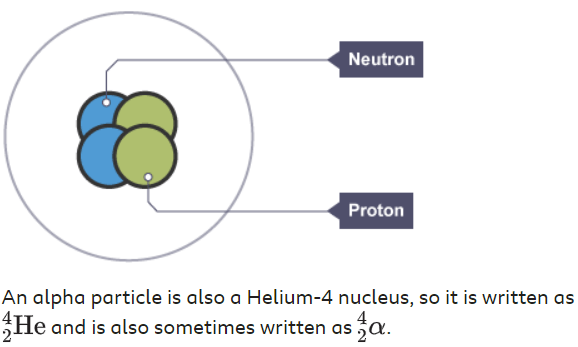
Alpha particles (α) consist of 2 neutrons and 2 protons (no electrons).

This is the same as a helium nucleus.


Alpha decay causes the mass number of the nucleus to decrease by four and the atomic number of the nucleus to decrease by two.


The overall charge of an alpha particle is +2.
Slide image

6

Beta Particles

If a nuclei has too many neutrons, a neutron will turn into a proton and emit a fast-moving electron. This electron is called a beta (β) particle.


A beta particle has a relative mass of zero. Beta decay causes the atomic number of the nucleus to increase by one and the mass number remains unchanged.


The charge of a beta particle is -1.

Slide image

7

Gamma rays

After emitting alpha/beta particles, nuclei still have a high amount of energy and need to 'cool down'.


So, often they will emit gamma rays (γ). These are electromagnetic (EM) waves.


Gamma ray emission causes no change in the number of particles in the nucleus meaning both the atomic number and mass number remain unchanged.

Slide image

8

Multiple Choice

which type of decay is also referred to as a helium nuclei?

1

alpha

2

beta

3

gamma

9

Multiple Choice

Which type of decay is a type of electromagnetic wave?

1

alpha

2

beta

3

gamma

10

Chernobyl Disaster 1986

During 1986, a nuclear power plant in Ukraine experienced a critical failure in their safety measures. This resulted in a considerable amount of radioactive contamination.


This contamination included alpha, beta and gamma radiation.


Today, tourists can enter limited parts of Chernobyl.

Slide image

11

Geiger-Muller counter

All types of radioactive decay can be detected by a Geiger-Muller tube, or G-M tube.


The radiations ionise the gas inside and the resulting charged particles move across the chamber and get counted as charges rather like an ammeter.

Slide image

12

Open Ended

Tourists at Chernobyl must wear miniature versions of GM counters - why is this a good idea?

13

Ionising and Penetrating Power

Ionising Power - to ionise means to convert an uncharged atom or molecule into a charged particle by adding or removing electrons.


Penetrating Power - the power of the radiation that demonstrates how far into a material the radiation will go.

14

Youtube Video

GCSE Physics - Alpha, Beta and Gamma Radiation #33 - YouTube


This video will tell you about the ionising and penetrative power of alpha/beta/gamma radiation. You will be asked questions based on this video!


*this video will talk about neutron decay - you do not need to worry about this for now!*

15

Multiple Choice

How ionising is alpha decay?

1

low

2

moderate

3

high

16

Multiple Choice

how penetrating is beta decay?

1

low

2

moderate

3

high

17

Multiple Choice

how ionising is gamma radiation?

1

low

2

moderate

3

high

18

Slide image

19

Multiple Select

How confident do you feel with radioactive decay?

1

I'm not sure, I think I need some practice

2

I think I've got it but would like some practice

3

I've got this - I can practice independently

Radioactive Decay

Monday 1st March 2021

Slide image

Show answer

Auto Play

Slide 1 / 19

SLIDE

