

Biconditional Statements

Presentation
•
Mathematics
•
8th - 10th Grade
•
Hard

Joseph Anderson
FREE Resource
7 Slides • 5 Questions
1
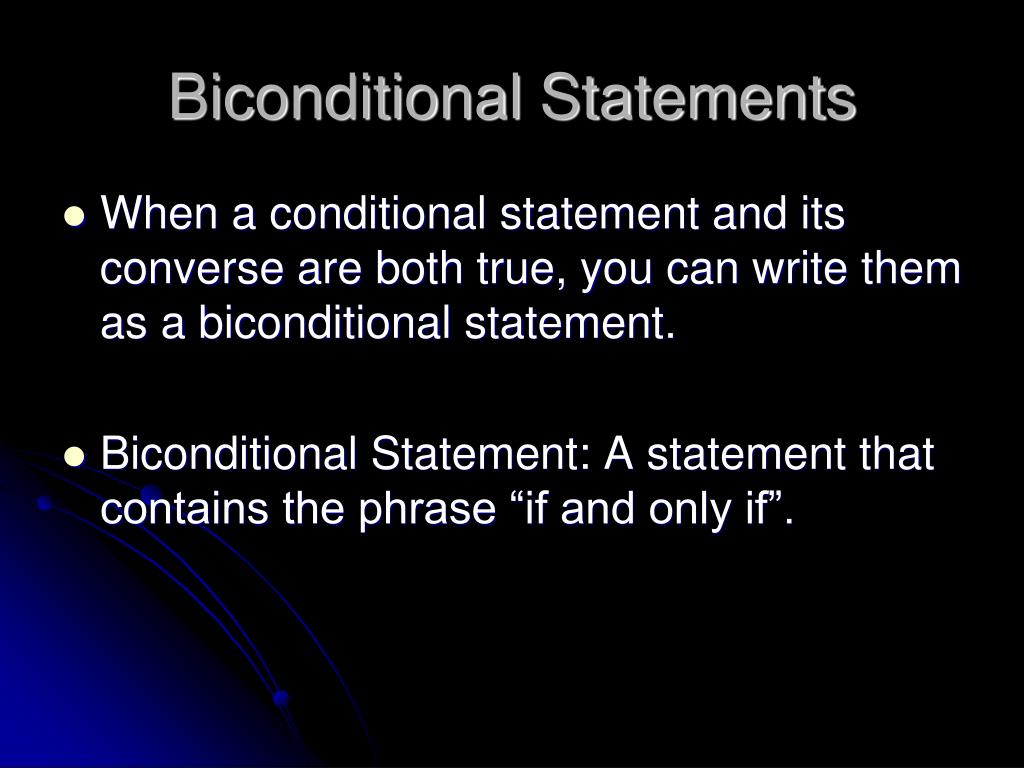
Biconditional Statements
2
Example 1
Conditional: If two lines are perpendicular, then they form a right angle.
Converse: If two lines form a right angle, then they are perpendicular.
Both the conditional and converse are true, so this is biconditional.
3
Example 1 Continued
Now we can write the statement in the "if and only if" form.
Biconditional: Two lines are perpendicular if and only if they form a right angle.
*Notice how the words "if" and "then" were removed and the hypothesis and conclusion were connected with the phrase "if and only if" in the middle.
4
Example 2
Conditional: If a triangle is a right triangle, then it has two acute angles.
Converse: If a triangle has two acute angles, then it is a right triangle.
The conditional is true but the converse is false. So this is not a biconditional statement and it would not make sense to write this in the "if and only if" form.
5
Open Ended
Write the converse of the statement and if both are true write as a biconditional.
Conditional: If x is even, then 2x is even.
6
Answer
Converse: If 2x is even, then x is even. False
Example: If 2x=6, then x=3. 3 is odd.
Not Biconditonal
7
Open Ended
Write the converse of the statement and if both are true write as a biconditional.
Conditional: If a polygon is a hexagon, then it has six sides.
8
Answer
Converse: If a polygon has six sides, then it is a hexagon. True
Biconditonal: A polygon is a hexagon if and only if it has six sides.
OR: A polgyon has six sides if and only if it is a hexagon.
The biconditional can be written in either order since they are both true.
9
Good Definition
A good definition should be biconditional. Such as the last example about hexagons.
Examples
Two different lines are parallel if and only if they have the same slope. This is a good definition of parallel lines because it is biconditional.
Two angles are a linear pair if and only if the two angles are supplementary. This is a bad definition of linear pair because it is not biconditional. Supplementary angles don't have to be adjacent so they don't have to be a linear pair.
10
Multiple Choice
Determine if the following is a good or bad definition:
An equation is linear if and only if its graph forms a straight line.
good definition
bad definition
11
Multiple Choice
Determine if the following is a good or bad definition:
The converse of a conditional statement is true if and only if the contrapositive is true.
good definition
bad definition
12
Multiple Select
Select the if-then statements that could have formed the following biconditional.
Two lines are perpendicular if and only if their slopes are opposite reciprocals.
If two lines are perpendicular, then their slopes are the same.
If two lines are perpendicular, then their slopes are opposite reciprocals.
If two lines have opposite reciprocal slopes, then they are perpendicular.
If two lines have opposite reciprocal slopes, then they are parallel.
Two lines will always be parallel or perpendicular.
Biconditional Statements
Show answer
Auto Play
Slide 1 / 12
SLIDE
Similar Resources on Wayground

10 questions
parallel lines cut by transversal
Presentation
•
8th - 10th Grade
11 questions
Systems of Equations Word Problems
Presentation
•
8th - 9th Grade
10 questions
1.02 (Distributive Property)
Presentation
•
9th Grade
11 questions
Linear Equation in two variable
Presentation
•
9th Grade
11 questions
1.3 Day 1 Solving Eq. with Variable on both Sides
Presentation
•
9th Grade
10 questions
Solving Equations with Variables on Both Sides Lesson
Presentation
•
8th - 10th Grade
12 questions
Computations with Scientific Notation
Presentation
•
8th - 9th Grade
7 questions
Different Forms of Linear Equations
Presentation
•
8th - 10th Grade
Popular Resources on Wayground
10 questions
How much do you know about our Portrait of an Eagle?

Quiz
•
10th Grade
10 questions
Fast Food Slogans
Quiz
•
6th - 8th Grade
21 questions
Continents and Oceans
Quiz
•
6th Grade
20 questions
Parts of Speech
Quiz
•
5th Grade
16 questions
Subject & Predicate
Quiz
•
5th Grade
25 questions
Multiplication Facts
Quiz
•
5th Grade
12 questions
Map Skills
Quiz
•
3rd Grade
22 questions
Continents and Oceans
Quiz
•
5th Grade
Discover more resources for Mathematics
20 questions
Rational and Irrational Numbers
Quiz
•
8th Grade
10 questions
Exploring Angles Formed by Lines Intersected by a Transversal
Quiz
•
8th Grade
20 questions
Add and Subtract Integers
Quiz
•
6th - 8th Grade
20 questions
Graphing Inequalities on a Number Line
Quiz
•
6th - 9th Grade
20 questions
Slope from a Graph
Quiz
•
8th Grade
22 questions
Adding Integers
Quiz
•
7th - 8th Grade
10 questions
Translating Algebraic Expressions
Quiz
•
9th Grade
20 questions
Proportional vs. Non-Proportional
Quiz
•
8th Grade