

Building Amino Acid

Presentation
•
Biology
•
9th - 12th Grade
•
Hard

Joseph Anderson
FREE Resource
18 Slides • 27 Questions
1
U2: Translation Notes
2


TRANSLATION
Translation is the final step of protein synthesis - it involves
ALL THREE types of RNA (mRNA, tRNA and rRNA).
• Translation is a process in which the mRNA that was
manufactured during transcription is translated into an
amino acid sequence (proteins).
• occurs in the cytoplasm
and on the ribosomes
3
Multiple Choice
What is the correct order to make a protein?
Protein, DNA, RNA
RNA, DNA, Protein
DNA, RNA, Protein
Protein, RNA, DNA
4


Ribosomal RNA (rRNA)= a major
component of ribosomes; also helps bond
amino acids together to make polypeptides
(proteins)!
The goal of the 3 types of RNA is to work
together to make proteins using the DNA’s
instructions!
5
Multiple Choice
mRNA
tRNA
rRNA
DNA
6


TRANSLATION
Transfer RNA (tRNA)= helps transfer amino acids to the corresponding mRNA
codons (tRNA is always complementary to the mRNA strand)
mRNA codons: U G C A A U C G G
tRNA anticodons: A C G U U A G C C
tRNA bases are referred to as “anti-codons” because they are
complementary to mRNA codons.
mRNA strand (codons) U G C A A U C G G
tRNA strand (anti-codons) A C G U U A G C C
7
Multiple Choice
What is the process by which mRNA is decoded to produce a specific sequence of amino acids?
mutation
transcription
replication
translation
8
Multiple Choice
How many nucleotides are there in a codon?
3
1
4
2
9
Multiple Choice
When the mRNA sequence leave the nucleus, what organelle does it travel to?
mitochondria
smooth ER
ribosome
vacuole
10
Multiple Choice
What best explains the interaction between tRNA and mRNA during translation?
anticodons on the mRNA line up with complementary codons on the tRNA
anticodons on the tRNA line up with complementary codons on the mRNA
tRNA attach amino acids to the complementary mRNA sequence
mRNA attach amino acids to the complementary tRNA sequence
11
Multiple Choice
What are the 4 RNA bases?
A (adenine)
T (Thymine)
G (Guanine)
G (Glycine)
A (adenine)
U (uracil)
A (Alanine)
C (Cytosine)
A (adenine)
T (Thymine)
C (Cytosine)
G (Guanine)
A (adenine)
U (uracil)
C (Cytosine)
G (Guanine)
12
Multiple Choice
Name the 3 types of RNA
mRNA
dRNA
rRNA
mRNA
tRNA
rRNA
mRNA
tRNA
cRNA
mRNA
dRNA
tRNA
13
Multiple Select

draw each type of RNA
see picture, practice drawing each type
see picture, practice drawing each type
14
Multiple Choice
DNA strand reads TAC CCG GCA
Find the mRNA that matched
ATG GGC CGT
AGG GGC CGU
AUG GGC CGU
AUG GGC CGA
15
Multiple Choice
One codon codes to make how many amino acids?
64
1
12
3
16


TRANSLATION
tRNA transfers amino acids
to the ribosome. The amino
acids are attached to the
tRNA via a specialized
enzyme called tRNA
synthetase.
Analogy: tRNA is a librarian; mRNA
codons are the book codes; amino acids
are the books. tRNA reads the mRNA and
fetches the appropriate amino acid.
17


Example)
If the mRNA codon is
CUU, that would
translate to the amino
acid leucine.
The tRNA molecule that
will deliver leucine to the
ribosome has the
anticodon GAA.
Once the amino acid is delivered, the tRNA releases
itself from the ribosome, and leaves to find another
amino acid to add to the growing polypeptide chain.
ANTICODON
LEUCINE
18
Multiple Choice
What best explains the interaction between tRNA and mRNA during translation?
anticodons on the mRNA line up with complementary codons on the tRNA
anticodons on the tRNA line up with complementary codons on the mRNA
tRNA attach amino acids to the complementary mRNA sequence
mRNA attach amino acids to the complementary tRNA sequence
19
Multiple Choice
What does tRNA "transfer"?
amino acids
nucleic acids
nucleotides
AUG
20


DNA Template Strand: A C G T T A G C C
mRNA strand: U G C A A U C G G
Codons?
1)
UGC
2)
AAU
3)
CGG
Which three amino
acids do these
mRNA codons
code for?
1.
2.
3.
21

22
Multiple Choice

The following codon is translated into which amino acid?
AUU
Methionine
Isoleucine
Histidine
Arginine
23
Multiple Choice

The following codon is translated into which amino acid?
CAU
Methionine
Isoleucine
Histidine
Arginine
24
Multiple Choice

The following codon is translated into which amino acid?
UAA
STOP
Phenylalanine
Valine
Aspartic acid
25
Multiple Choice

26
Multiple Choice

27
Multiple Choice
What type of bonds are forming during translation?
Peptide bonds (covalent)
Hydrogen bonds
Acid bonds
ionic bonds
28


RNA Synthesis: Transcription
Transcription is catalyzed
by RNA polymerase
● It unzips the DNA
strands
● Then joins together the
RNA nucleotides that
are complementaryto
the DNA template strand
● Transcription follows the
same base-pairing rules
as DNA, except that
uracil substitutes for
thymine
29
Multiple Choice
30
Multiple Choice
31
Multiple Choice

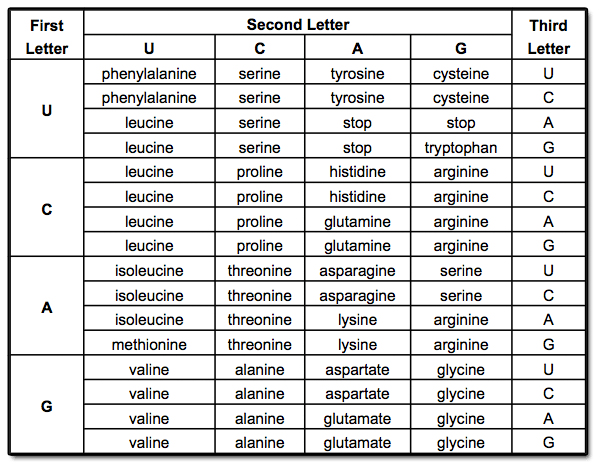
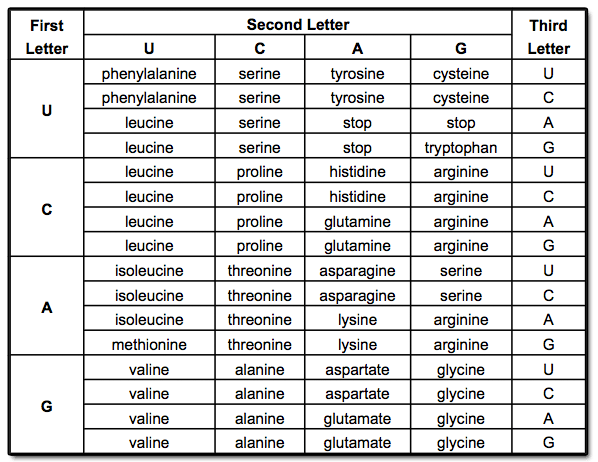
The table below shows the codons that make up the genetic code and the sequence of nucleotides that corresponds to them. To determine which amino acid corresponds to a codon, find the row matching the first RNA nucleotide, the column matching the second nucleotide, and the specific codon containing the third nucleotide. What sequence of amino acids would be coded by the following set of nucleotides? AGU AUA UCG CGU UGU
A. Arg, Thr, Lys, Thr, Gly
B. Ser, Ile, Ser, Arg, Cys
C. Ser, Met, Leu, Gln, Cys
D. Arg, Leu, Ser, Asn, Stop
32


33


LABEL THE FOLLOWING:
MRNA, TRNA, RIBOSOME, PEPTIDE (PROTEIN) CHAIN,
AMINO ACID
34


START AND STOP SIGNALS
Proteins are made up of a very specific sequence of amino
acids.
DNA contains “start” and “stop” codons so that the cell knows
where to start decoding proteins and where to stop.
The start codon= AUG (codes for the amino acid methionine)
Stop codons = UAA, UAG, UGA
35
Multiple Choice
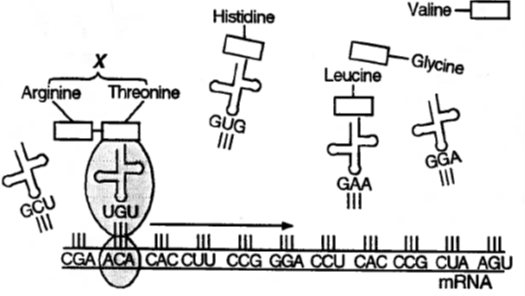
Transcription
Translation
Replication
All the above
36
Multiple Choice
transcription
rRNA
replication
translation
37
Multiple Choice
nucleus
cytoplasm
ribosome
mitochondria
38
Multiple Choice
The main function of tRNA is to
Carry a message that, when translated, forms proteins
Form a portion of ribosomes
String together complementary RNA and DNA strands
Carry amino acids to the ribosomes where they are joined to form proteins
39
Multiple Choice
The main function of mRNA is to
Copy DNA in the nucleus and carries the information to the ribosomes
Bring amino acids from the cytoplasm to the ribosomes
String together complementary RNA and DNA strands
Form a portion of ribosomes
40


41


42

Overview
● When a particular protein is needed, the cell must make the
protein through the process of transcription and translation.
● DNA molecules (which contain the code) do not leave the
nucleus of the cell.
● Protein synthesis occurs on ribosomes located outside of the
nucleus.
● Therefore, the code must be carried from the nucleus to the
cytoplasm.
● RNA plays an important role in protein synthesis but it can also
have other functions in the cell.
○ mRNA is essential to the process of transcription, tRNA is
essential to the process of translation, and rRNA makes up
the ribosomes in which translation takes place.
43

Overview
●
Transcription is the process by which a portion of the molecule of
DNA is copied into a complementary strand of RNA. The process of
transcription takes place as follows:
○
An enzyme attaches to the DNA molecule at the gene of interest.
○
The two strands of DNA separate at that location.
○
Complementary RNA nucleotides bond to the nitrogenous bases on
one of the separated DNA strands.
○
The chain of RNA nucleotides forms a single-stranded molecule of
RNA by using the DNA strand as a template.
○
When a stop codon is reached, the RNA strand separates from the
DNA molecule, leaves the nucleus and goes through the nuclear
membrane into the cytoplasm.
○
The two DNA strands rejoin.
44

Overview
●
Translation is the process by which the genetic message, carried by the
mRNA, is used to assemble a protein.
○
The mRNA attaches to a ribosome, which contains proteins and ribosomal
RNA (rRNA). The function of ribosomes is to assemble proteins according
to the genetic message.
○
Each three-base nucleotide sequence on the mRNA is called a codon. Each
codon specifies a particular amino acid that will be used to build the
protein molecule. For example, if the DNA sequence was GAC, then the
RNA sequence becomes CUG (transcription) and the amino acid that is
coded is Leucine (translation).
○
Another type of RNA, transfer RNA (tRNA), brings amino acids to the
ribosome in the order specified by the codon sequence on the mRNA. At
one end of each tRNA is the anticodon, a region that consists of three
nucleotide bases that are complementary to the codon of mRNA. The
other end of the tRNA molecule binds to the specific amino acid that is
determined by the mRNA codon.
45

Overview
● The translation process takes place as follows:
○
The anticodon of the tRNA, with its attached amino acid, pairs
to the codon of the mRNA, which is attached to a ribosome.
○
When a second tRNA with its specific amino acid pairs to the
next codon in sequence, the attached amino acid breaks from
the first tRNA and is bonded to the amino acid of the second
tRNA.
○
The ribosome forms a peptide bond between the amino acids,
and an amino acid chain begins to form.
○
The empty tRNA moves off and picks up another matching
amino acid from the cytoplasm in the cell.
○
This sequence is repeated until the ribosome reaches a stop
codon on the mRNA, which signals the end of protein synthesis.
U2: Translation Notes
Show answer
Auto Play
Slide 1 / 45
SLIDE
Similar Resources on Wayground

36 questions
Lab Safety Rules
Presentation
•
9th - 12th Grade
42 questions
Six Kingdoms EOC Review
Presentation
•
9th - 12th Grade
41 questions
Earthquakes Notes w/ videos
Presentation
•
9th - 12th Grade
40 questions
Factors Affecting Blood Flow
Presentation
•
9th - 12th Grade
39 questions
PBS 3.1.3 Modes of Transmission (Part 2)
Presentation
•
9th - 12th Grade
40 questions
Plant Systems
Presentation
•
9th - 12th Grade
41 questions
Cell's Organelles
Presentation
•
9th - 12th Grade
41 questions
Air Pollution Lesson
Presentation
•
9th - 12th Grade
Popular Resources on Wayground
6 questions
Secondary Safety Quiz
Presentation
•
9th - 12th Grade
10 questions
Afterschool Activities & Sports

Quiz
•
6th - 8th Grade
19 questions
ROAR Week 2026
Quiz
•
9th - 12th Grade
20 questions
Lab Safety Quiz
Quiz
•
6th Grade
15 questions
Cool Tool:Chromebook
Quiz
•
6th - 8th Grade
22 questions
would you rather
Quiz
•
3rd - 11th Grade
21 questions
Continents and Oceans
Quiz
•
6th Grade
20 questions
Parts of Speech
Quiz
•
5th Grade
Discover more resources for Biology
12 questions
Lab Safety Quizizz
Quiz
•
9th Grade
20 questions
Characteristics of Life
Quiz
•
9th - 10th Grade
20 questions
Lab Equipment
Quiz
•
10th Grade
10 questions
Exploring the 4 Major Macromolecules and Their Functions

Interactive video
•
9th - 12th Grade
44 questions
Biology Pretest
Quiz
•
9th - 12th Grade
12 questions
Characteristics of Life Review
Quiz
•
9th Grade
37 questions
Unit 1: Macromolecules & Cells
Quiz
•
9th Grade
20 questions
Characteristics of Life
Quiz
•
7th - 10th Grade