

Compare Poems

Presentation
•
English
•
12th Grade
•
Hard

Joseph Anderson
FREE Resource
9 Slides • 7 Questions
1


Today's lesson is for practice/participation only, so if you are in class, you may submit it blank once class is over.
2
Poll

Have you ever seen a solar storm? One may be viewable from Pennsylvania this evening after the sun sets!
Click here to read more: https://www.spaceweather.gov/communities/aurora-dashboard-experimental
I have, yes.
I never have but I hope to see one someday.
Wait, what?
3
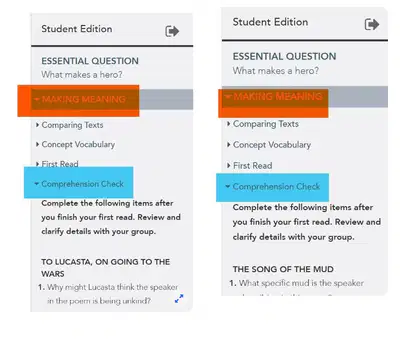
After the First Read
After you read your selected poems, it is recommended that you stop and complete the comprehension questions (1-3) on page 80 (Poetry Collection 1) or 90 (Poetry Collection 2) of your myPerspectives workbook for each poem to ensure you comprehended the poems and are thinking deeply about what you just read. I will not be collecting this work, so it is technically optional for you to complete.
*If using the digital textbook linked here instead of your physical workbook, the comprehension questions can be accessed via the sidebar on the right.
From yesterday's lesson:
4
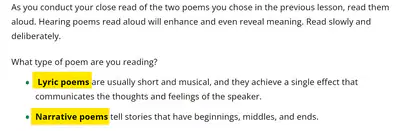
We will now briefly revisit the four poems we read yesterday in our e-text. As you encounter the poems, considering whether each is a lyric or a narrative poem.
5
Multiple Choice
Fill in the blanks in the following sentence based on the choices below.
"To Lucasta, on Going to the Wars," "The Song of the Mud," and "Dulce et Decorum Est" are all ___ poems, whereas "The Charge of the Light Brigade" is a ___ poem.
narrative; lyric
lyric; lyric
lyric; narrative
6
Match
Poets use sound in many different ways, and the way a poet uses sound is called a sound device. Match the sound devices with their examples below (definitions will be confirmed on the following slide). Next, please review your poems and mark details that reveal the sound qualities of the poems you chose to read/listen to yesterday.
The sinister, sly serpent hissed scarily.
Dressed in black, her name is Mack, she has the sharpness of a tack.
"Tomorrow, and tomorrow, and tomorrow/creeps in..."
alliteration
rhyme
repetition
alliteration
rhyme
repetition
7
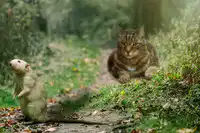

Rhyme is the similarity of sound between words or the endings of words, especially when these are used at the ends of lines of poetry.
a hungry cat
waited for a rat
Rhyme
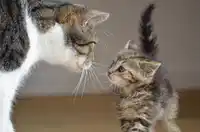
Repetition is the repeating of the same words, phrases, or ideas a few times to make an idea clearer and more memorable.
big cat
small cat
young cat
old cat
Repetition
Alliteration is the occurrence of the same letter or sound at the beginning of adjacent or closely connected words.
the cunning cat caught the rat
Alliteration
Analyze the Sound of a Poem
8


W
O
W
W
I
E
!
Did anyone see the Aurora Borealis last night?
9
Word Cloud

Typing A-I (letters today instead of numbers), which Strange Planet comic excerpt aligns with you today?
10
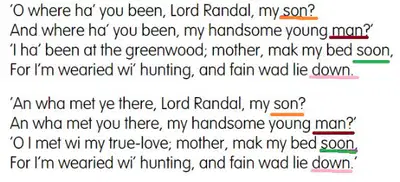
In a previous lesson, you learned about lines and stanzas. A refrain is a line or stanza that is repeated at regular intervals to emphasize the most important ideas and structure rhythm. When a poet changes the repeated line slightly, it is called incremental repetition.
Incremental repetition can be seen mostly in English and Scottish poems. This technique provides narrative progression or adds suspense. Look at the example on the right.
Incremental Repetition
11
Open Ended
How does the use of incremental repetition impact a poem containing this device? Ex: "It makes a poem sound musical."
12
Themes
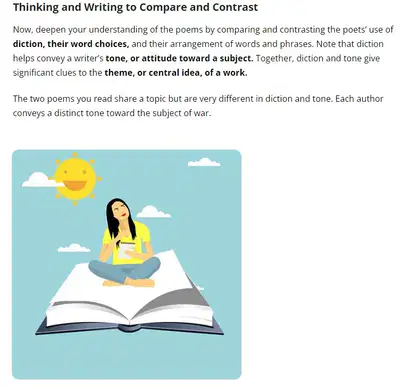
Writers use many strategies to develop the themes, or central ideas/messages they wish to convey. A theme is different from a subject. The subject of a poem might be named in a word or two, such as war, beauty, or time.
A theme is best expressed in a complete sentence. For example, a poem might express this theme about war: The stress of war can bring out both a person’s best and worst qualities. Even a short work can often contain two or more themes.
A writer’s diction, or word choice, helps establish the writer’s tone or attitude toward a given subject or audience. Analyzing diction can help you identify the themes a writer wants to share.
13
Folks in class, you may submit this lesson blank when we are done!

14
15
Open Ended
Think about all the poems we read over the last couple of days. They all focus on the topic of war, but their approaches are varied. How are these poems similar, and how do they differ?
16
Open Ended
Pre-long weekend check-in: Do you have any questions for me before class ends? Are you doing anything noteworthy this weekend?
Today's lesson is for practice/participation only, so if you are in class, you may submit it blank once class is over.
Show answer
Auto Play
Slide 1 / 16
SLIDE
Similar Resources on Wayground

10 questions
Review simple past tense
Presentation
•
12th Grade
14 questions
CAPTION TEXT
Presentation
•
12th Grade
14 questions
Presentation
Presentation
•
12th Grade
12 questions
Who, Which, Where
Presentation
•
12th Grade
12 questions
Procedure text
Presentation
•
12th Grade - University
11 questions
Teenager 5 Session 24: Pronunciation & Speaking
Presentation
•
KG
12 questions
SECOND CONDITIONAL
Presentation
•
12th Grade
13 questions
Mixed Conditional
Presentation
•
12th Grade
Popular Resources on Wayground
10 questions
HCS SCI 03 Summer School Assessment 1

Quiz
•
3rd Grade
15 questions
HCS SCI 05 Summer School Assessment 1 Review
Quiz
•
5th Grade
22 questions
Day 9 Equations and Inequalities Review
Quiz
•
9th Grade
10 questions
Writing and Identifying Ratios Practice
Quiz
•
5th - 6th Grade
7 questions
PYRAMID PERSPECTIVES part 1
Presentation
•
9th - 12th Grade
12 questions
Understanding the Fourth of July
Quiz
•
9th Grade
15 questions
Soccer World Cup Quiz Questions
Quiz
•
7th Grade