Function Introduction
Presentation
•
Mathematics
•
9th - 12th Grade
•
Hard

Joseph Anderson
FREE Resource
22 Slides • 18 Questions
1
Relations and Functions
by Jesus Molina
2
What are functions?
​
3
Multiple Choice
Determine if the relation is a function
Not a function, each input has more than one output
Yes it is a function, because each input has exactly on output
Not a function, input is equal to output
Yes it is a function, -1/2 is a fraction of 2
4
Multiple Choice
Does the graph represent a function?
Yes, because the vertical line test shows there are no repeating input values
No, because the vertical line test shows there are repeating input values
5
Multiple Select
Which among the following is a function?
All of the above
6
What is Domain and Range?
​
7
Examples of Domain and Range with graph and algebraic function
.
8
Next example...
.
9
Last example
.
10
Things to notice...
On the three previous examples you are able to see the following three components:
1. The algebraic representation on the left ex. 1/x
2. A table of values with you independent input on the left "x" and your dependent value on the right "y"
3. The graphical representation "the picture" of the function covering points from both sides of "0" meaning the immediate positive and negative values around the zero "0"
11
Multiple Choice
What is the domain of a relation?
the set of all x-values
the set of all y-values
12
Multiple Choice
Which is the set of all y-values or the outputs?
Domain
Range
Relation
Function
13
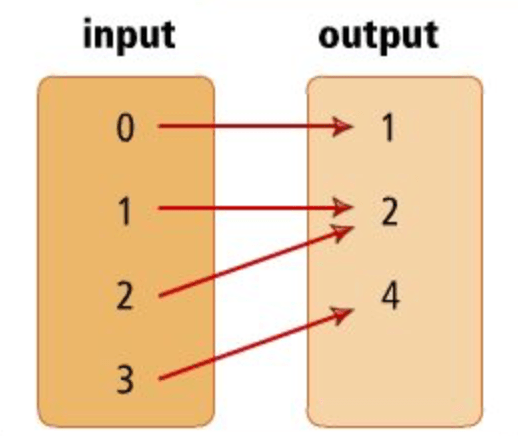
Multiple Choice
What is the range of the mapping?
{1, 2, 4}
{0, 1, 2, 3}
{0, 3}
{1, 4}
14
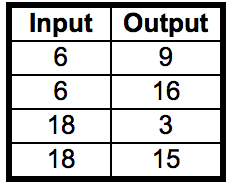
Multiple Choice
What is the domain of the relation shown in the table?
{12}
{6, 18}
{3, 9, 15, 16}
{13}
15
Analyzing the Parent Functions
Each parent function, as in the "basic" beginning function before any kind of transformation of dilation, has seven key attributes that makes them unique:
1. Their individual algebraic representation
2. The graph
3. Their Domain and Range
4. Their x and y intercepts
5. Possible Symmetries
6. Asymptotic Behavior
7. Maximum and Minimum values.
16
Exmaples of the parent functions covered during this class
.
17
Examples part 2...
.
18
Examples Part 3...
.
19
Examples part 4...
.
20
21
22
So...
There are a couple of ways to write domain and range:
1. Sentence form i.e. All real numbers
2. Symbolic form {x:}
3. Inequalities 0<x<5
4. Brackets and paranthesis (0,9]
5. Combinations (0,2) u (3,9)
We will further explore each method as we progress in the class.
23
.
24
Now, let's check for understanding
25
Multiple Choice
R: {0, 1, 2, -4}
R:{-4, -3, 1}
R:{1, -3, -4}
R: {1, -3, -4, 1}
26
Multiple Choice
27
Multiple Choice
28
Multiple Choice
29
Lets stop for a second because this is a good example.
The circle here is a great example of "part of" but "not included" because you "need it" as a place holder like "it's around here but not here." So, to describe the number of the circle you would use < or > and to describe the number with the dot you would use ≥ or ≤
30
Multiple Choice
31
Multiple Choice
What is the RANGE of this graph?
y < -3
y ≤ -3
y > 1
y ≥ 1
32
Multiple Choice
33
So what happens when we apply functions to real life situations?
34
35
Let's try so more graphs and situations with restrictions.
36
Multiple Choice
What is the domain of the graph?
[-3, 3]
(3, -3]
(-3, 3)
(2, 10]
37
Multiple Choice
A holiday church's meal costs $12.50 a person plus a delivery fee of $30. The equation is: f(x)=30+12.5x, where x is the number of hungry people. If there are 15 people in the church, what is the domain?
0, 1, 2, 3, 4, 5, 6, 7, 8, 9, 10, 11, 12, 13, 14, 15
0, 42.50, 55, 67.50, 80, 92.50, 105, 117.50, ....
None of the above.
38
Multiple Choice
Leslie's car travels about 25 miles per gallon of gas. Her car needs 14 gallons of gas to be full. What is a reasonable domain?
x≥25
0≤y≤14
x≤14
0≤x≤14
39
Multiple Choice
Speedy Boat Rental charges a $15 deposit fee plus $2 for each hour of use to rent a paddle boat. The equation: C=2h+15. If Frank has $33 to spend, what is the domain of the situation?
0 < x < 9
0, 1, 2, 3, 4, 5, 6, 7, 8, 9
15, 17, 19, 21, 23, 25, 27, 29, 31, 33
0 < y < 33
40
Alright! we will further discuss the topic of "restrictions" tomorrow when we work on inverse functions.
Make sure to complete the assignment on Step 3.
Relations and Functions
by Jesus Molina
Show answer
Auto Play
Slide 1 / 40
SLIDE

Similar Resources on Wayground
34 questions
7.4 Special Parallelograms and 7.5 Trapezoids and Kites
Presentation
•
9th - 12th Grade
34 questions
4.1-4.3 Review
Presentation
•
9th - 12th Grade
32 questions
Graphing Rational Functions
Presentation
•
10th - 12th Grade
33 questions
DNA/RNA terms part 1
Presentation
•
9th - 12th Grade
35 questions
Welcome Back
Presentation
•
9th - 12th Grade
34 questions
8/25 Review Unit 1 - Factoring (1 of 2)
Presentation
•
9th - 12th Grade
35 questions
Alg1 Lesson 3.2: Area Models for Quadratic Functions
Presentation
•
9th - 12th Grade
35 questions
Review of Graphing Quadratics
Presentation
•
9th - 12th Grade
Popular Resources on Wayground
20 questions
Math Review
Quiz
•
3rd Grade
15 questions
Fast food
Quiz
•
7th Grade
20 questions
Context Clues
Quiz
•
6th Grade
20 questions
Inferences
Quiz
•
4th Grade
19 questions
Classifying Quadrilaterals
Quiz
•
3rd Grade
20 questions
Figurative Language Review
Quiz
•
6th Grade
20 questions
Equivalent Fractions
Quiz
•
3rd Grade
10 questions
Identify Fractions, Mixed Numbers & Improper Fractions
Quiz
•
3rd - 4th Grade
Discover more resources for Mathematics
10 questions
Test Your Knowledge with 15 Fun Trivia Questions
Interactive video
•
6th - 10th Grade
21 questions
Factoring Trinomials (a=1)
Quiz
•
9th Grade
25 questions
Final Exam Review
Quiz
•
8th - 9th Grade
23 questions
Cumulative Vocabulary Practice
Quiz
•
9th - 11th Grade
25 questions
Complementary and Supplementary Angles
Quiz
•
7th - 10th Grade
21 questions
Quadratic Unit Review
Quiz
•
9th Grade
31 questions
IM1: Naming <'s, Transform. & Tri Congruence Final Review #3
Quiz
•
9th - 10th Grade
30 questions
Geometry Semester 2 Final
Quiz
•
10th Grade