Rate of Reactions
Presentation
•
Science
•
8th Grade
•
Hard

Joseph Anderson
FREE Resource
17 Slides • 31 Questions
1
2
Instructions
Creating notes
In this lesson you will try the questions first and then move on to the notes. Use educated guesses and take note of whats being asked so you can better take down the information you need later in the slides
Copy down the headings and notes on each slide. Always highlight key information. Make sure to label your diagrams.
When answering the questions use your notes and your book Chapter 20 for help
3
Multiple Choice
Which of the following would increase the rate of a chemical reaction?
Freezing the chemicals
Increasing the temperature of the reagents
Removing a catalyst
Using less chemicals
4
Multiple Choice
Which of the following would increase the rate of a chemical reaction?
Removing a catalyst
Diluting the chemicals
Decreasing the temperature
Adding a catalyst
5
Multiple Choice
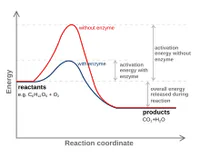
Which colour on the graph would represent the solution with the higher temperature?
Red
Blue
None
Both
6
Multiple Choice
Which colour on the graph would represent the solution with a catalyst?
Red
Blue
Both
None
7
Multiple Choice
Which of the following would increase the rate of CO2 made using marble chips and HCl?
Lowering the temperature
Crushing the marble chips
Using less acid
Using bigger marble chips
8
Multiple Choice
Which of the following lines represents the chemical with the lower concentration?
Red
Blue
Both
None
9
Multiple Choice
A chemical reaction in which energy is absorbed is ______________.
an endothermic reaction
an exothermic reaction
a single replacement reaction
a double replacement reaction
10
Multiple Choice
A chemical reaction in which energy is released or removed is ______________.
endothermic
exothermic
11
Multiple Choice
12
Multiple Choice
13
Multiple Choice
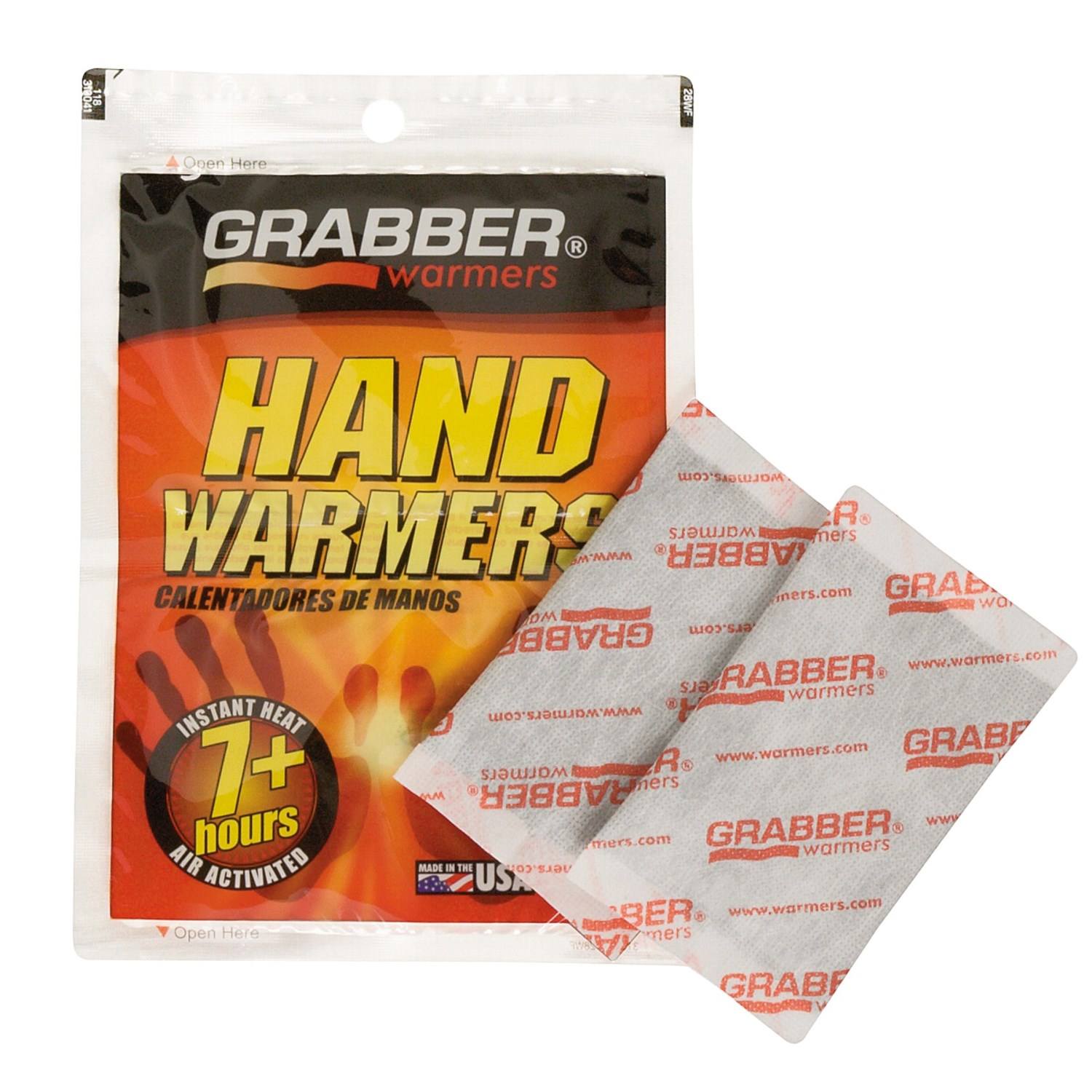
_____ reactions usually feel hot!
endothermic
exothermic
14
Multiple Choice
____ reactions usually feel cold.
endothermic
exothermic
15
Multiple Choice
The graph above is from which type of reaction?
Endothermic reaction
Exothermic Reaction
16
Multiple Choice
The graph above is from which type of reaction?
Endothermic reaction
Exothermic reaction
17
Multiple Choice
Solid --> liquid --> gas is what type of reaction?
endothermic
exothermic
catalytic
inhibited
18
Multiple Choice
19
Multiple Choice
What does a catalyst do in a chemical reaction?
Increases the activation energy
Decreases the activation energy
Increases the temperature
Decreases the temperature
20
Multiple Choice
What is the energy that the reactants need in order to collide successfully called?
Activation energy
Kinetic energy
Chemical energy
Potential energy
21
Multiple Choice
What factor can be used to control the rate of a reaction by increasing the surface area of a solid reactant?
Increasing the concentration of a reactant in solution
Increasing the surface area of a solid reactant
Increasing the energy (heat)
Increasing the pressure of a gaseous reactant
22
Multiple Choice
What is the concept of energy as the ability to do work?
Ability to do work over time
Ability to do work over distance
Ability to do work over area
Ability to do work over volume
23
Multiple Choice
What factor affects the rate of a reaction by changing the concentration of a reactant in solution?
Increasing the temperature
Increasing the pressure of a gaseous reactant
Increasing the surface area of a solid reactant
Increasing the concentration of a reactant in solution
24
Multiple Choice
What is the concept of activation energy in a chemical reaction?
Energy released during a reaction
Energy absorbed during a reaction
Energy required to initiate a reaction
Energy stored in the reactants
25
Multiple Choice
A temperature increase causes the particles ......
to slow down
move faster
collide higher
in the right order
26
Multiple Choice
How does a catalyst work in speeding up a reaction?
By lowering the activation energy or reaction
by giving them more energy
by making them more available
27
Multiple Choice
28
Multiple Choice
The ______________is required to break the bonds of the reactants.
Carbonic energy
Activation energy
Plutonic energy
Energi Gaib
29
Multiple Choice
30
Multiple Choice
31
Multiple Choice
Which of the following would increase the rate of CO2 made using marble chips and HCl?
Lowering the temperature
Crushing the marble chips
Using less acid
Using bigger marble chips
32
Multiple Choice
Which graph shows the effect of increasing temperature on the rate of reaction of calcium carbonate with dilute hydrochloric acid?
33
Multiple Choice
34
35
What is the ‘rate of reaction’?
The rate of a chemical reaction tells us how quickly a chemical reaction happens.
One of the slowest rates of reaction is the rusting of iron. A really fast reaction is
an explosion, which is all over in a fraction of a second.
36
What is the ‘rate of reaction’?
In industry it is very
important to know how
long it will take for a
reaction to occur.
Reactions can take
varying amounts of time
from start to finish, so
chemists measure how
many reactants are used
up and how much
product is formed in a
certain time.
Rate at which the reactants are
used up or the product is formed
37
What is particle theory?
During a chemical reaction the particles in
the reactants are moving all the time. The
rate of a reaction simply depends on how
often and how hard the reacting particles
collide with each other.
For the particles to react they must collide
with enough energy to break the bonds in
the molecules. Once the bonds are broken
the atoms can rearrange to make the
products.
Increasing the rate of a reaction involves
increasing the number of successful collisions
between the reacting particles. There are a
number of factors that affect the behaviour
of particles and have an overall effect.
Particle theory – an
unsuccessful collision
Particle theory – a
successful collision
38
What happens to the rate of the reaction when you stir
the solution?
Stirring the solution keeps the reactant particles in motion, increasing the chances
of collisions and increasing the rate of reaction.
39
What happens to the rate of reaction as you increase
the temperature?
When you raise the temperature the particles have more energy so they move
around more quickly. This results in more collisions in a certain time, and so
reactions get faster as we raise the temperature.
As particles get more energy they move at a greater speed,
and so there are more collisions and reactions get faster
Reaction at 30°C
Reaction at 40°C
40
What happens to the rate of reaction when you increase
the surface area?
Surface area is the measure of how much surface (of the reactants) is exposed.
When a large piece of solid material is cut into smaller pieces its surface area is
increased. The smaller the particle size, the greater the surface area on which the
reaction takes place, and so the faster the reaction.
You increase the surface area of the potato each time you cut it into smaller pieces
41
What happens to the rate of reaction when you increase
the surface area?
The effect of increasing surface area on the rate of reaction: the steepest part of
the curve is at the start, hence the fastest part of the reaction, but the curve
becomes less steep as the reaction slows down and eventually becomes flat,
indicating the end of the reaction
42
What happens to the rate of reaction as you increase
the concentration of the acid?
When you increase the concentration, you increase the number of particles,
which results in more collisions in a certain time and so you get an increase in
rate of reaction (that is, the reaction gets faster).
43
What happens to the rate of reaction as you increase
the concentration of the acid?
The effect of increasing concentration on the rate of reaction: the reaction is
fastest at the start (steep curve), gradually becoming slower as the reaction
proceeds. The curve on the graph goes flat when the reaction is complete
44
Light sticks
Light sticks produce light because of a chemical reaction. Dropping a light stick
into hot water makes it glow more intensely, demonstrating that the reaction
occurs faster at higher temperatures.
45
What is the effect of using a catalyst?
Transition metals lie between group 2 and group 3 in the periodic table. Some
well-known transition metals are iron, copper, chromium, nickel and gold.
Transition metals and their compounds are important catalysts. (A catalyst is a
substance which alters the rate of a reaction without getting used up.) How will
a catalyst affect the rate of reaction?
46
What is the effect of using a catalyst?
Activation energy is the
minimum amount of
energy that reactant
particles must
have in order for them
to react.
When you add a catalyst
it lowers the activation
energy; this makes it
easier for the particles to
react, so there is an
increase in the rate of
reaction.
How a catalyst works
47
Biochemical reactions
There are several factors that can affect the rate of biochemical reactions, such as,
respiration and photosynthesis (see chapter 10). The main factors that affect the
rate of photosynthesis are light intensity, carbon dioxide and temperature.
48
Photo credits
•Shutterstock
•Science Photo Library
•Michael Philips
•Compuscript
Show answer
Auto Play
Slide 1 / 48
SLIDE

Similar Resources on Wayground
38 questions
Life Cycle of a Star
Lesson
•
8th Grade
45 questions
Human impacts and Global warming
Lesson
•
8th Grade
42 questions
Compressing Liquids - Hydraulics
Lesson
•
8th Grade
44 questions
Physical Properties of Stars
Lesson
•
8th Grade
42 questions
1-Chemistry Basics Lesson
Lesson
•
8th Grade
45 questions
Characteristics of Stars
Lesson
•
8th Grade
42 questions
Andrew Jackson
Lesson
•
8th Grade
44 questions
4/12 - Blitz - Physics
Lesson
•
8th Grade
Popular Resources on Wayground
15 questions
Fractions on a Number Line
Quiz
•
3rd Grade
14 questions
Boundaries & Healthy Relationships
Lesson
•
6th - 8th Grade
13 questions
SMS Cafeteria Expectations Quiz
Quiz
•
6th - 8th Grade
20 questions
Equivalent Fractions
Quiz
•
3rd Grade
25 questions
Multiplication Facts
Quiz
•
5th Grade
12 questions
SMS Restroom Expectations Quiz
Quiz
•
6th - 8th Grade
20 questions
Main Idea and Details
Quiz
•
5th Grade
10 questions
Pi Day Trivia!
Quiz
•
6th - 9th Grade
Discover more resources for Science
20 questions
Cell Organelles and Functions
Quiz
•
6th - 8th Grade
10 questions
Exploring the Layers of the Earth
Interactive video
•
6th - 10th Grade
21 questions
Waves and Wave Properties
Quiz
•
6th - 8th Grade
20 questions
Newton's Laws of Motion
Quiz
•
8th Grade
20 questions
Heredity Punnett square review
Quiz
•
8th Grade
13 questions
Plate Tectonics and Earth's Structure
Lesson
•
6th - 8th Grade
16 questions
Pedigree
Quiz
•
8th Grade
10 questions
Exploring Heat Transfer: Conduction, Convection, and Radiation
Interactive video
•
6th - 8th Grade