
Lesson Wave Terminology

Presentation
•
Science
•
7th Grade
•
Hard

Joseph Anderson
FREE Resource
16 Slides • 9 Questions
1

MS-PS4-1. Use mathematical representations to describe a simple model for waves that includes how the amplitude if a wave is related to the energy of a wave.
MS-PS4-2. Develop and use a model to describe that waves are reflected, absorbed or transmitted through varius materials.
2
Homework Check

3
Open Ended

What do you already know about waves?
4

Learning Outcomes
Key Words
Wave 波 (bō)
Medium 介质 (jièzhì)
Oscillate 振荡 (zhèndàng)
Equilibrium 平衡 (pínghéng)
Describe a wave and define important wave terminology.
5
What is a wave?
Explain how a wave moves using the terms medium (介质), oscillate (振荡) and equilibrium (平衡).
What does a wave transfer as it moves?
Compare and contrast mechanical and electromagnetic waves.
How might life on Earth be different if light waves were mechanical waves?

6
Waves are everywhere. In fact, you observe many different kinds of waves every day.
You see waves that move through matter, such as those that cause water to rise and sink in the ocean.
You feel waves such as those that produce heat and hear waves such as those that produce sound.
What is a wave?


7
A wave is a regular pattern of motion created by a disturbance.
A wave can move through matter. Some waves can move through a vacuum (empty space).
A wave transfers energy as it moves from one place to another.
What is a wave?


8
You can “see” energy carried by a wave traveling through matter. The movement of a wave is actually movement of energy through the matter.
In Jurassic Park, the water moves due to a vibratory disturbance created from the T-Rex. This creates waves that travel through the water. The movement of the waves is actually movement of energy.
What is a wave?

9
Most waves travel through a medium. A medium is a substance (gas, liquid or solid) through which a wave travels.
When a wave travels through a medium, it causes particles in that substance to oscillate.
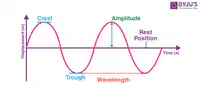
An oscillation is a repeating and regular vibration. It is a “back and forth” motion across a point, called equilibrium. Equilibrium is also known as the rest position.
What is a wave?


10

11
A wave does NOT transfer matter.
The wave causes particles to move up and down or left and right. However, they always return to equilibrium (or rest) once the wave has passed.
What is a wave?


12

13
14
Multiple Choice

What is a wave?
The transfer of matter from one location to another
A regular pattern of motion created by a vibratory disturbance
An irregular pattern of motion created by a vibrating object
An irregular movement of energy across a vacuum
15
Multiple Choice

What is an oscillation?
A regular motion that happens only once
A regular and repeating motion
An irregular motion that occurs only once
An irregular and repeating motion
16
Multiple Choice

A periodic wave...
Travels at a constant speed only
Travels with regular oscillations only
Travels for only a short amount of time
Travels at a constant speed AND with regular oscillations
17
Open Ended

What is the difference between a mechanical and electromagnetic wave?
18
What is the difference between a mechanical and electromagnetic wave
A mechanical wave is created by a mechanical motion or vibration. An electromagnetic wave is created by oscillations of electric and magnetic fields
19
20

21

Complete your homework.
You will be tested next class!
Homework
22
Poll

How would you rate your effort this class?
Excellent
Good
Okay
Poor
Awful
23
Poll
How difficult was today's class?
Very Easy
Easy
Okay
Hard
Very Hard
24
Open Ended

Tell a joke if you have one (school appropriate)
25
Open Ended

Ask a question
MS-PS4-1. Use mathematical representations to describe a simple model for waves that includes how the amplitude if a wave is related to the energy of a wave.
MS-PS4-2. Develop and use a model to describe that waves are reflected, absorbed or transmitted through varius materials.
Show answer
Auto Play
Slide 1 / 25
SLIDE
Similar Resources on Wayground

20 questions
Crash Course: Genetics - Lost and Found
Presentation
•
7th Grade
20 questions
Quiz Recovery - Carbon Cycle
Presentation
•
6th - 7th Grade
20 questions
Solids, Liquids, Gases
Presentation
•
7th - 8th Grade
20 questions
Thermal Energy 2
Presentation
•
7th Grade
20 questions
Cell Review
Presentation
•
7th Grade
19 questions
Forces
Presentation
•
7th Grade
18 questions
Secondary Succession
Presentation
•
7th Grade
21 questions
Element ,compound and mixture
Presentation
•
7th Grade
Popular Resources on Wayground
10 questions
Safety Day 2026 – Student Review

Quiz
•
9th Grade
21 questions
Continents and Oceans
Quiz
•
6th Grade
20 questions
Parts of Speech
Quiz
•
5th Grade
16 questions
Subject & Predicate
Quiz
•
5th Grade
25 questions
Multiplication Facts
Quiz
•
5th Grade
12 questions
Map Skills
Quiz
•
3rd Grade
22 questions
Continents and Oceans
Quiz
•
5th Grade
15 questions
Rounding Decimals
Quiz
•
5th Grade
Discover more resources for Science
10 questions
Exploring Chemical and Physical Changes

Interactive video
•
6th - 10th Grade
14 questions
Week 1 Falcon Flex Fast and Curious
Quiz
•
7th Grade
42 questions
Explore Plate Tectonics and Boundaries
Quiz
•
7th Grade
21 questions
Waves and Wave Properties
Quiz
•
6th - 8th Grade
16 questions
Photosynthesis and Cellular Respiration Review
Quiz
•
7th Grade
20 questions
Food Webs + Energy Pyramids
Quiz
•
7th Grade
9 questions
Biology: Cell Structure
Interactive video
•
7th Grade
8 questions
Diffusion and Osmosis Review
Presentation
•
6th - 8th Grade