
Mass and Kinetic Energy
Presentation
•
Physics
•
6th - 12th Grade
•
Hard

Joseph Anderson
FREE Resource
5 Slides • 21 Questions
1
KE, PE, ME
Calculating Kinetic, Potential, and Total Mechanical Energy
2
Review: Kinetic Energy
KE = (0.5)(mass)(velocity2)
So kinetic energy is based on MASS and SPEED,
The unit for energy is J for Joules.
3
Multiple Choice
The faster an object moves, the ________ kinetic energy it has.
more
less
none of the above
all of the above
4
Multiple Choice
Which affects kinetic energy?
mass
speed
height
mass and speed
mass and height
5
Multiple Choice
What is the unit for energy?
kilogram (kg)
meter (m)
Newton (N)
Joule (J)
6
Multiple Choice
Calculate the kinetic energy of a moving 4 kg object travelling at a velocity of 1 m/s.
2 J
4 J
20 J
40 J
7
Multiple Choice
What is the mass of a ball with a kinetic energy of 2000J, rolling at 10m/s?
50 kg
400 kg
40 kg
10,000 kg
8
Review: Gravitational Potential Energy
PE = (mass)(9.8)(height)
So gravitational potential energy is based on MASS and HEIGHT.
The unit for energy is J for Joules.
9
Multiple Choice
Choose the answer that has the most GRAVITATIONAL POTENTIAL energy.
a 500 kg boulder on a 5 meter hill
a 500 kg boulder on a 10 meter hill
a 500 kg boulder on a 20 meter hill
10
Multiple Choice
What two factors affect GRAVITATIONAL POTENTIAL energy?
mass
height
speed
mass and speed
mass and height
11
Multiple Choice
How could you increase the object's gravitational potential energy (GPE) without changing its distance from the ground (height)?
Decrease the object's mass
Increase the object's height
Increase the object's mass
Decrease the object's height
12
Multiple Choice
Which would have the LEAST gravitational potential energy (GPE)?
A ball sitting on the ground
Moon viewed from the Earth
An airplane flying 30,000 feet above the ground
A rock sitting on top of Mt. Everest
13
Multiple Choice
If the height is zero, gravitational potential energy
is zero
at its maximum
100J
200J
14
Multiple Choice
How much mass does a student have if they stand at a height of 1 meter and have 500 J of potential energy?
9.8 m/s^2
51 kg
10000 kg
490 kg
15
Review: Mechanical Energy
The total Mechanical Energy of a system is the potential energy + kinetic energy.
ME = PE + KE
The Law of Conservation Energy = The Mechanical Energy always stays constant.
The unit for energy is J for Joules.
16
Multiple Choice
At which point in the picture must the cart have the most MECHANICAL energy?
Point 1
Point 2
Point 3
They would all be the same
17
Multiple Choice
What is the MECHANICAL energy of the roller coaster car?
100 joules
50 joules
2500 joules
1 joule
18
Multiple Choice
What is the total Mechanical energy of a ball that has 2500 J of potential energy and 1000 J of kinetic energy?
2500 J
1000 J
1500 J
3500 J
19
Total Mechanical Energy is Conserved
If an object is at its highest point but not moving, then all the energy is potential. When it goes down, the potential energy is converted to kinetic energy.
The kinetic energy at a height of 0 will be equal to the potential energy the object had at the top.
PE initial = KE final
20
Multiple Choice
A 2 kg television is at a height of 1 meter. This makes its potential energy at the top 19.6 J. How much kinetic energy will it have at the bottom of a fall to the floor?
19.6 J
196 J
2 J
9.8J
21
Multiple Choice
You hold a 5 kg ball from a height of 2 m. How much mechanical energy does it have?
10 J
7 J
98 J
25 J
22
Multiple Choice
You drop a 5 kg ball from a height of 2 m. Just before it reaches the ground, how much kinetic energy does it have?
10 J
98 J
7 J
20 J
23
Multiple Choice
24
Multiple Choice
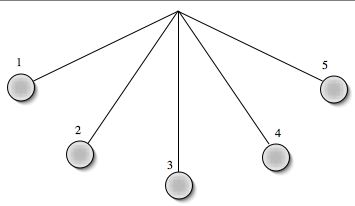
When a pendulum swings, at which point is potential energy at its greatest?
1 and 5
2 and 4
3
4 and 5
25
Multiple Choice
Where is kinetic energy at its maximum?
a
b
c
d
26
Multiple Choice
If a ball tossed into the air has a maximum gravitational potential energy of 5.75 joules, what is its maximum kinetic energy in the same toss?
5.75 joules
11.14 joules
2.88 joules
7.93 joules
KE, PE, ME
Calculating Kinetic, Potential, and Total Mechanical Energy
Show answer
Auto Play
Slide 1 / 26
SLIDE

Similar Resources on Wayground
20 questions
Electromagnetic Waves
Lesson
•
6th Grade - University
22 questions
Endothermic and Exothermic Reactions
Lesson
•
6th Grade - University
22 questions
Revision Perfect Tense with AVOIR
Lesson
•
5th - 12th Grade
24 questions
Cell Structure and Function
Lesson
•
7th - 12th Grade
22 questions
Earthquakes
Lesson
•
6th Grade - University
20 questions
Motion and Speed Lesson
Lesson
•
7th - 12th Grade
20 questions
Renewable and Nonrenewable Resources
Lesson
•
6th Grade - University
18 questions
Water on Earth
Lesson
•
6th Grade - University
Popular Resources on Wayground
10 questions
5.P.1.3 Distance/Time Graphs
Quiz
•
5th Grade
10 questions
Fire Drill
Quiz
•
2nd - 5th Grade
20 questions
Equivalent Fractions
Quiz
•
3rd Grade
15 questions
Hargrett House Quiz: Community & Service
Quiz
•
5th Grade
20 questions
Main Idea and Details
Quiz
•
5th Grade
20 questions
Context Clues
Quiz
•
6th Grade
20 questions
Inferences
Quiz
•
4th Grade
15 questions
Equivalent Fractions
Quiz
•
4th Grade
Discover more resources for Physics
17 questions
Newtons Laws
Quiz
•
8th Grade
20 questions
Measuring Speed, Distance, and Time Learning Check
Quiz
•
6th - 8th Grade
28 questions
Lenses
Quiz
•
10th Grade
25 questions
Newton's Laws of Motion
Quiz
•
9th Grade
20 questions
Friction and Gravity
Quiz
•
6th - 8th Grade
20 questions
Unit 10 - Acceleration Mini-Test
Quiz
•
9th Grade
32 questions
Quiz#2 Optics/EMS study guide
Quiz
•
8th Grade
10 questions
E-M Wave Formation
Quiz
•
11th Grade