Newton Secon by Jessica Freeman
Presentation
•
Science
•
8th Grade
•
Hard

Joseph Anderson
FREE Resource
27 Slides • 57 Questions
1
Newton's First Law of Motion...
Today, you will work with your group to complete this exploration. And thank you Chris Kesler @ keslerscience.com
2
Multiple Choice
3
12/1 - Newton's 2nd Law of Motion
4
Multiple Choice
A 20-N net force acts on an object with a mass of 2.0 kg. What is the object's acceleration?
10 m/s2
0.1 m/s2
40 m/s2
22 m/s2
5
Read It! Station Instructions
Each member of the group will read the passage and answer the questions from the task cards on the lab sheet in the Read It! section.
It is important to remember that the answers will come directly from the reading passage.
6
Review - Newton's 1st Law - Law of Inertia
An object at rest stays at rest,
An object in motion stays in motion,
Unless acted on by an unbalanced force.
7
Multiple Choice
8
Multiple Choice
9
The Law of Inertia...
Sir Isaac Newton was an English scientist famous for describing physics – the science of movement. Specifically, he formulated three laws of motion. This does not mean he invented the concepts of motion and gravity or the Earth’s downward pull. Rather, he studied forces, pushes, or pulls on objects that cause objects to change their speed and/or direction. Newton’s laws help explain an object’s motion after something exerts a force on it. Sometimes objects even resist forces that have been exerted upon them, which affects their motion as well.
10
Multiple Choice
What is Newton's First Law
F=ma
Every action has an equal and opposite reaction
An object at rest stays at rest, an object in motion stays in motion, unless acted on by an unbalanced force
Friction
11
Multiple Choice
12
Multiple Choice
A person is pushed forward into their seatbelt when a car suddenly stops
1st Law
2nd Law
3rd Law
13
Newton’s 1st Law states, “An object in motion continues in motion with the same speed and in the same direction unless acted upon by an unbalanced force.” The same is true of an object at rest – an object stays at rest until it is acted upon by an unbalanced force. Newton’s 1st Law is also called the Law of Inertia (pronounced inn-urr-shuh). All objects possess something called inertia, or their tendency to keep doing what they’re already doing and resist changes in motion. Without an unbalanced force, an object will maintain its state of motion or rest.
Did you know you have inertia when you ride in a car? A car’s passengers tend to experience the same motion as the vehicle; they accelerate as the car speeds up and decelerate as the car slows down. This is why it is so important to wear a seatbelt!
14
Multiple Choice
1st Law
2nd Law
3rd Law
All of the above
15
Multiple Choice
16
Multiple Choice
17
Imagine your car is moving forward at highway speeds, and then it collides with another vehicle. The other vehicle exerts an unbalanced force on yours, which causes your car to decelerate to rest abruptly. If you are belted in, your body will decelerate with the vehicle. However, imagine you are not wearing a seatbelt. What do you think happens? With nothing keeping you attached to the vehicle, you will not share the vehicle’s change in motion. Instead, your body’s inertia will cause it to continue moving forward at the same rate of motion and in the same direction, which could cause harm.
It’s a good thing we can study forces and motion in the world around us. Newton’s Laws help us understand how objects move, which helps us enjoy things like sports and roller coasters. But they also help keep us safe!
18
Multiple Choice
You are riding in a vehicle with a coffee cup on the dashboard while traveling 30 km/h. The vehicle makes a sudden stop to avoid hitting the car that has stopped in front of it. Which illustration best demonstrates what would happen to the coffee cup?
19
Multiple Choice
20
Multiple Choice
How does a continental plate demonstrate Newton's law of inertia?
A continental plate will continue to move until it cracks from the pressure applied by Earth's atmosphere.
A continental plate will continue to move until it crashes into or slides against another continental plate.
A continental plate will continue to move until it melts into molten rock from the heat of the Sun.
A continental plate will continue to move until it travels back to its original location on Earth's surface.
21
Multiple Choice
What would be another good title for this passage?
A.The Story of Isaac Newton
A.Newton’s 3 Laws
A.How Seatbelts Work
A.An Explanation of Newton’s 1st Law of Motion and Inertia
22
Multiple Choice
A steel ball is at one end of a box that is moving forward as shown. The box suddenly stops. According to Newton's first law, what happens to the steel ball just after the box stops?
Because of friction, the ball continues rolling forward at the same speed.
Because of friction, the ball rolls forward at an increase speed.
Because of inertia, the ball continues rolling forward at the same speed.
Because of inertia, the ball rolls forward at an increased speed.
23
Multiple Choice
24
Multiple Choice
Which of these best explains why the coin fell straight down into the cup instead of remaining on the index card?
The coin was at rest until the card was removed, so it tended to remain in the same location. Once the card was gone, the unbalanced force of gravity caused the coin to fall.
Moving the card applied an action force on the coin. Since the card was gone, gravity applied a reaction force on the coin.
The card had less mass than the coin, so a smaller force of gravity acted on the card. The larger force of gravity on the coin made it fall.
The acceleration of the coin falling into the cup was equal and opposite to the acceleration of the card.
25
Multiple Choice
Which of the following objects has the most inertia?
a pen
a bowling ball
a ping pong ball
a car
26
Multiple Choice
Marshall and his friends like to skateboard in an empty swimming pool. The picture below shows a cross-section of the swimming pool. Several points along Marshall's path have been labeled. At which point is Marshall's potential energy the greatest?
Point A
Point B
Point C
Point D
27
Multiple Choice
28
29
Multiple Choice
According to the article, what is one benefit of a seatbelt?
It decreases the passenger’s inertia.
It allows you to share the same motion as the vehicle.
It makes you fly out of the car when stopping.
It prevents gravity from affecting the passenger.
30
31
Multiple Choice
32
33
Watch It! Station Instructions
Watch the video and be ready to answer the questions on the next slides.
34
35
Multiple Choice
36
37
Multiple Choice
What is inertia?
Inertia is an object’s resistance to change in motion.
Inertia is anything that makes a moving object slow down or stop.
38
39
Multiple Choice
40
41
Multiple Choice
What is friction?
Friction is anything that makes a moving object keep going.
Friction is anything that makes a moving object slow down or stop.
42
43
Multiple Choice
Which of the following is the best example of Newton's First Law of Motion?
Jessica's body flies forward after she hits the brakes
Jessica drives a car
Jessica is at a road crossing
Jessica is sleeping
44
45
Multiple Choice
What will happen to an object if it is put into motion in space?
It will stop eventually due to friction.
It will continue to move until it is acted on by an unbalanced force.
It will speed up over time.
It will slow down over time.
46
47
Multiple Choice
48
49
Assess It! Station Instructions
Each member will answer the questions from the task cards...
50
51
Multiple Choice
52
53
Multiple Choice
Which force opposes motion between two surfaces in direct contact?
inertia
mass
friction
acceleration
54
55
Multiple Choice
1st
Law of Motion
2nd
Law of Motion
3rd
Law of Motion
56
57
Multiple Choice
Newton’s 1st Law applies to…
only moving objects
only nonmoving objects
both moving and nonmoving objects
no objects, except those in space
58
59
Multiple Choice
1st
Law of Motion
2nd
Law of Motion
3rd
Law of Motion
60
61
Multiple Choice
You push a sofa, but you can’t get it to move by yourself. Why?
You have more inertia than the sofa.
There is no inertia because the sofa is not moving.
Your force is stronger than the friction between the sofa and the floor.
The sofa’s inertia is greater than your applied force.
62
63
Multiple Choice
64
Multiple Choice
The ______ the mass of an object, the ______ force it will take to accelerate.
smaller, more
greater, more
greater, less
smaller, less
65
Multiple Choice
66
Multiple Choice
67
Multiple Choice
68
Multiple Choice
69
Multiple Choice
70
Multiple Choice
If both rocks are pushed with the same amount of force, which rock would accelerate more?
The 400kg Rock because it weighs more.
The 40kg rock because it weighs less.
71
Multiple Choice
72
Multiple Choice
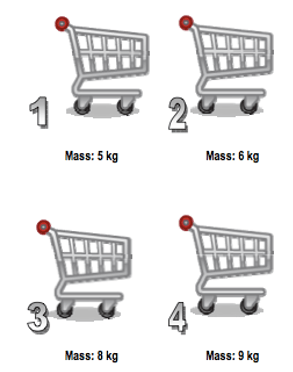
Which grocery basket will have the least acceleration, if both grocery baskets are pushed with the same amount of force?
The one without groceries because it has more mass.
The one with groceries because it has more mass.
The one without groceries because it has the least mass.
The one with groceries because it has least mass.
73
Multiple Choice
74
Multiple Choice
If the man pushes with an equal amount of force, which object will accelerate more?
Car because it has more mass
Lawnmower because it has less mass
Car because it has less mass
Lawnmower because it has more mass
75
Multiple Choice
76
Multiple Choice
77
Multiple Choice
78
Multiple Choice
79
Multiple Choice
What is the net force acting on this box?
8N to the right
5N to the left
5N to the right
9N to the left
80
Multiple Choice
81
Multiple Choice
What is the net force acting on this box?
16N to the right
4N to the left
0N
8N to the left
82
Multiple Choice
83
Multiple Choice
Which of these are examples of Newton's First Law:
1. A stationary object with no outside force will not move
2. An astronaut who has their screwdriver knocked into space will see the screwdriver continue on at the same speed and direction forever
3. If you use the same force to push a truck and a car, the car will have more acceleration than the truck because the car has less mass
4. An object at rest stays at rest
1,3,4
1,2,4
2,3,4
1,2,3
84
Multiple Choice
How can you use Newton’s first law to stop your skateboard?
Once the skateboard starts moving, it would keep moving at the same speed and in the same direction if not for another unbalanced force. That force is gravity between the skateboard and the pavement. The force of gravity is unbalanced because you are no longer pushing with your foot to keep the skateboard moving. That’s why the skateboard stops.
Once the skateboard starts moving, it would keep moving at the same speed and in the same direction if not for another unbalanced force. That force is friction between the skateboard and the pavement. The force of friction is unbalanced because you are no longer pushing with your foot to keep the skateboard moving. That’s why the skateboard stops.
Newton's First Law of Motion...
Today, you will work with your group to complete this exploration. And thank you Chris Kesler @ keslerscience.com
Show answer
Auto Play
Slide 1 / 84
SLIDE

Similar Resources on Wayground
79 questions
Unit 2 Review Cell Processes
Lesson
•
9th Grade
80 questions
Unit 1- Economic Systems
Lesson
•
9th Grade
80 questions
Evolution Intro and Natural Selection
Lesson
•
9th Grade
80 questions
Classification Practice
Lesson
•
9th Grade
77 questions
Ch.1 LA Culture Sect. 2 Festivals
Lesson
•
8th Grade
75 questions
Identification of Minerals
Lesson
•
8th Grade
77 questions
8.PS.2-6-Lesson 3: Applying Newton’s Third Law – Motion and Reac
Lesson
•
8th Grade
76 questions
11/29 Force & Motion Review
Lesson
•
8th Grade
Popular Resources on Wayground
8 questions
Spartan Way - Classroom Responsible
Quiz
•
9th - 12th Grade
15 questions
Fractions on a Number Line
Quiz
•
3rd Grade
14 questions
Boundaries & Healthy Relationships
Lesson
•
6th - 8th Grade
20 questions
Equivalent Fractions
Quiz
•
3rd Grade
3 questions
Integrity and Your Health
Lesson
•
6th - 8th Grade
25 questions
Multiplication Facts
Quiz
•
5th Grade
9 questions
FOREST Perception
Lesson
•
KG
20 questions
Main Idea and Details
Quiz
•
5th Grade
Discover more resources for Science
22 questions
Phases of the moon
Quiz
•
8th Grade
20 questions
Waves and Wave Properties
Quiz
•
6th - 8th Grade
8 questions
Amoeba Sister Asexual vs Sexual Reproduction
Interactive video
•
8th Grade
10 questions
Exploring the Rock Cycle: Types and Formation
Interactive video
•
6th - 8th Grade
20 questions
8th Grade Science STAAR Review
Quiz
•
8th Grade
22 questions
Newton's Laws of Motion
Lesson
•
8th Grade
9 questions
Seasons and Earth's Tilt
Lesson
•
6th - 8th Grade
10 questions
Exploring the Evolution of the Peppered Moth
Interactive video
•
6th - 10th Grade