
Orbit and Seasons
Presentation
•
Science
•
9th - 12th Grade
•
Hard

Joseph Anderson
FREE Resource
8 Slides • 21 Questions
1
2
3
Multiple Choice
4
Multiple Choice
5
Multiple Choice
6
Multiple Choice
7
Multiple Choice
8
Multiple Choice
9
Multiple Choice
10
Multiple Choice
Which diagram best explains why the sun appears to move across the sky each day?
11
12
13
14
15
16
Multiple Choice
On which of the following days the day and night are of equal duration throughout the world?
28th March and 21st September
21st March and 23rd September
21st June and 23rd December
23rd March and 22nd December
17
Multiple Choice
During the month of June ______ is inclined towards the sun.
Moon
Earth
South Pole
North Pole
18
Multiple Choice
During the equinoxes, the sun's rays are perpendicular to the earth's axis. Which of the following depicts a perpendicular angle?
19
Multiple Choice
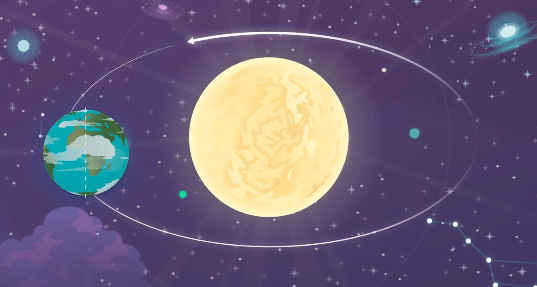
The Earth revolves around the sun in a _______________ direction
clockwise
counterclockwise
20
Multiple Choice
On June 21, the Northern Hemisphere faces __________ the sun.
toward
away from
21
Multiple Choice
On June 21, the Northern Hemisphere has ______________ hours of daylight than the Southern Hemisphere.
more
fewer
22
Multiple Choice
On June 21, the Northern Hemisphere receives ________ rays. These are ________ rays.
direct; strong
direct; weak
indirect; strong
indirect; weak
23
Multiple Choice
On June 21, the Northern Hemisphere has the first day of _____________.
Winter
Spring
Summer
Fall
24
Multiple Choice
On September 23, the Earth's axis is tilted _____________ the sun.
toward
away from
none of the above
25
Multiple Choice
The day of the year with the most daylight hours is the
spring equinox
fall equinox
summer solstice
winter solstice
26
Multiple Choice
The day of the year with the fewest daylight hours is called the
spring equinox
fall equinox
summer solstice
winter solstice
27
Multiple Choice
When daylight hours are almost equal to night time hours, it is called
equinox
solstice
28
Multiple Select
How many types of Solstices are there?
4
2
1
3
29
Show answer
Auto Play
Slide 1 / 29
SLIDE

Similar Resources on Wayground
24 questions
Earth's Resources
Presentation
•
9th - 11th Grade
22 questions
Metals, Nonmetals, & Metalloids
Presentation
•
8th - 12th Grade
23 questions
3.3 Fluids
Presentation
•
9th - 12th Grade
23 questions
Forensics: Observation pt 2
Presentation
•
9th - 12th Grade
25 questions
Physical and Chemical Changes Review
Presentation
•
8th Grade
23 questions
Water Resources
Presentation
•
10th - 12th Grade
20 questions
Anatomical Directional Terms
Presentation
•
9th - 12th Grade
22 questions
Fossils
Presentation
•
9th - 11th Grade
Popular Resources on Wayground
10 questions
Safety Day 2026 – Student Review
Quiz
•
9th Grade
21 questions
Continents and Oceans
Quiz
•
6th Grade
20 questions
Parts of Speech
Quiz
•
5th Grade
16 questions
Subject & Predicate
Quiz
•
5th Grade
25 questions
Multiplication Facts
Quiz
•
5th Grade
12 questions
Map Skills
Quiz
•
3rd Grade
22 questions
Continents and Oceans
Quiz
•
5th Grade
15 questions
Rounding Decimals
Quiz
•
5th Grade
Discover more resources for Science
10 questions
Exploring Chemical and Physical Changes
Interactive video
•
6th - 10th Grade
20 questions
Atomic Structure
Quiz
•
9th Grade
10 questions
Exploring the Electromagnetic Spectrum for Middle School Science
Interactive video
•
6th - 10th Grade
10 questions
Exploring Force and Motion Concepts
Interactive video
•
6th - 10th Grade
10 questions
Exploring Air Masses and Weather Fronts
Interactive video
•
6th - 10th Grade
14 questions
Periodic Trends
Interactive video
•
11th Grade
10 questions
Exploring the States of Matter
Interactive video
•
6th - 10th Grade
10 questions
Exploring Forces: Net Force, Normal Force, Gravity, and Friction
Interactive video
•
6th - 10th Grade