

Path of a Protein

Presentation
•
Biology
•
9th Grade
•
Hard

Joseph Anderson
FREE Resource
18 Slides • 8 Questions
1
Proteins
2
3
4

5
6
Multiple Choice

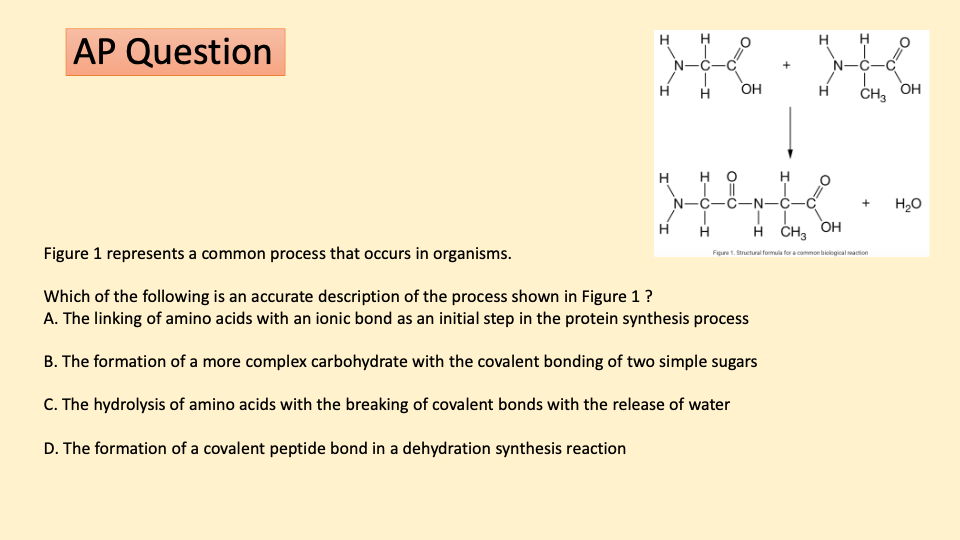
Figure 1 Represents a common process that occurs in organisms.
Which of the following is an accurate description of this process shown in figure 1?
The linking of amino acids with an ionic bond as an initial step in the protein synthesis process
The formation of a more complex carbohydrate with the covalent bonding of 2 simple sugars
the hydrolysis of amino acids with the breaking of covalent bonds with the release of water
The formation of a covalent peptide bond in a dehydration synthesis reaction
7
8
Multiple Choice

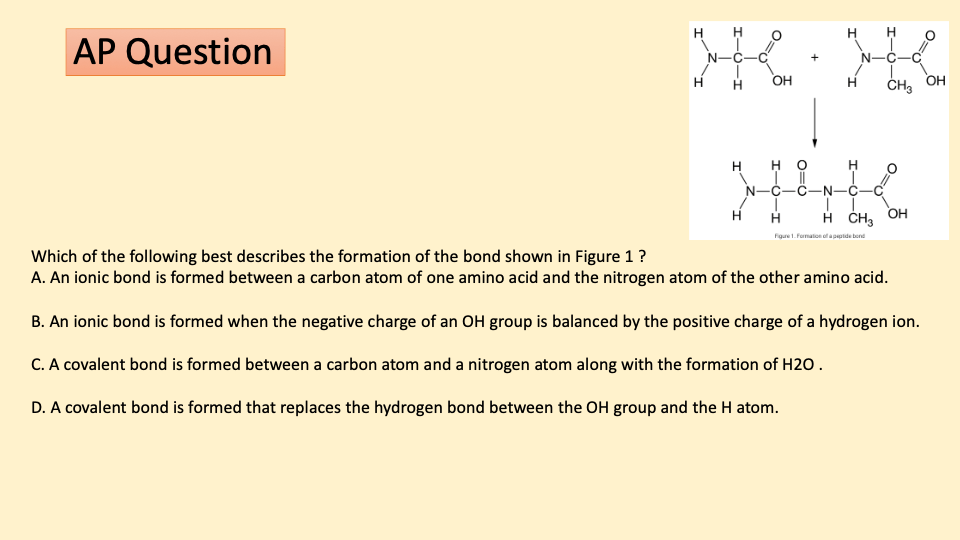
Which of the following best describes the formation of the noms shown in figure 1?
An ionic bond is formed between a carbon atom of one amino acid and the nitrogen atom of the other amino acid
an ionic bond is formed when the negative charge of an OH group is balanced by the positive charge of a hydrogen ion
a covalent bond is formed between a carbon atom and a nitrogen atom along with the formation of water
a covalent bond is formed that replaces the hydrogen bond between the oH group and H atom
9

10
Multiple Choice
Polypeptides are continuously being formed and degraded. One of these processes is shown in the figure.
which statement is the most accurate description of the reaction shown in figure 1?
Ir represents monomers linked by dehydration synthesis
It represents a polypeptide chain that folds to form the tertiary structure
It represents the polypeptide chain that is denatured into the primary structure
It represents the polypeptide chain that is broken down through a hydrolysis reaction
11
12
13
14
15
16
Multiple Choice
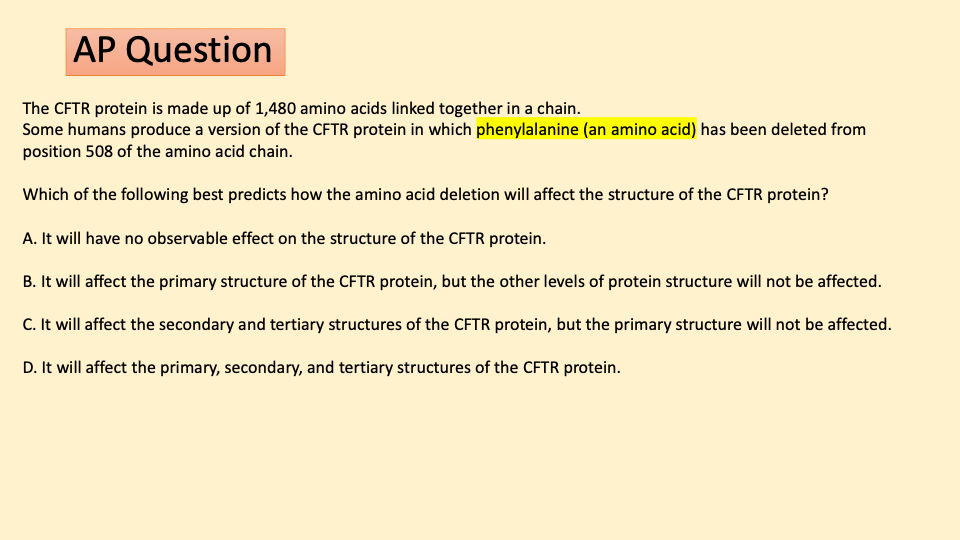
The CFTR protein I made of 1,480 amino acids linked together in a chain.
some humans produce a version of CFTR in which phenylalanine (an amino acid) has been deleted from position 508 of the amino acid chain.
which of the following best predicts how the amino acid deletion will affect the structure of the CFTR protein?
it will have no observable effect on the structure of the CFTR protein
it will affect the primary structure of the CFTR protein, but the other levels of protein structure will not be affected
it will affect the secondary and tertiary structure of the CFTR protein, but the primary structure will not be affected
it will affect the primary, secondary and tertiary structure of the CFTR protein
17

18

19
Multiple Choice
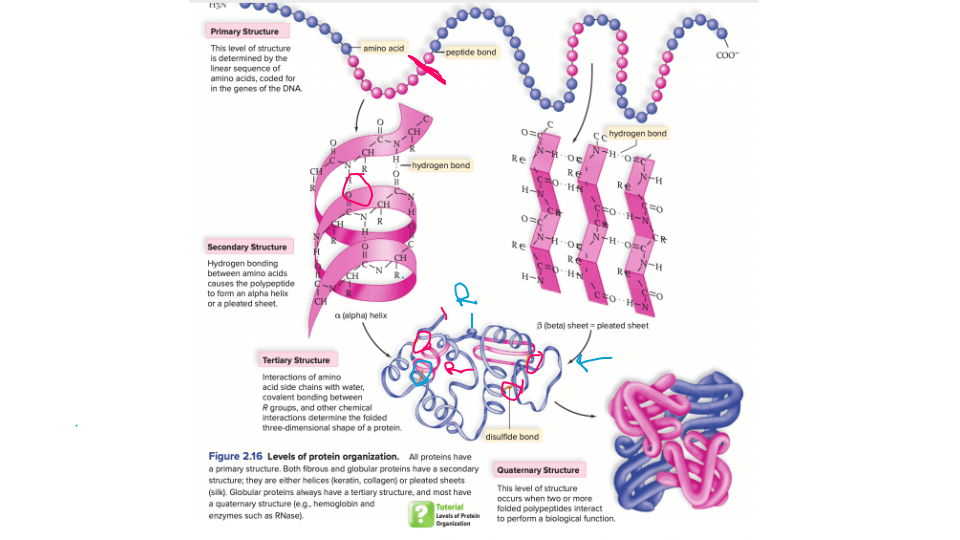
which of the following best describes how amino acids affect the tertiary structure of a protein?
the number of amino acids determines the tertiary structure of the protein
the interactions of the different R-groups with other R-groups and with their environment determine the tertiary structure of the protein
the R-group of the last amino acid that is added to a growing polypeptide chain determines the next amino acid that is added to the chain
the sequence of the amino acids in the polypeptide chain determines the protein's primary structure but has no effect on it's tertiary structure
20
21
Multiple Choice

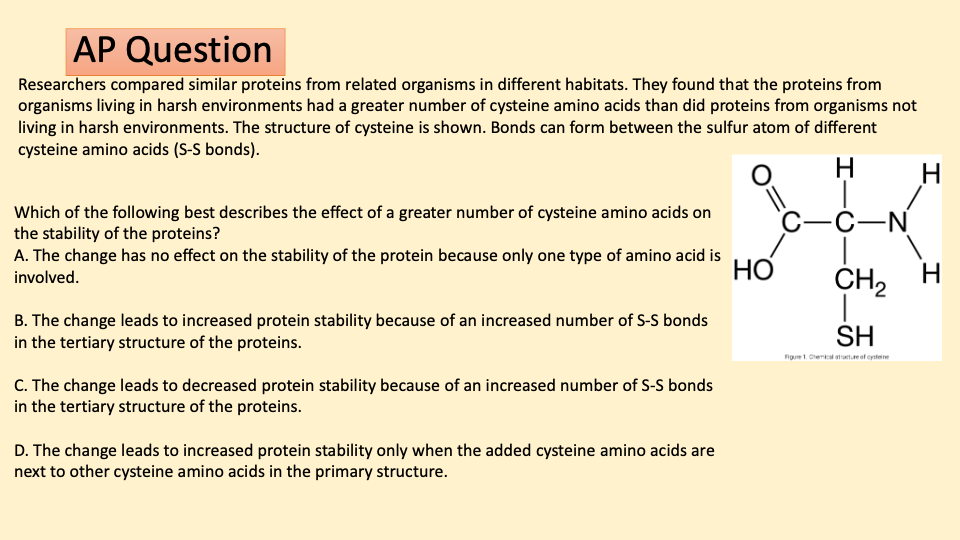
which of the following describes the effect of a greater number of cysteine amino acid on the stability of a protein?
the change has no effect on the stability of the protein because only one type of amino acid is involved
the change leads to increased protein stability because of an increased number of S-S bonds in the tertiary structure of proteins
the change leads to decreased protein stability because of an increased number of S-S bonds in the tertiary structure of the proteins
the change leads to increased protein stability only when the added cysteine amino acids are next to other cysteine amino acids in the primary structure
22
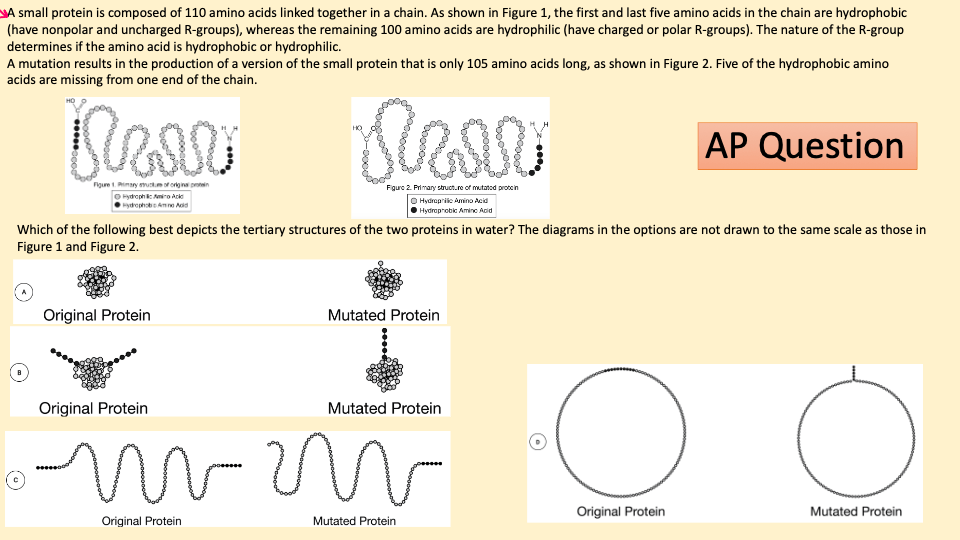
23
24
Multiple Choice
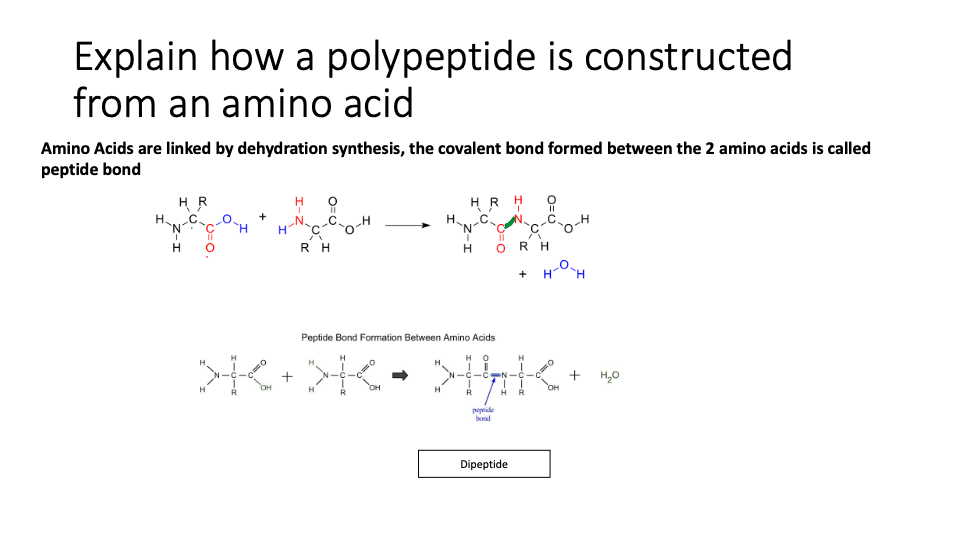
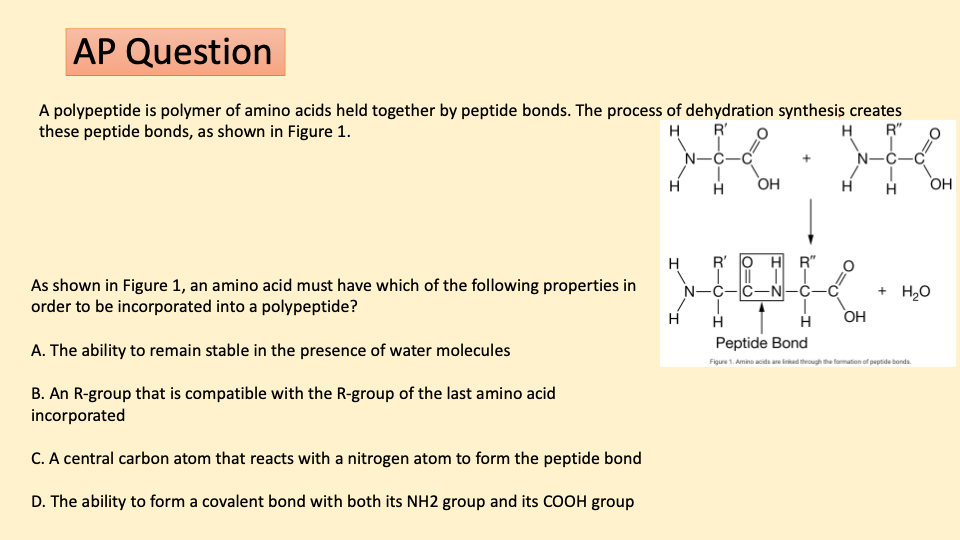
A polypeptide is polymer of amino acids held together by peptide bonds. The process of dehydration synthesis creates these peptide bonds, as shown in Figure 1.
As shown in Figure 1, an amino acid must have which of the following properties in order to be incorporated into a polypeptide?
The ability to remain stable in the presence of water molecules
An R-group that is compatible with the R-group of the last amino acid incorporated
A central carbon atom that reacts with a nitrogen atom to form the peptide bond
The ability to form a covalent bond with both its NH2 group and its COOH group
25

26
Multiple Choice

Figure 1 shows three amino acids that are part of a polypeptide chain. Figure 2 shows the same section of the chain after a mutation has occurred.
How might this change affect the structure and function of the protein?
The R-group of the new amino acid, valine, has different chemical properties than the R-group of cysteine. This will cause the protein to misfold and not function properly in the cell.
The new amino acid, valine, has replaced cysteine in the new protein. Since the number of amino acids has remained the same, there will be no change in the three-dimensional folding, or function, of the protein.
Since this is a linear section, it does not influence protein folding. Thus, there will be no change in protein structure or function.
Since the new amino acid is bounded on one side by an amino acid with a negatively charged R-group and by an amino acid on the other side with a positively charged R-group, the charges will balance and the protein will fold as usual.
Proteins
Show answer
Auto Play
Slide 1 / 26
SLIDE
Similar Resources on Wayground

18 questions
Graphing Practice
Presentation
•
9th Grade
20 questions
Enzymes
Presentation
•
9th - 10th Grade
21 questions
Intro to Punnett Squares Accelerated
Presentation
•
9th - 10th Grade
23 questions
6C: Protein Synthesis
Presentation
•
9th Grade
17 questions
Pedigrees
Presentation
•
9th Grade
20 questions
respiratory system bio lesson
Presentation
•
9th Grade
22 questions
G9 Chap 1.3 - Methods of Science
Presentation
•
9th Grade
22 questions
Natural Selection & Speciation
Presentation
•
9th Grade
Popular Resources on Wayground
10 questions
Safety Day 2026 – Student Review

Quiz
•
9th Grade
21 questions
Continents and Oceans
Quiz
•
6th Grade
20 questions
Parts of Speech
Quiz
•
5th Grade
16 questions
Subject & Predicate
Quiz
•
5th Grade
25 questions
Multiplication Facts
Quiz
•
5th Grade
12 questions
Map Skills
Quiz
•
3rd Grade
22 questions
Continents and Oceans
Quiz
•
5th Grade
15 questions
Rounding Decimals
Quiz
•
5th Grade
Discover more resources for Biology
20 questions
Cell Transport
Quiz
•
9th - 12th Grade
25 questions
photosynthesis and cellular respiration
Quiz
•
9th Grade
20 questions
Cell Cycle
Quiz
•
9th Grade
8 questions
DNA vs. RNA
Presentation
•
9th - 12th Grade
14 questions
Ecological Succession: Primary and Secondary
Quiz
•
9th Grade
20 questions
Characteristics of Life
Quiz
•
9th - 10th Grade
12 questions
Cell Cycle
Quiz
•
9th Grade
20 questions
Cell Organelles
Quiz
•
9th Grade