Search Header Logo
Population, Size and Structure

Population, Size and Structure

Assessment

Presentation

Biology

9th Grade

Hard

Created by

Joseph Anderson

FREE Resource

28 Slides • 30 Questions

1

Populations, Microscopes, and Humans

Slide image

2

Geographic distribution

  • The area or locations inhabited by a population

Slide image

3

Population density

The number of individuals in a unit area

Slide image

4

Multiple Choice

The range or area occupied by a population is its

1

growth rate

2

geographic distribution

3

age structure

4

population density

5

Multiple Select

Which definition best matches the term population density?

1

human beings in general

2

number of people in a particular area

3

A measurement of people for a specific area

4

All the inhabitants of a particular area

6

Growth Rate

The rate of change of a population over time

7

Growth Factors

Number of births

Number of deaths

The number of individuals that enter or leave

Slide image

8

Individual movement

  • emigration- out

  • immigration- in

9

Multiple Choice

The number of births compared to the total number of people in a population
1
death rate
2
birth rate
3
baby boom
4
doubling time

10

Multiple Choice

If the number of births is greater than the number of deaths in a population, what will happen to the growth of the population?
1
It will increase.
2
It will decrease.
3
It will stay the same.
4
It will fluctuate.

11

Multiple Choice

The movement of individuals into an areas is called

1

demography

2

immigration

3

emigration

4

carrying capacity

12

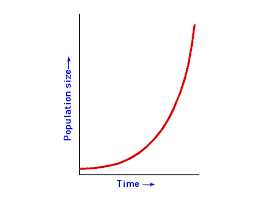
Exponential Growth

population increases at a constant rate without a limiting factor

13

Logistic Growth

leveling or stop of exponential growth due to a limiting resource

14

Carrying Capacity

Represents the largest number of individuals that a given environment is able to support

15

Multiple Choice

Question image

What is the carrying capacity of the graph?

1

1000

2

8000

3

800

4

600

16

Multiple Choice

Question image

What happens if a population grows past its carrying capacity?

1

The population keeps growing

2

The population starts to die off

3

The entire species will go extinct

4

The carrying capacity just increases

17

Multiple Choice

Question image
What type of growth is shown in the diagram?
1
exponential growth
2
logistic growth 
3
predator-prey cycle
4
boom-bust curve

18

Multiple Choice

Question image

Is this graph showing exponential growth or logistical growth?

1

Exponential

2

logistical

19

Limiting Factor

Causes a population's growth to decrease

20

Density Dependant Factors

  • A Limiting factor dependant on size of the population

21

density independent factor

Not dependent on population size

22

Multiple Choice

Competition, disease, predation, and parasitism are considered ___________ ____________ limiting factors
1
Density-dependent
2
Density-independent

23

Multiple Choice

Which describes the impact predators have on the population growth of the prey?

1

Predators maintain the prey population.

2

Predators increase the prey population growth.

3

Predators decrease the prey population growth.

4

Predators have no impact on the prey population growth.

24

Demography

 study of human populations

Slide image

25

Humans impact through history

agriculture

industrial revolution

artificial selection

Slide image

26

Multiple Choice

1. Why has Earth's human carrying capacity increased greatly?

1

Other organisms have been displaced by agriculture, so there is more space for humans.

2

Humans have modified their environment due to technological advances.

3

Humans can live closer together than other animals

4

Humans are now eating fewer plants than they used to.

27

Renewable Resources

 replaced relatively quickly by natural processes

Slide image

28

Nonrenewable Resources

 forms at a much slower rate

Slide image

29

Multiple Choice

1. What are renewable resources?

1

. Resources that are used faster than they form

2

resources that can replenish themselves over time

3

resources that formed over millions of years

4

resources that exist only in rural areas

30

Multiple Choice

Question image

Hydro Power is a __________ energy resource.

1

Renewable

2

Non-renewable

31

Multiple Choice

Why are fossil fuels considered non-renewable resources if they are still forming beneath the surface today?

1

They are being formed as a type of methane which we cannot use.

2

They are being formed too far beneath the surface.

3

We are depleting the fossil fuels much faster than they can form.

32

Biological Magnification

The concentration of certain compounds in each organism in a food chain increases

Slide image

33

Depletion

 a large fraction of the resource has been used up

34

Pollution

an undesired change in air, water, or soil that adversely affects the health, survival

35

Multiple Choice

Coal burning increased the concentration of Mercury found in air, rain, soil, and water. Plankton ingested the mercury and the concentration increased through the trophic levels to where the FDA has recommended women to refrain from eating shellfish. This is an example of?

1

Biological toxicity

2

Biological magnification

3

Biological ingestion

4

Biological infestation

36

Multiple Choice

Loss of resources due to deforestation is an example of

1

depletion

2

pollution

3

environmental controls

4

sustainable development

37

Multiple Choice

Nitrification caused by agricultural run off, is an example of?

1

Biological magnification

2

Depletion

3

Pollution

4

Sustainable development

38

Air Pollution

Smog-fog and Chemicals

Slide image

39

Acid Rain

 pollutants in the air combine with water vapor to form droplets of acid

Slide image

40

Compounding of the Greenhouse effect

increased CO2 emissions traps more heat in the biosphere increasing temperature Global Warming

41

Multiple Choice

Over the past 200 years, the level of carbon dioxide in the atmosphere has
1
decreased slightly.   
2
increased until recently, and then decreased.
3
increased steadily.   
4
stayed about the same.

42

Multiple Choice

Which of these is an impact of acid rain?
1
dissolves nutrients in the soil
2
raises oxygen levels
3
gives off chemicals
4
reduces the amount of coal used

43

Hole in the Ozone

Chemicals called CFC's

Slide image

44

Biodiversities

  • Ecological- refers to the variety of habitats

  • Species- refers to all the differences between populations of species

  • Genetic-

  • refers to all the different genes contained within all members of a population

Slide image

45

invasive species

introduction of non native plants or animals

Slide image

46

Ecological hot spot

a place where significant numbers of species and habitats are in immediate danger of extinction

Slide image

47

Ecological Footprint

the human impact on the biosphere

Slide image

48

Multiple Choice

Biodiversity, aka biological diversity, usually refers to

1

the same species in a general location

2

the number of different species in a given area

3

the number of animal species in a given area

4

the number of plant species in a given area

49

Multiple Choice

Invasive species grow quickly due to the lack of predators, this leads to a decline or extinction of the native population. True or false? 
1
false
2
true

50

Multiple Choice

What kinds of resources make up your ecological footprint?

1

waste production

2

water and energy use

3

food and shelter

4

clothing and transportation

5

All of the above

51

Microscope Questions

52

Multiple Choice

Supports the microscope and located at the bottom.
1
Base
2
Arm
3
Body Tube
4
Stage

53

Multiple Select

What does it mean to make the object become clearer, sharper, or more in focus?

1

magnification

2

resolution

54

Multiple Select

What does it mean to make the object appear larger than it actually is?

1

magnification

2

resolution

55

Multiple Choice

When looking at a specimen on your slide, you should always start with the
1
low objective lens
2
medium objective lens
3
high objective lens
4
super extra high power lens

56

Multiple Choice

Find the total magnification: 
Eyepiece = 10X 
Objective lens = 55X
 
1
10x
2
55x
3
65x
4
550x

57

Multiple Choice

You can find total magnification by which of the following methods?
1
ocular PLUS objective
2
ocular TIMES objective
3
ocular MINUS objective
4
ocular DIVIDED BY objective

58

Poll

Population is a United States problem only

True

False

Populations, Microscopes, and Humans

Slide image

Show answer

Auto Play

Slide 1 / 58

SLIDE