

Ribosomes and Protein Synthesis

Presentation
•
Biology
•
9th Grade
•
Hard

Joseph Anderson
FREE Resource
23 Slides • 29 Questions
1

Unit: 2
Topic: 13.2 Ribosomes and
Protein Synthesis
EQ: How would you build a
system to read the
messages that are coded in
genes and transcribed into
RNA?
2

Think about it
• How would you build a system to read the
messages that are coded in genes and
transcribed into RNA?
•
Would you read the bases one at a
time, as if the code were a language with
just four words—one word per base?
•
Perhaps you would read them as
individual letters that can be combined to
spell longer words.
This Photo by Unknown Author is licensed under CC BY
3


The Genetic
Code
• What is the genetic code, and how is it read?
• The genetic code is read three “letters” at a time, so
that each “word” is three bases long and
corresponds to a single amino acid.
• The first step in decoding genetic messages is to
transcribe a nucleotide base sequence from DNA to
RNA.
4
5


The Genetic
Code
• This transcribed information contains a code for
making proteins.
• Proteins are made by joining amino acids together
into long chains, called polypeptides.
• As many as 20 different amino acids are commonly
found in polypeptides.
6


The Genetic
Code
• The specific amino acids in a
polypeptide, and the order in
which they are joined,
determine the properties of
different proteins.
• The sequence of amino acids
influences the shape of the
protein, which in turn
determines its function.
• RNA contains four different
bases: adenine, cytosine,
guanine, and uracil.
7


The Genetic
Code
• These bases form a
“language,” or genetic code,
with just four “letters”: A, C,
G, and U.
• Each three-letter “word” in
mRNA is known as a codon.
• A codon consists of three
consecutive bases that
specify a single amino acid to
be added to the polypeptide
chain.
8
Multiple Choice

DNA is produced by protein which is produced in the cell
Protein is composed of DNA which is produced in the cell
DNA controls the production of protein in the cell
A cell is composed of DNA and protein
9
Multiple Choice
Uracil
Thymine
Cytosine
Guanine
10
Multiple Choice

A polypeptide (protein chain) is a sequence of ____________________ held together by a _______________ bond.
amino acids; peptide
proteins; hydrogen
fatty acids; ionic
fatty acids; covalent
11
Multiple Choice
When RNA is being made, the RNA base ____ always pairs with the base ___ in DNA.
U-T
T-G
U-A
A-U
12
Multiple Choice
How many nucleotides make up a codon?
1
3
5
15
13
Multiple Choice
How many codons: AAU GCG AUG
9
1
3
15
14


How to read codons
• Because there are four different bases in
RNA, there are 64 possible three-base
codons (4 × 4 × 4 = 64) in the genetic
code.
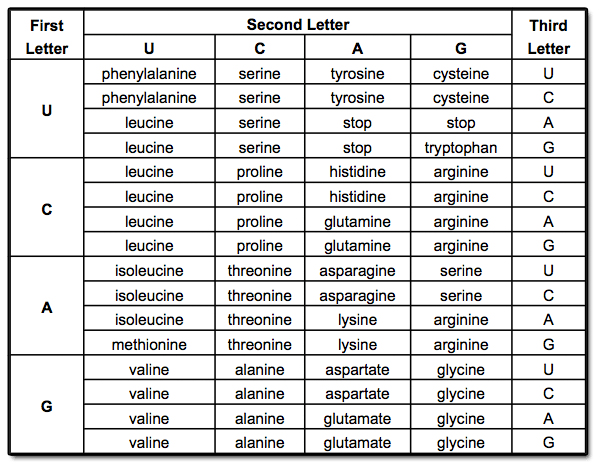
• This circular table shows the amino acid to
which each of the 64 codons corresponds.
To read a codon, start at the middle of the
circle and move outward.
15


How to read codons
• Most amino acids can be specified by more
than one codon.
• For example, six different codons—UUA,
UUG, CUU, CUC, CUA, and CUG—specify
leucine. But only one
codon—UGG—specifies the amino acid
tryptophan
16
Multiple Choice
In mRNA, each codon specifies for a particular
nucleotide
Enzyme
Amino Acid
Monomers
17
Multiple Choice
18

Start and stop Codons
• The genetic code has punctuation
marks.
• The methionine codon AUG serves
as the initiation, or “start,” codon for
protein synthesis.
• Following the start codon, mRNA is
read, three bases at a time, until it
reaches one of three different “stop”
codons, which end translation.
19
Multiple Choice
Arginine
AAG
AGG
ACU
CUG
UAG
20
Multiple Choice
Stop
CUG
UAG
ACU
CCC
UAG
21
Multiple Choice
AUG
Arginine
Serine
Lysine
Threonine
Methionine
22
Fill in the Blanks

What is the amino acid sequence for the following mRNA strand:
AUG-GAC-ACU-UAG
Type answer...
23
Fill in the Blanks
What is the amino acid sequence for the following mRNA strand:
UGU-UGG-AUA-CCC
Type answer...
24
Fill in the Blanks
What is the amino acid sequence for the following mRNA strand:
UCG-GAA-CAC-AAU
Type answer...
25

Translation
• What role does the ribosome play in
assembling proteins?
• Ribosomes use the sequence of codons
in mRNA to assemble amino acids into
polypeptide chains.
• The sequence of nucleotide bases in an
mRNA molecule is a set of instructions that
gives the order in which amino acids should
be joined to produce a polypeptide.
26

Translation
• The forming of a protein requires the
folding of one or more polypeptide chains.
• Ribosomes use the sequence of codons in
mRNA to assemble amino acids into
polypeptide chains.
• The decoding of an mRNA message into a
protein is a process known as translation.
27


Steps in Translation
Messenger RNA is transcribed in the
nucleus and then enters the cytoplasm
for translation.
28

Steps in translation
• Translation begins when a ribosome
attaches to an mRNA molecule in the
cytoplasm.
• As the ribosome reads each codon of
mRNA, it directs tRNA to bring the
specified amino acid into the
ribosome.
• One at a time, the ribosome then
attaches each amino acid to the
growing chain.
• Each tRNA molecule carries just one
kind of amino acid.
•
29

Steps in translation
• In addition, each tRNA molecule has
three unpaired bases, collectively called
the anticodon—which is
complementary to one mRNA codon.
• The tRNA molecule for methionine has
the anticodon UAC, which pairs with the
methionine codon, AUG.
• The ribosome has a second binding site
for a tRNA molecule for the next codon.
• If that next codon is UUC, a tRNA
molecule with an AAG anticodon brings
the amino acid phenylalanine into the
ribosome.
30

Steps in Translation
• The ribosome helps form a
peptide bond between the first
and second amino
acids—methionine and
phenylalanine.
• At the same time, the bond
holding the first tRNA molecule
to its amino acid is broken.
• That tRNA then moves into a
third binding site, from which it
exits the ribosome.
31

Steps in Translation
• The ribosome then moves to the
third codon, where tRNA brings it
the amino acid specified by the
third codon.
• The polypeptide chain continues
to grow until the ribosome
reaches a “stop” codon on the
mRNA molecule.
• When the ribosome reaches a
stop codon, it releases both the
newly formed polypeptide and
the mRNA molecule, completing
the process of translation.
32

Steps in Translation
• The polypeptide chain continues
to grow until the ribosome
reaches a “stop” codon on the
mRNA molecule.
• When the ribosome reaches a
stop codon, it releases both the
newly formed polypeptide and
the mRNA molecule, completing
the process of translation.
33

The Roles of tRNA and rRNA
in Translation
• Ribosomes are composed of roughly 80
proteins and three or four different rRNA
molecules.
• These rRNA molecules help hold ribosomal
proteins in place and help locate the
beginning of the mRNA message.
• They may even carry out the chemical
reaction that joins amino acids together.
34
Multiple Choice
ribosome
chloroplast
nucleus
mitochondria
35
Multiple Choice
mRNA
tRNA
rRNA
DNA
36
Multiple Choice
GTC
GUC
CUG
CAG
37
Multiple Choice
converts mRNA into a polypeptide
catalyzes bonds between amino acids
produces RNA from DNA molecules
recycles tRNA molecules for reuse
38
Multiple Choice
Peptide bonds
Hydrogen bonds
Acid bonds
39
Multiple Choice

Transcription
Translation
Replication
40
Multiple Choice
DNA
mRNA
tRNA
rRNA
41
Multiple Choice
carry amino acids to the ribisomes
carry ribisomes to the ER
carry glucose to mitochondria
carry mRNA out of the nucleus
42
Multiple Choice
GTC
GUC
CUG
CAG
43

The Molecular Basis
of Heredity
• What is the “central dogma” of
molecular biology?
• The central dogma of molecular
biology is that information is
transferred from DNA to RNA to
protein.
44

The Molecular Basis
of Heredity
• A gene that codes for an enzyme to
produce pigment can control the color
of a flower. Another gene produces
proteins that regulate patterns of tissue
growth in a leaf. Yet another may
trigger the female or male pattern of
development in an embryo.
• Proteins are microscopic tools, each
specifically designed to build or
operate a component of a living cell.
45

The Molecular
Basis of
Heredity
• Molecular biology seeks to explain living
organisms by studying them at the molecular
level, using molecules like DNA and RNA.
• The central dogma of molecular biology is that
information is transferred from DNA to RNA to
protein.
• There are many exceptions to this “dogma,”
but it serves as a useful generalization that
helps explain how genes work.
• Gene expression is the way in which DNA,
RNA, and proteins are involved in putting
genetic information into action in living cells.
• DNA carries information for specifying the traits
of an organism.
46

The Molecular
Basis of
Heredity
• The cell uses the sequence of bases in DNA as a
template for making mRNA.
• The codons of mRNA specify the sequence of
amino acids in a protein.
• Proteins, in turn, play a key role in producing an
organism’s traits.
• One of the most interesting discoveries of
molecular biology is the near-universal nature of
the genetic code.
• Although some organisms show slight variations in
the amino acids assigned to particular codons, the
code is always read three bases at a time and in
the same direction.
• Despite their enormous diversity in form and
function, living organisms display remarkable unity
at life’s most basic level, the molecular biology of
the gene.
47
Multiple Choice
protein synthesis, transcription, translation
protein synthesis, translation, transcription
transcription, translation, protein synthesis
translation, transcription, protein synthesis
48
Multiple Choice

diffusion
repiration
recombination
translation
49
Multiple Choice

DNA is produced by protein which is produced in the cell
Protein is composed of DNA which is produced in the cell
DNA controls the production of protein in the cell
A cell is composed of DNA and protein
50
Multiple Choice

Transcription
Translation
Replication
Mitosis
51
Multiple Choice
nucleus
ribosome
cytoplasm
smooth ER
52
Multiple Choice
Unit: 2
Topic: 13.2 Ribosomes and
Protein Synthesis
EQ: How would you build a
system to read the
messages that are coded in
genes and transcribed into
RNA?
Show answer
Auto Play
Slide 1 / 52
SLIDE
Similar Resources on Wayground

44 questions
Conditionals
Presentation
•
9th Grade
46 questions
Effector Receptor Control Center
Presentation
•
9th Grade
46 questions
Transcription and Translation Lesson
Presentation
•
9th Grade
48 questions
Earth's layers & Continental Drift
Presentation
•
9th - 10th Grade
44 questions
blood typing lesson
Presentation
•
9th Grade
47 questions
Mutations
Presentation
•
9th - 10th Grade
50 questions
Cell Cycle & Viruses
Presentation
•
9th Grade
Popular Resources on Wayground
21 questions
Continents and Oceans

Quiz
•
6th Grade
20 questions
Parts of Speech
Quiz
•
5th Grade
16 questions
Subject & Predicate
Quiz
•
5th Grade
25 questions
Multiplication Facts
Quiz
•
5th Grade
12 questions
Map Skills
Quiz
•
3rd Grade
22 questions
Continents and Oceans
Quiz
•
5th Grade
15 questions
Rounding Decimals
Quiz
•
5th Grade
20 questions
Brand Labels
Quiz
•
5th - 12th Grade
Discover more resources for Biology
10 questions
Exploring the 4 Major Macromolecules and Their Functions

Interactive video
•
9th - 12th Grade
20 questions
Cell Transport
Quiz
•
9th - 12th Grade
25 questions
photosynthesis and cellular respiration
Quiz
•
9th Grade
20 questions
Cell Cycle
Quiz
•
9th Grade
20 questions
BIOLOGY-CELL MEMBRANE AND CELL TRANSPORT
Quiz
•
9th - 10th Grade
19 questions
Macromolecules
Quiz
•
9th Grade
20 questions
Cell Organelles
Quiz
•
9th Grade
18 questions
The Carbon Cycle
Quiz
•
9th Grade