
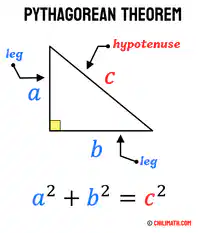
Pythagorean Theorem Solving for Hypotenuse

Presentation
•
Mathematics
•
8th Grade
•
Hard

Joseph Anderson
FREE Resource
9 Slides • 4 Questions
1
Discovering the Pythagorean Theorem
Exploring the relationship between the sides of a right triangle and the theorem's applications in geometry and real-world scenarios.
2
Pythagorean Theorem:
Deprecated: a² - b² = c²
3
Multiple Choice
What is the formula for the Pythagorean Theorem?
a² + b² = c²
a² - b² = c²
a² + b² + c² = 0
a² - b² + c² = 0
4
Pythagorean Theorem:
a² + b² = c² is the formula for the Pythagorean Theorem. It is used to find the length of the hypotenuse in a right triangle. The theorem is named after the Greek mathematician Pythagoras. It is one of the most famous and widely used theorems in mathematics. Remember, the sum of the squares of the two legs is equal to the square of the hypotenuse!
5
Applying the Pythagorean Theorem
6
Multiple Choice
What is the purpose of Step 4 in discovering the Pythagorean Theorem?
To identify the two legs of the right triangle
To square the length of each leg
To add the squared values of the legs
To find the length of the hypotenuse
7
Pythagorean Theorem:
Step 4: To find the length of the hypotenuse. The hypotenuse is the longest side of a right triangle and can be calculated by adding the squared values of the two legs and then taking the square root of the sum. This theorem is named after the Greek mathematician Pythagoras.
8
Discovering the Pythagorean Theorem
9
Multiple Choice
What is the first step in solving for the missing side length using the Pythagorean Theorem?
Identify the known side lengths
Substitute the values into the formula
Simplify and solve for the missing side
Discover the Pythagorean Theorem
10
Identify Known Side Lengths
11
Real-Life Applications of the Pythagorean Theorem
12
Multiple Choice
In which field is the Pythagorean Theorem essential?
Architecture
Navigation
Surveying
Engineering
13
Pythagorean Theorem in Engineering
Trivia: The Pythagorean Theorem is essential in engineering for calculating distances, angles, and dimensions in various applications. It is used in structural design, electrical circuit analysis, and even in computer graphics for 3D modeling. Fun Fact: The theorem is named after the ancient Greek mathematician Pythagoras, but evidence suggests that it was known and used by the Babylonians even earlier!
Discovering the Pythagorean Theorem
Exploring the relationship between the sides of a right triangle and the theorem's applications in geometry and real-world scenarios.
Show answer
Auto Play
Slide 1 / 13
SLIDE
Similar Resources on Wayground

10 questions
Scientific Notation
Presentation
•
7th - 9th Grade
10 questions
Integers and number line
Presentation
•
7th Grade
10 questions
Operations in scientific Notation Word Problems
Presentation
•
8th Grade
9 questions
Slope Intercept Form Word Problems
Presentation
•
8th - 9th Grade
11 questions
Slope of a line/Right triangles
Presentation
•
8th Grade
11 questions
Percent Change
Presentation
•
7th - 8th Grade
10 questions
Solving Equations
Presentation
•
6th Grade
11 questions
8.FGR.7.4 Solving Systems by Substitution
Presentation
•
8th Grade
Popular Resources on Wayground
24 questions
PBIS-HGMS Day 10

Quiz
•
6th - 8th Grade
10 questions
HCS SCI 03 Summer School Review 3
Quiz
•
3rd Grade
11 questions
Home Scope
Quiz
•
7th - 8th Grade
15 questions
HCS SCI 05 Summer School Assessment 3 Review
Quiz
•
5th Grade
35 questions
Lufkin Road Middle School Student Handbook & Policies Assessment
Quiz
•
7th Grade
18 questions
Geo 11.3 Area of Circles and Sectors
Quiz
•
9th - 11th Grade