


Radio and Microwaves
Presentation
•
Science
•
6th - 7th Grade
•
Hard

Joseph Anderson
FREE Resource
7 Slides • 6 Questions
1
Electromagnetic Spectrum
Study Guide Questions
2
3
Multiple Choice
1. Arrange the waves according to increasing wavelength:
Ultraviolet Rays, Radio waves, Infrared, Microwave
Radio>Microwaves>Infrared>Ultraviolet
Ultraviolet> Infrared Waves > Microwaves> Radio
4
Multiple Choice
2.Describe the energy from the sun.
An electromagnetic spectrum that includes Radio waves, micro, infrared, visible, ultraviolet, xray and gamma rays
A strong energy that heats up the planet and all living organisms.
A strong radiation that is seen as waves and used up as radiation.
5
Sun's Energy
All of the energy from the Sun that reaches the Earth arrives as solar radiation, part of a large collection of energy called the electromagnetic radiation spectrum.
Solar radiation includes visible light, ultraviolet light, infrared, radio waves, X-rays, and gamma rays.
Radiation is one way to transfer heat.
6
Multiple Choice
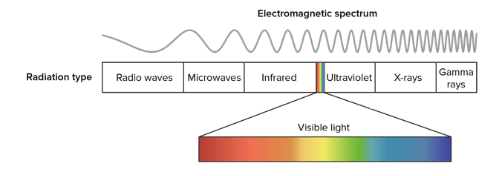
3. Use the diagram to answer the questions below.
How are the waves arranged in the spectrum?
Waves are arranged from low frequency to high frequency, longest wavelength to shortest wavelength
Waves are arranged according to the energy released.
Waves are arranged according to it's usefulness and application.
7
EM Spectrum is arranged according to frequency and wavelength
8
Multiple Choice
4.What is the relationship between the wavelength and frequency in the spectrum?
The longer the wavelength, the lower the frequency. The shorter the wavelength, the higher is the frequency.
The longer the wavelength, the higher the frequency. The shorter the wavelength, the lower is the frequency.
9
Frequency and Wavelength
Long wavelength - Low frequency
Short wavelength - High frequency
10
Multiple Choice
5.What is Visible Light?
The highest energy wave in the EM Spectrum
The lowest energy wave in the EM Spectrum.
The only wave that is visible to the human eye.
11
Visible Light
12
Multiple Choice
6. Describe the location of the visible light in the electromagnetic spectrum.
Visible light sits after xrays in the EM Spectrum
Visible light sits in the region with ultraviolet (UV) to the left of the spectrum and infrared (IR) to the right.
It has the longest wavelength and sits after microwave.
13
Visible Light
Electromagnetic Spectrum
Study Guide Questions

Show answer
Auto Play
Slide 1 / 13
SLIDE

Similar Resources on Wayground
10 questions
7.8C Impact of Human Activity on Watersheds
Presentation
•
7th Grade
10 questions
CELL ORGANELLES
Presentation
•
5th - 7th Grade
10 questions
Mechanical and chemical digestion
Presentation
•
6th - 8th Grade
10 questions
Parts of an Experiment
Presentation
•
6th Grade
9 questions
soil
Presentation
•
7th Grade
11 questions
Force & Motion
Presentation
•
6th - 8th Grade
11 questions
Dichotomous Keys & Taxonomy
Presentation
•
7th Grade
11 questions
Earth's Tides
Presentation
•
6th - 8th Grade
Popular Resources on Wayground
10 questions
5.P.1.3 Distance/Time Graphs
Quiz
•
5th Grade
10 questions
Fire Drill
Quiz
•
2nd - 5th Grade
20 questions
Equivalent Fractions
Quiz
•
3rd Grade
22 questions
School Wide Vocab Group 1 Master
Quiz
•
6th - 8th Grade
20 questions
Main Idea and Details
Quiz
•
5th Grade
20 questions
Context Clues
Quiz
•
6th Grade
20 questions
Inferences
Quiz
•
4th Grade
12 questions
What makes Nebraska's government unique?
Quiz
•
4th - 5th Grade
Discover more resources for Science
19 questions
Introduction to Properties of Waves
Presentation
•
6th - 8th Grade
16 questions
Interactions within Ecosystems
Presentation
•
6th - 8th Grade
10 questions
Exploring the Layers of the Earth
Interactive video
•
6th - 10th Grade
16 questions
Photosynthesis and Cellular Respiration Review
Quiz
•
7th Grade
20 questions
Abiotic & Biotic Factors
Quiz
•
7th Grade
15 questions
Punnett Squares
Quiz
•
6th Grade
10 questions
Exploring the Evolution of Cell Theory
Interactive video
•
7th Grade
17 questions
Human body systems
Quiz
•
7th Grade