Search Header Logo
S8P1 Review

S8P1 Review

Assessment

Presentation

Science

8th Grade

Hard

Created by

Joseph Anderson

FREE Resource

12 Slides • 59 Questions

1

Final review-Term 1 Grade 8

by Danelle Ackerman

2

media

3

Multiple Choice

The temperature of a substance increases as___.
1
the substance expands
2
the average kinetic energy of its particles increases
3
the substance's volume increases
4
the substance's mass increases

4

Multiple Choice

The lowest possible temperature is___.
1
0⁰F
2
0 K
3
 0⁰C
4
273 K

5

Multiple Choice

If the particles of two substances have the same average kinetic energy, then___.
1
the specific heats of the substances are identical 
2
the particles will not react chemically
3
the substances have equal thermal energies
4
the substances have equal temperatures

6

Multiple Choice

Heat is thermal energy that flows between objects that differ in___.
1
temperature
2
radiation
3
thermal energy
4
specific heat

7

Multiple Choice

A measure of the average kinetic energy of the particles in an object
1
temperature
2
absolute zero
3
thermal expansion
4
none of these are the answer

8

Multiple Choice

The total kinetic energy of a substance's particles
1
thermal energy
2
heat
3
convection
4
conduction

9

Multiple Choice

Thermal energy that flows between an object at a higher temperature to an object at a lower temperature
1
heat
2
thermal expansion
3
insulation
4
specific heat

10

media

11

Multiple Choice

What is the original source of the most of the energy that people use?

1

By radiation from the sun.

2

By convection from the sun.

3

By radiation from the Earth's core.

4

Conduction from Earth's core.

12

Multiple Choice

Which best explains how this roasting marshmallows happens?

1

Heat from the fire is conducted into the marshmallow.

2

Heat from the fire is radiated into the marshmallow.

3

The coolness of the marshmallow is conducted into the fire.

4

The coolness of the marshmallow is radiated into the fire.

13

Multiple Choice

Why should space be left at the top of the plastic bottle when filling with water and then freeze?

1

Because water expands when frozen.

2

Because water contracts when frozen.

3

Because plastic contracts when frozen.

4

Because plastic expands when frozen.

14

Multiple Choice

Popcorn is made from corn kernels. What happens when kernels are heated in a microwave?

1

The kernels expand.

2

The kernels dissolve.

3

The kernels become hard and brittle.

4

The kernels stick together to form ball.

15

Multiple Choice

Which of the following best describes CONVECTION?

1

When heat is transferred through waves.

2

When heat is transferred through objects that are touching.

3

The movement of gas or liquid in which warmer parts move up and the colder parts moves down.

16

media

17

Multiple Choice

Question image

Is a device that converts electric energy into thermal energy

1

thermostat

2

Heating appliance

3

refrigerator

18

Multiple Choice

Question image

Is a device that regulates the temperature of a system.

1

thermostat

2

heating appliance

3

bimetallic coil

19

Multiple Choice

Question image

What causes the bimetallic coil inside a thermostat to expand and contract?

1

pressure changes

2

metal changes

3

temperature changes

20

media

21

Multiple Choice

electrons have a _________ charge

1

positive

2

negative

3

neutral

22

Multiple Choice

What is the atomic number?
1
the number of protons
2
the number of protons and neutrons
3
the number of neutrons
4
the number of protons and electrons

23

Multiple Choice

How many valence electrons can fit in the first energy level?
1
2
2
1
3
4
4
8

24

Multiple Choice

What is the goal of an atom?
1
To become stable by filling its energy level with all its valence electrons
2
To bond with another atom
3
To gain the most amount of energy possible
4
To lose all its electrons

25

Multiple Choice

What group on the periodic table is stable on its own because they have all their valence electrons?
1
Noble Gases
2
Halogens
3
Alkali
4
Alkaline Earth

26

media

27

Multiple Choice

Question image
What's a valence electron?
1
electrons in the second energy level
2
electrons in the outermost energy level
3
the atomic number
4
electrons in the first level

28

media

29

Multiple Choice

What type of elements form covalent bonds?

1

Metals

2

Non Metals

3

Metalloids

4

Nobel Gas

30

Multiple Choice

When a covalent bond forms _______________ are shared.

1

protons

2

nutrons

3

valence electrons

4

quarks

31

Multiple Choice

Compounds have _________________ properties, compared to the elements that form them.

1

similar

2

different

32

Multiple Choice

Question image

How many valence electrons does Oxygen (O) have?

1

6

2

8

3

15

4

16

33

Multiple Choice

How many atoms of hydrogen are in a sugar molecule with the formula C6H12O6

1

12

2

6

3

24

4

18

34

Multiple Choice

Atoms that are _____________ will form bonds.

1

stable

2

unstable

35

Multiple Choice

Question image

Polar molecules form due to ___________ sharing of valence electrons.

1

equal

2

unequal

3

greater

4

group

36

media

37

Multiple Choice

Question image

What happens when two oppositely charged ions are pushed together?

1

they will repel (move apart)

2

they will be attracted to each other (move together)

38

Multiple Choice

Question image

What happens when two negatively charged ions are pushed together?

1

they will repel (move apart)

2

they will be attracted to each other (move together)

39

Multiple Choice

Question image

The positive ions tend to _____________ electrons.

1

lose

2

gain

40

Multiple Choice

Question image

The negative ions tend to _____________ electrons.

1

lose

2

gain

41

Multiple Choice

Question image
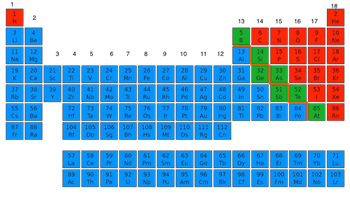
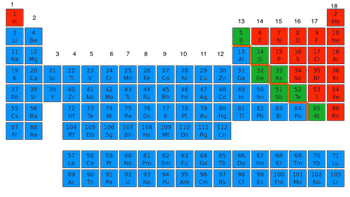
Where are the nonmetals located on the periodic table? 
1
Blue
2
Red
3
Green

42

Multiple Choice

Question image
Where are metals located on the periodic table?
1
Blue
2
Green
3
Red

43

Multiple Choice

Question image
What type of bond is illustrated above?
1
Metallic
2
Ionic
3
Covalent
4
Wiggly

44

Multiple Choice

What type of bond is present when electrons are freely shared between metal atoms?
1
Metallic
2
Ionic
3
Covalent
4
Hippie

45

media

46

Multiple Choice

What is the arrow in a chemical equation...
H2 + O --> H2O
1
Reactants
2
Products 
3
Yields 
4
Chemical Equation 

47

Multiple Choice

The substances at the beginning of a chemical equation are called the ____
1
product
2
yield
3
chemical symbol
4
reactants

48

Multiple Choice

Which of the following is evidence of a chemical reaction?
1
fizzing
2
water changing to ice
3
saltwater
4
paper being cut in half

49

Multiple Choice

What are Chemical Reactions?
1
It's when you mix substances.
2
a process in which atoms rearrange to form new substances
3
When something bubbles.
4
letter and numbers showing the types and number of atoms

50

Multiple Choice

How many F atoms are in this compound?
6MgF2 
1
2
2
6
3
8
4
12

51

Multiple Choice

A number in front of a chemical formula in an equation that indicates how many molecules or atoms of each reactant and product are involved in a reaction.
1
Coefficient
2
reactant
3
subscript
4
product 

52

media

53

Multiple Choice

Combining substances to form a new substance
1
Displacement
2
Synthesis
3
Decomposition
4
Oxidation

54

Multiple Choice

Breaking down a substance into simpler substances
1
Displacement
2
Synthesis
3
Decomposition
4
Oxidation

55

Multiple Choice

Switching one substance for another
1
Displacement
2
Synthesis
3
Decomposition
4
Oxidation

56

Multiple Choice

What type of reaction is the equation 2NaCl →2Na +Cl2?
1
Synthesis Reaction
2
Decomposition Reaction
3
Single Displacement Reaction
4
Double Displacement Reaction

57

media

58

Multiple Choice

The energy required to start a chemical reaction is ___.

1

endothermic

2

exothermic

3

activation

4

released

59

Multiple Choice

Energy is _____ when new bonds form.

1

absorbed

2

released

3

lost

4

gained

60

Multiple Choice

Energy is ______ when bonds break.

1

gained

2

lost

3

released

4

absorbed

61

Multiple Choice

An _______ reaction is when more thermal energy is absorbed than is released.

1

endothermic

2

endergonic

3

exothermic

4

exergonic

62

Multiple Choice

An _______ reaction is when more thermal energy is released than is absorbed.

1

endothermic

2

endergonic

3

exothermic

4

exergonic

63

media

64

Multiple Choice

Question image

In a stable atom the amount of electrons is equal to the amount of

1

neutrons

2

protons

3

atomic mass

4

neutrons + protons

65

Multiple Choice

Question image
What is the charge of the electron
1
positive
2
no charge
3
negative
4
neutral

66

Multiple Choice

What types of charges attract?
1
Positive and Positive
2
Positive and Neutral
3
Negative and Neutral
4
Positive and Negative

67

Multiple Choice

Electric charges that are alike _______ each other.
1
Attract
2
Repel

68

Multiple Choice

Electric charges that are different _______ each other.
1
Attract
2
Repel

69

Multiple Choice

If a substance has an excess number of electrons on its surface, what type of charge does it have?
1
A negative charge
2
A positive charge
3
A neutral charge
4
A nuclear charge

70

Multiple Choice

Question image

A balloon has a negative charge. A glass rod has a positive charge. What will happen when the rod is brought near the balloon?

1

the balloon will be attracted to the rod

2

the balloon will remain in place

3

the balloon will be repelled by the rod

4

the balloon will spin in circles

71

Multiple Choice

If an object has a net charge of +2e this means it has
1
lost 2 electrons
2
gained 2 electrons
3
lost 2 protons
4
gained 2 protons

Final review-Term 1 Grade 8

by Danelle Ackerman

Show answer

Auto Play

Slide 1 / 71

SLIDE