

Early Settlements in South Asia

Presentation
•
Geography
•
6th Grade
•
Practice Problem
•
Medium

Nathan Fowler
Used 4+ times
FREE Resource
15 Slides • 6 Questions
1
Early Settlements of South Asia
caste system, cultural hearths, edicts, Sanskrit
Vocabulary
identify the different groups that settled in South Asia
explain the cultural impacts of early groups that settled in South Asia
Goals
Essential Question: How did the early settlements of South Asia impact the culture of the region?
2
Fun facts!
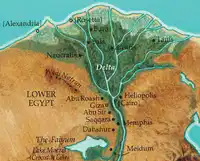
A flat, fan-shaped, fertile area where a river splits into smaller channels before emptying into a larger body of water.
What is a delta?
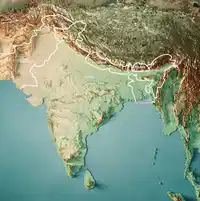
What is a subcontinent?
A large landmass joined to a continent.
What is a monsoon?
Seasonal winds that bring intense rainfall during part of the year.

3
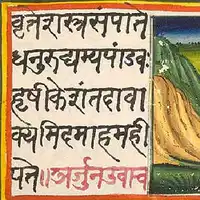
cultural hearths- centers of civilization from which ideas spread.
caste system- a system of social classes a person is born into.
edicts- official government announcements
sanskrit- a language that is the basis for many South Asian languages today
Vocabulary
4

Imagine walking along and discovering these ancient ruins.
What observations can be made about the people who lived here?
Throughout this lesson you will embark on a journey to discover how the geography of South Asia—its rivers, mountains, and plains—played a key role in where these early settlers chose to live and build their communities. You will also learn about the ways these early settlements have impacted the culture of South Asia for thousands of years.
5

The history of a region can be impacted by the land and geographic features nearby. This is true for South Asia. The Indus and Ganges river valleys in South Asia had good farmland and were isolated geographically. This made them cultural hearths, or centers of civilization from which ideas spread. Invaders also had a tough time entering South Asia because of the natural boundaries of the mountains and oceans.
One of the earliest known civilizations in this region is the Indus Valley Civilization, which flourished around 2500 BCE along the banks of the Indus River. This civilization was in what is now Pakistan.
It was most likely environmental changes, like flooding or a drought, that caused the end of the Indus Valley Civilization in South Asia.
This ancient civilization is famous for many different achievements. Let's watch a video in EDIO (p.3). As you watch, listen to some of their greatest accomplishments.
6
Multiple Select
Which of the following are achievements of the Indus Valley Civilization?
plumbing or waste drainage system
a large temple dedicated to the river god
trading coins with elaborate designs
7
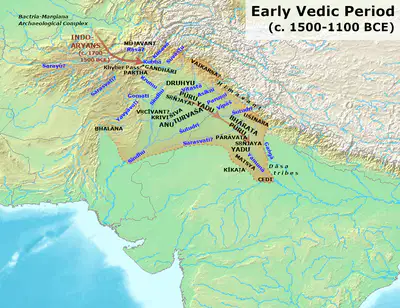
Around 1500 BCE, new groups of people started arriving in India. The main route they used was to cross the Hindu Kush mountains through the Khyber Pass. These new people were called Aryans (EH ree uhns), which means “noble ones.” These tribes from the northwest were mostly made up of hunters and herders.
The Aryans and the Vedic Age marked a period that laid the foundations of culture in the region of South Asia.
The Aryans
8

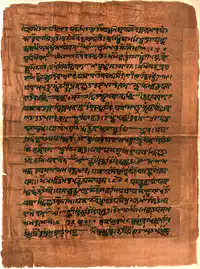

The Aryans brought with them a new language, Sanskrit (SAN skruht). The language has influenced literature, science, and philosophy. Many ancient Indian texts, poems, and epics, like the Mahabharata (muh haa BAA ruh tuh) and the Ramayana (raa MAI uh nuh), were written in Sanskrit. This language helped shape the culture and traditions of South Asia and continues to be studied and respected today.
Sanskrit
The Vedas are a collection of ancient religious texts that were written in Sanskrit by the Aryans. They are among the oldest sacred writings in the world and form the basis of Hinduism, one of the major religions in South Asia. The Vedas include hymns, prayers, rituals, and teachings about life and the universe. They provide spiritual guidance and cultural traditions that have influenced South Asian society for thousands of years.
The Vedas
The caste system in South Asia began over 3,000 years ago during the Vedic Age. The Aryan society was divided into various castes or classes, like priests, warriors, merchants, and laborers. Each caste had specific duties and roles, and people were born into their caste, which determined their job, social status, and who they could marry. Over time, the caste system became more complex and rigid, affecting many aspects of daily life.
The Caste System
9
Match
Match the part of Aryan culture to its importance in South Asia.
social structure used for thousands of years to determine jobs and marriage
used to create the Vedas and many South Asian languages
basis of many cultural and spiritual traditions in the region
caste system
Sanskrit
the Vedas
caste system
Sanskrit
the Vedas
10
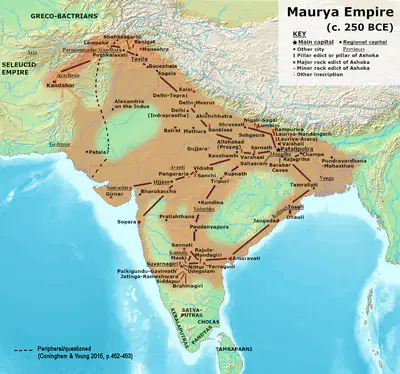
From 321 BCE to 184 BCE, the Maurya (ma REE uh) Empire emerged as the first major empire in South Asia, founded by Chandragupta (shan druh GHUP tuh) Maurya. It became one of the largest and most powerful empires in ancient India.
Under the rule of Emperor Ashoka (uh SHOW kuh), the Maurya Empire reached its peak. Ashoka is remembered for his role in spreading the religion of Buddhism across Asia.
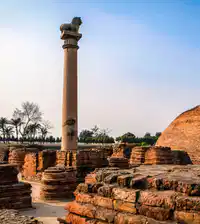
After witnessing the horrors of war, he embraced Buddhism and promoted non-violence, tolerance, and welfare for his people. He sent missionaries to other countries and inscribed his edicts, official government announcements, on pillars and rocks throughout his empire, many of which can still be seen today.
Maurya Empire
11
Multiple Choice
How did Emperor Ashoka unify the Maurya Empire?
allowed for only one language to be used
conquered the most land in South Asia
spread the religion of Buddhism through the empire
12

The Gupta (GOOP tuh) Empire rose to prominence around the fourth century CE and lasted til the sixth century CE. Often referred to as the Golden Age of India, the Gupta period was marked by great achievements in art, science, and literature.
Scholars like Aryabhata (AAR yuh bhuht taa) made significant advancements in mathematics and astronomy. He discovered the approximate value of pi (π), as well as the fact that the Earth rotates on an axis. The Guptas also promoted Hinduism, and their patronage led to the creation of beautiful temples and sculptures. The works of poets and playwrights from this era, such as Kalidasa (ka luh DA suh), are still celebrated today.
Gupta Empire
13


The Bitargaon Temple from the Gupta period provides one of the earliest examples of pointed arches anywhere in the world.
A scene from one of Kalidasa's most famous plays, "The Recognition of Śakuntalā." This play is generally regarded as a masterpiece.
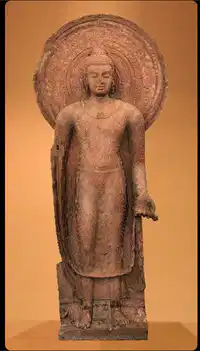
Statue of Buddha made out of red sandstone. This type of art was made during the Gupta period.
14
Multiple Choice
Why is the time of the Gupta Empire in South Asia known as the Golden Age?
The religion of Hinduism spread throughout the empire.
There were many achievements in math, science, literature, and architecture.
Gold was discovered in the region.
15
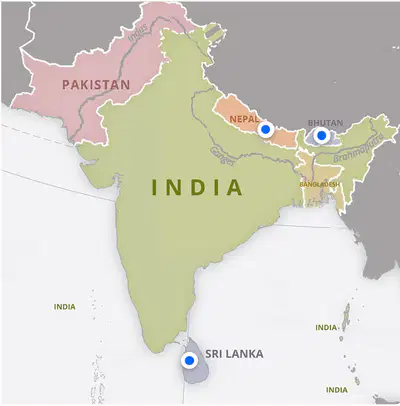
Early settlements in the countries of Nepal, Bhutan, and Sri Lanka are widely different.
Nepal-In 400 CE, Nepal was controlled by the Licchavi (li CHA vi) dynasty. It is most likely that these rulers came north from India. After the Licchavi dynasty fell in the ninth century, Nepal was led by three separate powers.
Bhutan-In Bhutan, the first recorded history comes from Tibetan monks settling here around 800 CE and establishing Tibetan Buddhism. The role of Buddhism has been strong within this nation since its introduction, influencing religion along with politics and education.
For Sri Lanka, the first recorded people to inhabit the country are the Sinhalese (sin huh LEEZ) in the sixth century. This civilization developed because of sea trade routes used by Arab, Greek, and Roman sailors.
16
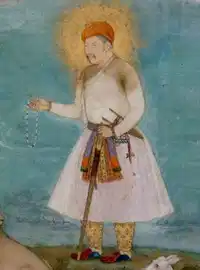
In the early sixteenth century, the Mogul (MOW gl) Empire was established by Babur, a descendant of the Mongol ruler Genghis Khan. The Moguls brought a rich cultural blend of Persian, Indian, and Islamic influences through the northwest part of South Asia and spread through the central and southern parts of the region.
Akbar (AAK baar) the Great, one of the most famous Mogul emperors, is known for his policy of religious tolerance and efforts to unite his diverse empire. During this empire, many people of India converted to the religion of Islam.
The Mogul Empire is also renowned for its architectural marvels, such as the famous Taj Mahal, Red Fort, and Jama Masjid. Many of these structures blended Persian, Indian, and Islamic styles.
Mogul Empire
17

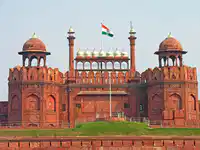
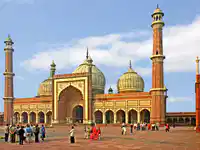
The Taj Mahal was built as a tomb for the wife of a Mogul emperor.
The Red Fort was the main residence of the Mogul emperors.
The Jama Masjid was the mosque used for the royal families during the Mogul Empire.
18
Multiple Choice
Which of the following is a famous architectural achievement of the Mogul Empire?
the Taj Mahal
the Great Pyramids of Giza
the Colosseum
19
Review/Reminder
Today we learned:
The Indus Valley Civilization had many important achievements, like a plumbing system.
The Aryan people created Sanskrit, the Vedas, and the caste system.
The Maurya, Gupta, and Mogul Empires provided significant contributions to religion, architecture, art, and literature in South Asia.
*You may submit today's lesson blank!
20
Complete the exit ticket!
21
Match
These are important vocabulary words for this unit. Let's practice matching them up!
A flat, fan-shaped, fertile area where a river splits into smaller channels before emptying into a larger body of water.
a large landmass joined to a continent
Seasonal winds that bring intense rainfall during part of the year.
delta
subcontinent
monsoon
delta
subcontinent
monsoon
Early Settlements of South Asia
caste system, cultural hearths, edicts, Sanskrit
Vocabulary
identify the different groups that settled in South Asia
explain the cultural impacts of early groups that settled in South Asia
Goals
Essential Question: How did the early settlements of South Asia impact the culture of the region?
Show answer
Auto Play
Slide 1 / 21
SLIDE
Similar Resources on Wayground

16 questions
LCM & Distributive Property!
Presentation
•
6th Grade
16 questions
Force and Motion
Presentation
•
6th Grade
16 questions
Decision Making
Presentation
•
6th Grade
18 questions
US Test Review
Presentation
•
6th Grade
20 questions
Cultural Diffusion
Presentation
•
6th Grade
20 questions
Geography of Ancient Greece
Presentation
•
6th Grade
16 questions
Geography of Ancient China
Presentation
•
6th Grade
16 questions
Reading /themes
Presentation
•
6th Grade
Popular Resources on Wayground
19 questions
Naming Polygons

Quiz
•
3rd Grade
10 questions
Prime Factorization
Quiz
•
6th Grade
20 questions
Math Review
Quiz
•
3rd Grade
15 questions
Fast food
Quiz
•
7th Grade
20 questions
Main Idea and Details
Quiz
•
5th Grade
20 questions
Context Clues
Quiz
•
6th Grade
20 questions
Inferences
Quiz
•
4th Grade
19 questions
Classifying Quadrilaterals
Quiz
•
3rd Grade
Discover more resources for Geography
15 questions
Australia Geography
Quiz
•
6th Grade
50 questions
U.S. 50 States Map Practice
Quiz
•
5th - 8th Grade
26 questions
Southeast Asia Geo Quiz
Quiz
•
6th - 8th Grade
21 questions
Continents and Oceans
Quiz
•
6th Grade
50 questions
50 States and Capitals
Quiz
•
5th - 6th Grade
20 questions
US States
Quiz
•
6th Grade