
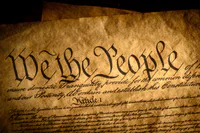
US Constitution Review

Presentation
•
Social Studies
•
6th - 8th Grade
•
Hard

Joseph Anderson
FREE Resource
15 Slides • 32 Questions
1

Constitution Era
2


Day 1
The Articles of Confederation
• In 1781, the Articles of
Confederation became the
first form of government in the United States
• The Articles of Confederation
had only one branch of
government—the legislative
branch—which had the
authority to declare war,
make treaties, and borrow
money
3
Multiple Choice
The reason the Articles of Confederation only established the legislative branch was to -
show the importance of a representative legislature to foreign nations
keep power out of the hands of the courts
ensure the government would not become too powerful
give the legislature supreme rule over all the states
4
Multiple Choice
What division of government had the majority of power under the Articles of Confederation?
Federal Government
State Government
5
Multiple Choice
Which branch of government was the only branch in the Articles of Confederation?
Judicial Branch
Federal Branch
Legislative Branch
Executive Branch
6


Day 1
Weaknesses of the Articles
• The government had no power to pass
taxes
• The government could not regulate
trade
• All states had to approve any
amendments, or changes to the government
• New laws required the approval of at
least 9 of the 13 states
• There was no executive branch to
enforce the laws
• The states had more power than the
national government
<
7
Multiple Select
Which of the following were weaknesses of the Articles of Confederation? Select THREE correct answers.
The states were more powerful than the national government
9 of the 13 states had to approve any changes to the government
There was no executive branch to enforce the laws
The government had no power to pass taxes
8
Fill in the Blanks
In the Articles of Confederation, the government could not
Type answer...
9
Multiple Choice
Why did the Articles of Confederation not include an executive branch?
They did not feel it was needed.
They were afraid of the central government becoming too strong.
They wanted to keep all the power in the federal government.
No one could serve as president.
10


Day 2
The Northwest Ordinance
• The Northwest Ordinance
established a plan for the
orderly addition of states to the United States
• This land forbid slavery,
allowed freedom of religion,
and ensured trial by jury
• Once a territory reached a
population of 60,000 they
could apply to be an equal state in the Union
11
Multiple Choice
One of the primary goals of the Northwest Ordinance was to -
establish a structure for adding states to the U.S.
prevent Native Americans from legitimately owning land
abolish old British and French forts still remaining in the area
create a means for transporting setters to western settlements
12
Multiple Select
Which details best explain the Northwest Ordinance? Select three correct answers.
Freedom of religion and trial by jury were freedoms provided
Once the population reached 60,000, the territory could apply to be a state
Slavery was forbidden in the Northwest Territory
If any gold or silver were found, it must be turned over to the state
13
Multiple Choice
After the end of the Revolutionary War, states were eager to expand into newly available territory. The states of New York, Connecticut, Massachusetts, and Virginia argued over competing claims to land west of the Appalachian Mountains. This conflict was addressed by the -
Missouri Compromise
Wilmot Proviso
Northwest Ordinance
Kansas-Nebraska Act
14


Day 3
Constitutional Convention
• In 1787, delegates met in
Philadelphia with the
intention of revising the
Articles of Confederation
• Once the meeting started,
they decided to create an
entirely new form of
government instead of
revising the Articles
15
Fill in the Blanks
The purpose of the Constitution Convention of 1787 was to
16
Multiple Choice
The Constitutional Convention of 1787, the decision was to create a new ____ of government.
law
compromise
form
vote
17


Day 4
Great Compromise
•The Virginia Plan suggested 3
branches of government and
representation in Congress based on the population of each state
•The New Jersey Plan
recommended that representation from each state be equal
•The Great Compromise created a bicameral Congress, with one
house based on population and
the other house having 2
representatives from each state
for equal representation
House of
Representatives
Senate
18
Multiple Select
Which of the following details were included in the Great Compromise? Select THREE correct answers.
House of Representatives chosen based on population
Senate had two representatives from each state
Bicameral congress
Executive branch that held all the power
19
Multiple Choice

Why was this congressional structure created by the framers of the Constitution?
To follow the plan outlined in the Articles of Confederation
To reach a compromise between large and small states
To reach a compromise between slave states and non-slave states
To implement the outcome of a popular vote
20
Multiple Choice

Which of the following should replace the question mark in this diagram?
Direct democracy
Great Compromise
Checks and balances
Missouri Compromise
21


Day 4
Three-Fifths Compromise
• Although the south treated
slaves as property, Southerners wanted to
count slaves towards their
population so they could
have more representation in
Congress
• Northerners and
Southerners agreed to have
3 out of every 5 slaves count
towards a state’s population
Count
Don’t Count
22
Multiple Choice
Southern states wanted to count slaves towards their population so that -
slaves could be given citizen status
slaves would be a tax break for landowners
they would have a larger population which would give them more representatives in congress
the British would recognize America as a country with a larger population than theirs
23

Day 5
Philosophers of the Constitution
•John Locke claimed that if a
government failed to fulfill its purpose
of protecting individuals’ freedoms,
citizens had both the right and
responsibility to overthrow the
government
•Montesquieu believed that
government power should be
separated to keep one group from
gaining too much power
•William Blackstone believed that even
a king should not take away a person’s
property and believed strongly in
individual rights
Life
Liberty
Property
Constitutio
n
24
Multiple Choice
Claimed that if government didn’t protect individual freedoms, then the people have the right to get rid of it
John Locke
Baron de Montesquieu
William Blackstone
25
Multiple Choice
Believed that government should have checks and balances, and supported individual rights
John Locke
Baron de Montesquieu
William Blackstone
26
Multiple Choice
Believed government power should be separated to prevent one branch from being too powerful
John Locke
Baron de Montesquieu
William Blackstone
27


Day 6
Constitutional Debate
•After the Constitution was written, it
required ratification, or approval, by
9 out of the 13 states for it to go into
effect
•Civil discourse is a form of debate in
which both sides respect each
other’s views while still expressing
their own opinion
•For over a year, all across the
country, delegates debated on the
ratification of the Constitution
28
Multiple Select
What was the significance of the Constitutional Convention of 1787?
Delegates created a new framework of government.
The British introduced new economic policies.
Delegates respectfully listened and debated with others.
The Anti-Federalists insisted on a bill of rights.
Delegates kept the majority of power at the state level.
29

Day 6
The Federalists
•The Federalists supported the
ratification of the Constitution
•They believed the Constitution
created a more powerful
government, but not too
powerful
•James Madison, Alexander
Hamilton, and John Jay wrote
The Federalist Papers to explain
how the Constitution worked
30


Day 6
The Anti-Federalists
•Patrick Henry and George
Mason emerged as leaders of
the Anti-Federalists group
•They believed that the
Constitution created a
government that was too
powerful and that it would take
away citizens’ rights
•The Anti-Federalists demanded
a bill of rights be added to the
Constitution before ratification
31
Multiple Choice
Which of the following describes a Federalist?
Preferred a stronger state government
Believed a strong federal government was essential
Fought and defeated the British Navy
Wanted a bill of rights added to the U.S. Constitution
32
Multiple Select
Which of the following best describe an Anti-Federalist? Select two correct answers.
Anti-Federalists wrote papers to explain how the Constitution worked.
Anti-Federalists wanted a bill of rights added to the Constitution to protect individual rights.
Anti-Federalists supported the expansion of power in the executive branch.
Anti-Federalists believed the Constitution made the government too powerful.
33
Multiple Choice

Those who agreed with this point of view were known as -
Minutemen
Loyalists
Federalists
Patriots
34


Day 7
Constitution Accepted
• Written in 1787
• After much discussion and
debate, all the states
ratified the Constitution
once the promise to add a
bill of rights was made
• In 1791, the Bill of Rights
was officially ratified
35
Multiple Choice
Both parties agreed to ratify the Constitution once the Federalist consented to -
returning land taken from farmers before Shays' rebellion
giving more power to the state governments than the federal government
providing medical care to former veterans of the American Revolution
adding the Bill of Rights to the Constitution
36

Day 7
Organization of the Constitution
• Preamble – Introduction
• Article I – Legislative Branch
• Article II – Executive Branch
• Article III – Judicial Branch
• Article IV – States Respect Each Other
• Article V – Amending the Constitution
• Article VI – Constitution is Supreme
37
Fill in the Blanks
The Legislative branch
38
Fill in the Blanks
The Executive branch
39
Fill in the Blanks
The Judicial branch
40
Multiple Choice
Which principle of the constitution is expressed in the three branches of government?
Federalism
Limited Government
Checks & Balances
Separation of Powers
41


Day 7
The Preamble
• The introduction to the
Constitution
• Announces the purpose of the
Constitution:
• To form a more perfect
union
• To give justice to all
• To keep peace
• To keep our country safe
• To help people
• To protect our liberty
42
Multiple Choice
Why were southern delegates to the Constitutional Convention willing to accept the Three-Fifths Compromise?
It increased the political influence of the South.
It allowed indentured servants in the South to become citizens.
It decreased the federal tax on property in the South.
It allowed the South to expand its industrial output.
43
Multiple Choice
Which argument would a Federalist make to support ratification of the Constitution?
The Constitution will enable states to nullify laws that are harmful to citizens.
A strong federal government will be more stable than a loose confederation of states.
The Constitution will allow states to establish banks to stabilize the national economy.
A republican system of government will better represent large states.
44


Day 10
Amending the Constitution
•The Constitution provides guidelines for
making changes to the document
•The amendment process allows for the
Constitution to change and grow with the nation, ensuring that the government adapts to the needs of its people
•It is an intentionally difficult process so
that any changes are fully thought-out
and totally necessary
•Only 27 amendments have been
passed
•Amendments 1-10 are the Bill of
Rights and protect individual
freedoms
Requirements for Amendment:
Proposed by two-thirds of the House & Senate
Ratified by three-fourths of state legislatures
45
Fill in the Blanks
To
46
Multiple Choice

What assurance did this argument give to those who opposed ratifying the Constitution?
The amendment process would allow state governments to nullify federal law.
Making the federal government superior to state governments would ensure greater stability.
The rights of citizens would be better protected by having both federal and state levels of government.
Giving greater power to the federal government would allow it to assist states in times of crisis.
47
Multiple Choice

What was the purpose of this amendment?
To encourage citizens to monitor the federal government
To prevent conflicts between state and local governments
To limit the authority of the federal government
To increase the participation of citizens in state government
Constitution Era
Show answer
Auto Play
Slide 1 / 47
SLIDE
Similar Resources on Wayground

44 questions
Figurative Language
Presentation
•
6th - 8th Grade
44 questions
Understanding The Constitution
Presentation
•
7th - 8th Grade
43 questions
Whiskey Rebellion
Presentation
•
6th - 9th Grade
43 questions
Canadian Confederation
Presentation
•
7th Grade
40 questions
Mexican-American War
Presentation
•
6th - 9th Grade
42 questions
Causes of the American Revolution
Presentation
•
6th - 8th Grade
40 questions
Phases of the Moon
Presentation
•
6th - 8th Grade
40 questions
Concordância verbal
Presentation
•
KG
Popular Resources on Wayground
10 questions
Impact of 9/11 and the War on Terror

Interactive video
•
10th - 12th Grade
21 questions
Continents and Oceans

Quiz
•
6th Grade
5 questions
9/11
Interactive video
•
9th Grade
20 questions
Parts of Speech
Quiz
•
5th Grade
16 questions
Subject & Predicate
Quiz
•
5th Grade
10 questions
Riddles Riddles fun Riddles
Quiz
•
6th - 12th Grade
21 questions
Lab Safety
Quiz
•
10th Grade
6 questions
PRIDE in the Hallways and Bathrooms
Presentation
•
12th Grade
Discover more resources for Social Studies
15 questions
6th Grade Europe's Environmental Issues/Impact of Geography
Quiz
•
6th Grade
10 questions
9/11
Quiz
•
5th - 7th Grade
6 questions
Branches of Hope: The 9/11 Survivor Tree
Interactive video
•
6th Grade
10 questions
Exploring the Age of Exploration: Key Events and Figures
Interactive video
•
6th - 10th Grade
20 questions
Primary and Secondary Sources
Quiz
•
7th Grade
13 questions
Primary and Secondary Sources
Quiz
•
6th Grade
7 questions
Otto's Tale Today is September 11th
Interactive video
•
6th Grade
21 questions
ss.7.cg.1.1- Ancient Influences
Quiz
•
7th Grade