Weather vs. Climate LEAP Packet
Presentation
•
Other
•
9th - 12th Grade
•
Easy

Jennifer Nowlin
Used 19+ times
FREE Resource
18 Slides • 102 Questions
1
2
Weather vs. Climate
By Jennifer Nowlin
3
Multiple Choice
Which of the following best describes weather?
day to day conditions of the atmosphere at a place in regards to heat, dryness, sunshine, wind, rain, etc.
long-term conditions (months/years) of the atmosphere at a place in regards to heat, dryness, sunshine, wind, rain, etc.
4
Multiple Choice
Which of the following best describes climate?
day to day conditions of the atmosphere at a place in regards to heat, dryness, sunshine, wind, rain, etc.
long-term conditions (months/years) of the atmosphere at a place in regards to heat, dryness, sunshine, wind, rain, etc.
5
Multiple Choice
6
Multiple Choice
7
Multiple Choice
8
Multiple Choice
It is raining outside right now.
weather
climate
9
Multiple Choice
Over the last decade we have had an increase in the amount of rain in our area.
weather
climate
10
Multiple Choice
Sandra visited her grandma in Florida over Thanksgiving. She noticed that they were selling bathing suits at the stores. Her grandma said they sell bathing suits all year because Florida is warm.
climate
weather
11
12
Multiple Choice
13
Multiple Choice
14
Multiple Choice
15
Multiple Choice
16
Multiple Choice
17
Multiple Choice
18
Multiple Choice
19
Multiple Choice
20
Multiple Choice
21
Multiple Choice
22
Multiple Choice
23
Multiple Choice
24
Multiple Choice
25
Multiple Choice
26
Multiple Choice
27
Multiple Choice
28
Multiple Choice
29
Multiple Choice
30
31
32
Multiple Choice
33
Multiple Choice
34
Multiple Choice
35
Multiple Choice
36
Multiple Choice
37
Multiple Choice
38
Multiple Choice
What type of weather will you see along a cold front?
Thunderstorms
Sunny skies
Gentle rain
No weather
39
Multiple Choice
What kind of weather happens along a Warm Front?
Thunderstroms
Gentle rain
Nothing
Hail
40
Multiple Choice
41
Multiple Choice
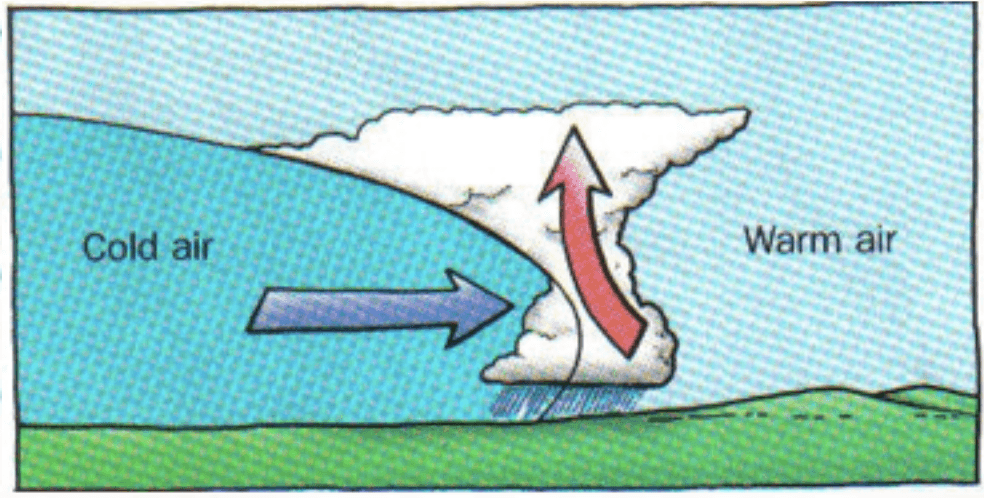
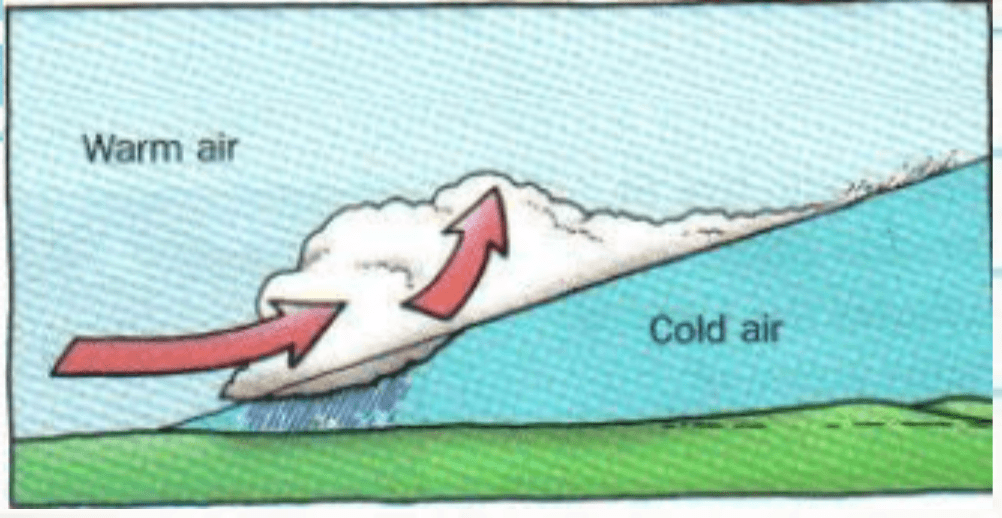
Name that front.
Cold Front
Warm Front
Stationary Front
Occluded Front
42
Multiple Choice
Name that front.
Cold Front
Warm Front
Stationary Front
Occluded Front
43
Multiple Choice
An ____________ front occurs when a warm front is overtaken from behind by a cold front.
cold
warm
stationary
occluded
44
Multiple Choice
Occluded fronts are associated with _____________.
sunny days
rain or snow
45
Multiple Choice
Which of the following symbols is used to represent an occluded front?
46
47
Multiple Choice
A scientist who studies the earth's atmosphere and who monitors, studies, and forecasts the weather.
meteorologist
biologist
weatherologist
oceanographer
48
Multiple Choice
What do you call the prediction that meteorologists make about the weather?
guess
forecasts
backcasts
forwardcasts
49
Multiple Choice
The table shows some weather data collected over a five day period. What trend over the five days can be observed in the collected data?
There was more rain on warm days than on cool days
There were fewer clouds on Thursday than on Monday
The temperature decreased as the cloud cover increased
The temperature increased over the course of the week
50
Multiple Choice
Students gathered weather data during the day and recorded it in a table. What tool did the students use to gather the data?
Thermometer
Rain gauge
Wind vane
Spring scale
51
Multiple Choice
Students measured the rainfall outside their classroom for five days and recorded their observations.
There was an increase in the amount of rainfall between–
June 10 and June 11
June 11 and June 12
June 12 and June 13
June 13 and June 14
52
Multiple Choice
What is this tool used for?
Knowing the amount of rain that has fallen
Identifying temperature
Determining which direction the wind is blowing
Determining the speed of the wind blowing
53
Multiple Choice
54
Multiple Choice
Which weather tool measures high and low air pressure?
thermometer
barometer
anemometer
psychrometer
55
Multiple Choice
56
Multiple Choice
57
Multiple Choice
58
59
60
61
Multiple Choice
This weather instrument is called a...
anemometer
Christmas ornament
wind vane
barometer
62
Multiple Choice
63
Multiple Choice
wind speed
64
Multiple Choice
65
Multiple Choice
66
Multiple Choice
67
Multiple Choice
This weather instrument is a/an...
rain gauge
U.F.O.
satellite
anemometer
68
Multiple Choice
69
Multiple Choice
70
Multiple Choice
Which tool is used to measure humidity (the amount of moisture) in the air?
wind vane
barometer
anemometer
hygrometer
71
Multiple Choice
What are the weather conditions in an area over a long period of time called?
climate
temperature
elevation
precipitation
72
Multiple Choice
The amount of moisture (water vapor) in the air is called
Barometer
Humidity
Rain gauge
Evaporation
73
Multiple Choice
What is a Dew Point
The pressure at which clouds form.
The temperature at which, when air is saturated (holding all the water it can), condensation forms.
The process of water changing between all 3 of its states.
When one has drank too many Mountain Dew's
74
Multiple Select
Computer modeling...
is always accurate
predicts the direction of storms
predicts the weather
uses only information from satellites to make predictions.
75
Multiple Choice
Radar is able to...
flash each time it spins, measuring the wind speed
measure the air pressure on other planets
function only when it has mercury in it
determine the direction and distance of objects that reflect radio energy back.
76
Multiple Choice
What does a psychrometer measure
atmospheric humidity
humidity of air at the earths surface
the temperature of the moon
the pressure on a rainy day
77
78
Multiple Choice
The rotation of the Earth causes winds to bend due to the...
coriolis effect
doldrums
trade winds
westerlies
79
Multiple Choice
Winds occur because hot air rises and cool air sinks in a process called...
conduction
convection
radiation
magnetism
80
Multiple Choice
what is the main cause of the coriolis effect?
earth’s rotation
trade winds
the sun and ocean
temperature
81
Multiple Choice
82
Multiple Choice
83
Multiple Choice
84
Multiple Choice
What is the initial source for global winds and convection in the atmosphere?
heat from the Earth's core
the rotation of the Earth
Moon's gravity
unequal heating of the Earth by the sun
85
Multiple Choice
_________ is the transfer of heat by direct contact. Warm air is less dense, so it rises above cold air.
Conduction
Convection
Radiation
86
Multiple Choice
87
Multiple Choice
88
Multiple Choice
89
Multiple Choice
90
91
92
Multiple Choice
What causes wind?
differences in temperature and air pressure
differences in gravity
differences in oxygen content
differences in location on the globe
93
Multiple Choice
What causes differences in air pressure?
even heating of the Earth
deep ocean currents
uneven heating of the earth
global warming
94
Multiple Choice
Sea breezes occur?
during the day
during the night
during both the day and night
only during a full moon
95
Multiple Choice
96
Multiple Choice
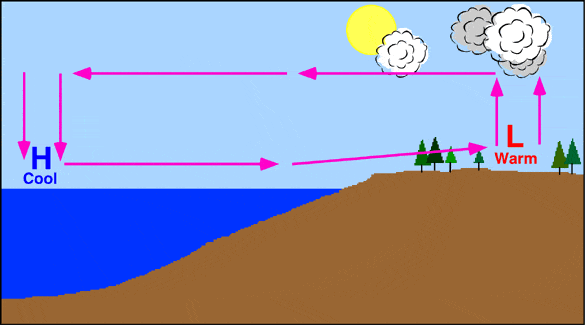
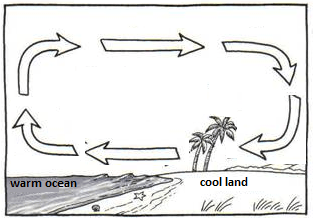
What kind of breeze is this and when will it form?
land breeze - daytime
sea breeze - daytime
land breeze - nighttime
sea breeze - nighttime
97
Multiple Choice
Which best describes why winds at the beach change direction between day and night? **
because the land heats and cools faster than water
because the direction of Earth's rotation changes
because warm air is more dense than cool air
because water is always colder than land
98
Multiple Choice
Why is the equator warmer than the north and south poles?
Because the equator receives less direct sunlight.
Because the equator receives more direct sunlight
Because gravity is stronger at the equator
Because gravity is stronger at the poles
99
Multiple Choice
On a sunny day at the beach, which of these is most likely to happen?
Both the sand and the water will heat up quickly.
The water will heat up quickly but the sand will stay relatively cool.
The sand will heat up quickly, but the water will stay relatively cool.
Both the sand and the water will stay relatively cool.
100
Multiple Choice
During a cold night on the beach, which of these would be most likely to happen?
The land will be warmer than the water because the water cools faster
The water will be warmer than the land because the land cools faster
The land and the water will stay the same temperature all night
101
Multiple Choice
Land breezes occur?
during the day
during the night
during both day and night
only during a full moon
102
103
104
Multiple Choice
What is cloud cover?
The measurement of temperature in the atmosphere.
Cloud cover is the amount of the sky covered by clouds.
The total amount of rainfall in a region.
The distance between clouds and the ground.
105
Multiple Choice
What is the purpose of a rain gauge?
The purpose of a rain gauge is to measure the amount of rainfall.
To collect water for irrigation
To measure humidity levels
To predict weather patterns
106
Multiple Select
All precipitation forms from?
Water droplets or ice crystals in the clouds
Water droplets only
High Dew Point
High levels of humidity
Ice crystals only
107
Multiple Choice
108
Multiple Choice
Which will hold more water, warm air or cold air?
Warm Air
Cold AIr
109
Multiple Choice
The amount of water vapor in the air is known as ___.
dew point
humidty
relative humidity
rain
110
111
Multiple Choice
1. This side of the mountain is dry and desert like because of the rain shadow effect.
Leeward
Sideward
Windward
Land
112
Multiple Choice
On the leeward side of a mountain, you might find _____.
Heavy rainfall
Desert
More vegetation
More snow
113
Multiple Choice
What landform causes the rain shadow effect?
Mountains
Lakes
Plains
Valleys
114
Multiple Choice
Review the image and answer the following question.
In the western United States, most rain shadows occur on what side of the mountain ranges?
The west side of the mountain
The Southern Part of a mountain
The Northern part of a mountain
The Eastern part of a mountain
115
Multiple Choice
This side of the mountain is where the wind originates and evaporation occurs
windward
leeward
rain shadow
prevailing winds
116
Multiple Choice
Which statement is true about air's capacity to hold water?
As air rises higher up the mountain, its capacity to hold water vapor decreases
As air rises higher up the mountain, its capacity to hold water vapor increases
117
Multiple Choice
This side of the mountain is the direction in which the wind is blowing so it is sometimes called the "downwind" or the "lee" side
windward
prevailing winds
leeward
wind currents
118
119
120
Show answer
Auto Play
Slide 1 / 120
SLIDE

Similar Resources on Wayground
119 questions
Unit 6 APES Notes - Smedes
Presentation
•
7th - 12th Grade
108 questions
Wildlife and Exotic Radiology
Presentation
•
KG - University
119 questions
Photosynthesis
Presentation
•
11th Grade - University
111 questions
Q1W3 ES Minerals Uses & Processing
Presentation
•
11th Grade
118 questions
Genetics, Biotechnology and DNA EOC Review
Presentation
•
9th - 12th Grade
119 questions
Lesson 26 - 29
Presentation
•
9th - 12th Grade
120 questions
The nature of business
Presentation
•
11th Grade
113 questions
Topik 1 LCTK Kimia UMC 2022
Presentation
•
10th Grade
Popular Resources on Wayground
10 questions
Factors 4th grade
Quiz
•
4th Grade
10 questions
Cinco de Mayo Trivia Questions
Interactive video
•
3rd - 5th Grade
13 questions
Cinco de mayo
Interactive video
•
6th - 8th Grade
20 questions
Math Review
Quiz
•
3rd Grade
20 questions
Main Idea and Details
Quiz
•
5th Grade
20 questions
Context Clues
Quiz
•
6th Grade
20 questions
Inferences
Quiz
•
4th Grade
19 questions
Classifying Quadrilaterals
Quiz
•
3rd Grade
Discover more resources for Other
20 questions
Algebra 1 EOC Review 1
Quiz
•
9th Grade
10 questions
Cinco De Mayo
Presentation
•
10th Grade
5 questions
A.EO.1-4 Quizizz Day 1
Quiz
•
9th - 12th Grade
100 questions
Biology EOC Review
Quiz
•
9th - 12th Grade
5 questions
A.EO.1-4 Quizizz Day 2
Quiz
•
9th - 12th Grade
5 questions
A.EI.1-3 Quizizz Day 4
Quiz
•
9th - 12th Grade
20 questions
Simple Probability
Quiz
•
10th Grade
50 questions
Biology EOC Review
Quiz
•
9th Grade