Search Header Logo
Dichotomous Keys and Taxonomy

Dichotomous Keys and Taxonomy

Assessment

Presentation

Biology

9th - 12th Grade

Hard

Created by

James Gonzalez

FREE Resource

50 Slides • 60 Questions

1

media

2

media

3

media

4

media

5

media

6

Multiple Choice

The science of describing, classifying, and naming living things is called:
1
Geology
2
Biology
3
Taxonomy
4
Chemistry

7

media

8

media

9

Multiple Choice

Which scientist is recognized for developing our modern classification system?

1

Carolus Linnaeus

2

Aristotle

3

Charles Darwin

4

Robert Hooke

10

media

11

media

12

Multiple Choice

Domain is the most specific taxon, while species is the broadest.

1

True

2

False

13

media

14

Multiple Choice

Which taxonomic level is broadest and includes the most organisms per group?
1
Domain
2
Phylum
3
Family
4
Species

15

media

16

Multiple Choice

Question image
The 8 levels of classification, broadest to most specific are....
1
Domain, Genus, Family, Order, Class, Phylum, Kingdom, Species
2
Domain, Species, Kingdom, Genus, Phylum, Family, Class, Order
3
Domain, Kingdom, Phylum, Class, Order, Family, Genus, Species
4
Order, Kingdom, Species, Domain, Phylum, Family, Class, Genus

17

media

18

media

19

media

20

media

21

22

Open Ended

State the TWO characteristics that define a biological species.

23

Multiple Choice

Organisms are classified based on shared physical characteristics ONLY.

1

True

2

False

24

Open Ended

Organisms X and Y share a kingdom, while organisms X and Z share a genus. Which TWO organisms are more closely related?

25

media

26

Multiple Choice

What is binomial nomenclature?

1

A two-word naming system for classifying organisms.

2

Two ways of numbering animals using a dual-digit system.

3

A two-group system designed to classify organisms based on shared characterists.

4

Two types of molecules involved in the biological classification of organisms.

27

media

28

Multiple Choice

The scientific name for an organism is made from the:

1

class and family

2

genus and species

3

domain and kingdom

4

kingdom and phylum

29

media

30

media

31

media

32

media

33

Multiple Choice

Which of the following scientific names is written CORRECTLY?

1

Felis Catus

2

Felis catus

3

felis catus

4

Feliscatus

34

Multiple Choice

In a properly written scientific name, which part is written entirely in lowercase?

1

species

2

genus

3

phylum

4

family

35

media

36

media

37

media

38

media

39

media

40

media

41

media

42

media

43

Multiple Choice

Question image
Which domain is capable of living in extreme environments like hot springs, geysers, or very salty waters?
1
Bacteria
2
Archaea
3
Eukarya

44

media

45

media

46

Multiple Choice

Question image

bacteria belong to which domain?

1

Eukarya

2

Prokarya

3

Archaea

4

Bacteria

47

media

48

Multiple Choice

Question image
Which domain includes all animals and plants?
1
Archaea
2
Eukarya
3
Bacteria

49

Multiple Select

SELECT ALL THAT APPLY: Which of the following Kingdoms belong to the Domain Eukarya?

1

Anamalia

2

Protista

3

Plantae

4

Fungi

50

media

51

media

52

media

53

media

54

media

55

media

56

media

57

media

58

Multiple Choice

Question image
In the 8 levels of classification which level is the broadest category? 
1
Kingdom
2
Family
3
Species
4
Domain

59

Multiple Choice

Which kingdoms have some organisms that can make their own food (autotrophic)?
1
Plantae and Animalia
2
Fungi and Plantae
3
Protista and Plantae

60

Multiple Choice

Things that are classified together ___________.
1
are not related to each other.
2
share a similar evolutionary history.
3
are larger organisms.
4
have a different evolutionary history

61

Multiple Choice

Who organized living things based on shared characteristics and created a system for assigning scientific names?
1
Carolus Linnaeus
2
Robert Hooke
3
Anton van Leeuwenhoek
4
James Watson

62

Multiple Choice

What are the 8 levels of classification of living things from most general to most specific?
1
domain, kingdom, phylum, class, order, family, genus, species
2
domain, kingdom, class, phylum, order, family, genius, species
3
domain, kingdom, family, class, order, family, genus, species
4
domain, king, phillip, class, order, family, genus, species

63

Multiple Choice

Question image

Which is the correct order of the levels of taxonomy, starting from the SMALLEST to the LARGEST

1

Species, Genus, Family, Order, Class, Phylum, Kingdom, Domain

2

Kingdom, Phylum, Class, Order, Family, Genus, Species

3

Domain, Kingdom, Phylum, Class, Order, Family, Genus, Species

64

Multiple Select

SELECT ALL THAT APPLY:

All of the organisms in these two Kingdoms are heterotropic

1

Plantae

2

Anamalia

3

Protista

4

Fungi

65

Multiple Choice

Which of the 4 Kingdoms contain all autotrophic organisms?

1

Anamalia

2

Fungi

3

Plantae

4

Protista

66

Multiple Choice

Question image

Which organism is most closely related to the mouse?

1

Mushroom

2

Tomato

3

Fern

4

Sponge

67

Multiple Choice

Question image

Which trait to mice and chimps have that pigeons do not?

1

Feathers

2

Fur

3

Claws or nails

4

Lungs

68

Multiple Choice

Question image

Which trait do all organisms share (excluding the out group)?

1

Fur

2

Claws or nails

3

Lungs

4

Jaws

69

Multiple Choice

Question image

Which group of animals on this tree are most closely related to birds?

1

Saurischian dinosaurs

2

Ornithischian dinosaurs

3

Crocodiles

4

None of these are related to birds

70

Multiple Choice

Question image

What number is the common ancestor of C and D

1

1

2

2

3

3

4

4

71

Multiple Choice

Question image

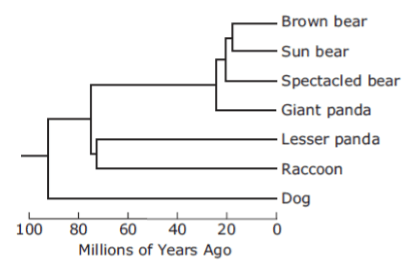
Who is the closest relative to the brown bear?

1

Giant panda

2

Dog

3

Lesser panda

4

Sun bear

72

Multiple Choice

Question image

Which organism is the most distantly related to all the others?

1

Raccoon

2

Dog

3

Giant Panda

4

Sun Bear

73

Multiple Choice

Question image

If two organisms belong to the same order, then they must also belong to the same...

1

Species

2

Class

3

Family

4

Genus

74

Multiple Choice

Question image

Within families, organisms are placed into groups called...

1

Genus

2

Kingdom

3

Class

4

Phylum

75

Multiple Choice

What is the genus name here:

Canis lupus

1

Canis

2

lupus

76

Multiple Choice

An organism that only has one cell.

1

Multicellular

2

Unicellular

3

Monocellular

4

Domain

77

Multiple Choice

Humans are made of

1

eukaryotic cells

2

prokaryotic cells

78

Multiple Choice

Some bacteria are motile which means

1

they are very big

2

they can move

3

they are multicellular

4

they are eukaryotes

79

Multiple Choice

Which of the following is the least closely related animal:
Gray Wolf: Canis lupus
Aardwolf: Proteles cristatus
Coyote: Canis latrans
1
Coyote
2
Aardwolf
3
Gray Wolf
4
Need more information on body characteristics

80

Multiple Choice

Which scientific name is written correctly?

1

Equus caballus

2

Equus caballus

3

Equus Caballus

4

Equus caballus

81

Multiple Select

Select the taxa that are used in an organism's scientific (binomial) name

1

Genus

2

Species

3

Family

4

Class

5

Order

82

Multiple Choice

What language is used to create scientific names?

1

English

2

Greek

3

Latin

4

French

83

Multiple Choice

What would the scientific name of this organism be?

Kingdom: Animalia

Phylum: Chordata

Class: Mammalia

Order: Carnivora

Family:Canidae

Genus: Canis

species: mesomelas

1

Mammalia carnivora

2

Canidae mesomelas

3

Canis mesomelas

4

Animalia chordata

84

Reorder

Reorder the following from most inclusive (larger) to most specific:

Kingdom

Phylum

Class

Order

Genus

1
2
3
4
5

85

Match

Match the following definitions to the corresponding taxa

A domain containing cells without a nucleus and potentially pathogenic species

A domain containing non-nucleated cells but are genetically similar to eukaryotes

A Kingdom containing the most diverse eukaryotic organisms

A kingdom containing organisms that photosynthesize and have land adaptations

A Phylum containing animals that have a nerve cord

Bacteria

Archaea

Protist

Plant

Chordata

86

Multiple Choice

Question image

According to this phylogenetic tree, which of these animal phyla are most closely related?

1

Arthropoda & Mollusca

2

Arthropoda & Chordata

3

Chordata & Mollusca

87

Multiple Choice

Question image

If a plant has vascular tissue but no seeds, which of the four plant groups (clades) here would it be classified as?

1

Ferns

2

Cone-bearing plants

3

Mosses

4

Flowering plants

88

Multiple Choice

Question image

Who is most closely related to Taxidea taxus?

1

Lutra lutra

2

Panthera pardus

3

Canis latrans

4

Canis lupus

89

Multiple Choice

Question image

Take your time and read carefully!


A student discovers an arachnid with a segmented abdomen, long legs, and a tail with no stinger. The student uses the dichotomous key below to identify it. Which arachnid has the student found?

1

Whip Scorpion

2

Wind Scorpion

3

Tick

4

Scorpion

90

media

Dichotomous Keys

91

Dichotomous Keys

What is a Dichotomous Key?

A dichotomous key is a series of "yes or no" questions that allow you to correctly identify any living organism, such as plant or animal, or non-living thing, like rocks. The word dichotomous means divided into two parts.

When following a dichotomous key you always answer with "yes" or "no" and follow the instructions.

92

media

Following a dichotomous key should be simple. Answer "yes" or "no" and follow along.
For example, comparing a turtle to a tortoise:

Identifying an Organism

93

media
  1. Does the animal have a flipper or foot? If it has a flipper go to 2. If it has a foot go to 3.

  2. The animal is a turtle.

  3. The animal is a tortoise.

Steps to Identify an Organism

​There are many other differences between a turtle and tortoise that can be observed by this picture! The examples given are just ONE of many ways of identifying a turtle or tortoise!

94

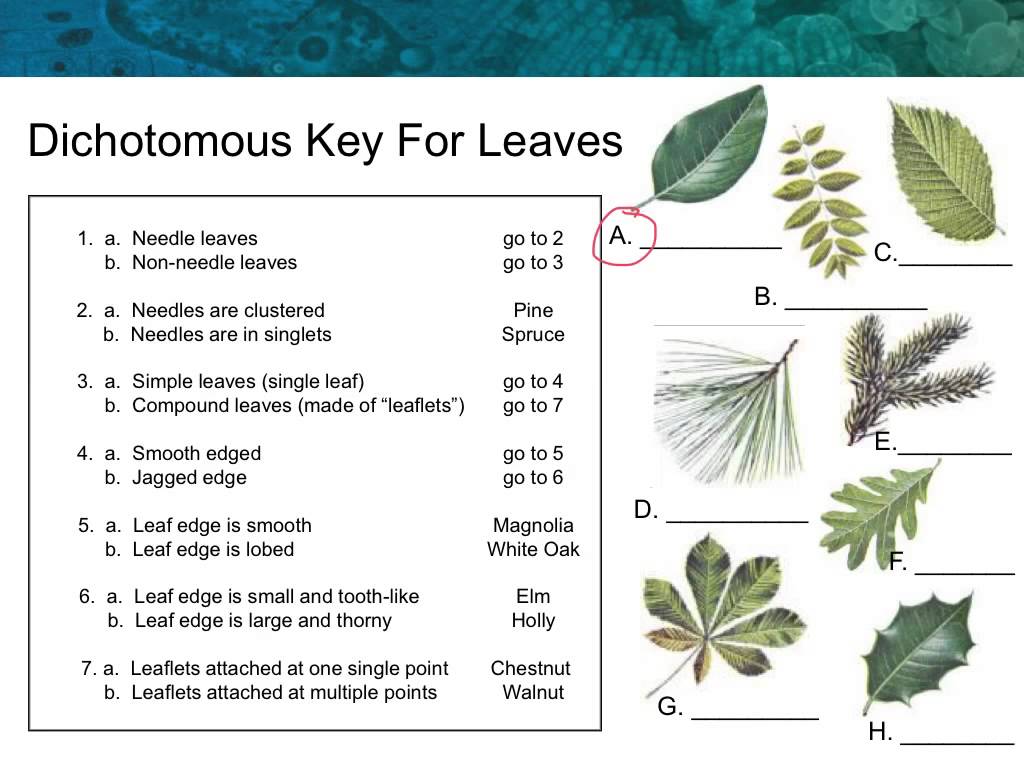
Follow along to identify the organism on the dichotomous key by answering "yes" or "no" starting with 1!

Dichotomous Key Example

media

95

Multiple Choice

Question image

Following this dichotomous key, identify the insect labeled "B"

1

Ladybug

2

Firefly

3

Dragonfly

4

Bee

96

Multiple Choice

Question image

Following this dichotomous key, identify the insect labeled "D"

1

Ladybug

2

Firefly

3

Dragonfly

4

Bee

97

Let's identify organism #4 together.

Following the Key Practice

media
  • It has NO backbone, so I'm going to look at b. I'll go to 5.

  • It has NO antenna so I'm going to look at b.

  • Organism #4 is a spider!

98

Multiple Choice

Question image

Using this dichotomous key identify organism 2.

1

Snake

2

Tortoise

3

Lizard

4

Ant

99

media

Looking at organism #2, this is how we can properly identify the lizard.
It has a backbone, it has no wings, it has legs, and it has no shell.
Therefore, it is a lizard!

Reviewing the Key

100

media

You can see in this dichotomous key that there are no living things present. Instead, there's different types of rocks!

​Dichotomous for non-living

101

media

Using this dichotomous key let's try to identify sample D:

​Dichotomous for non-living

  1. ​The rock is black - go to step 2.

  2. The rock has a glassy texture

  3. The rock is obsidian!

102

Multiple Choice

Question image

Using this dichotomous key, identify sample C:

1

Conglomerate

2

Granite

3

Slate

4

Gneiss

103

Multiple Choice

Question image

Using this dichotomous key, identify sample E:

1

Conglomerate

2

Granite

3

Slate

4

Gneiss

104

Multiple Choice

Question image

What is a dichotomous key used for in science?

1

To organize biomes

2

Classify organisms

3

Identify bacteria only

4

None of these

105

Multiple Choice

When using a dichotomous key to identify organisms, what do we look at?
1
physical features
2
weather patterns
3
environment
4
diet

106

Multiple Choice

What is the purpose of a dichotomous key?
1
to find a common ancestor
2
to show the evolution of organisms
3
to show relationships between organisms
4
to identify organisms

107

Multiple Choice

Question image
An illustration and a dichotomous key are given. What is the correct classification for this organism?
1
Class Insecta
2
Order Amblygygi
3
Order Araneae
4
Order Scorpiones

108

Multiple Choice

Question image

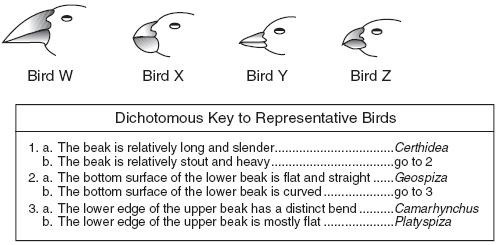
What is the name of bird W?

1

Certhidea

2

Geospiza

3

Camarhynchus

4

Platyspiza

109

Multiple Choice

Question image
A dichotomous key for trees is provided. Hikers found a tree that has large brown cones and single sharp needles. What species of tree have the hikers found?
1
Juniper
2
Pine
3
Spruce
4
Fir

110

Multiple Choice

What is the purpose of a dichotomous key?

1

To find a common ancestor.

2

To show the evolution of organisms.

3

To show relationships between organisms.

4

To identify and classify organisms.

media

Show answer

Auto Play

Slide 1 / 110

SLIDE