
Reconstruction

Presentation
•
Social Studies
•
8th Grade
•
Practice Problem
•
Easy

Brandon Jones
Used 6+ times
FREE Resource
24 Slides • 22 Questions
1
2
3
Multiple Choice
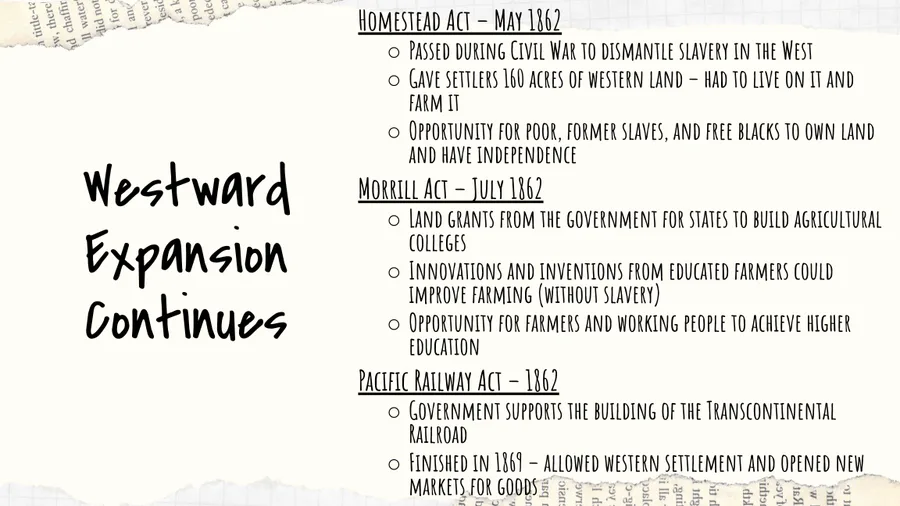
What was the primary goal of the Homestead Act of 1862?
To encourage settlement in the West by providing free land
To return land to Native American tribes
To expand industrial development in the North
To limit immigration to the United States
4
Multiple Choice
How did the Pacific Railway Act contribute to U.S. expansion?
It restricted railroad construction in the South
It provided government support for the Transcontinental Railroad
It prevented settlers from moving westward
It reduced the need for agricultural labor in the West
5
6
7
8
9

10
Multiple Choice
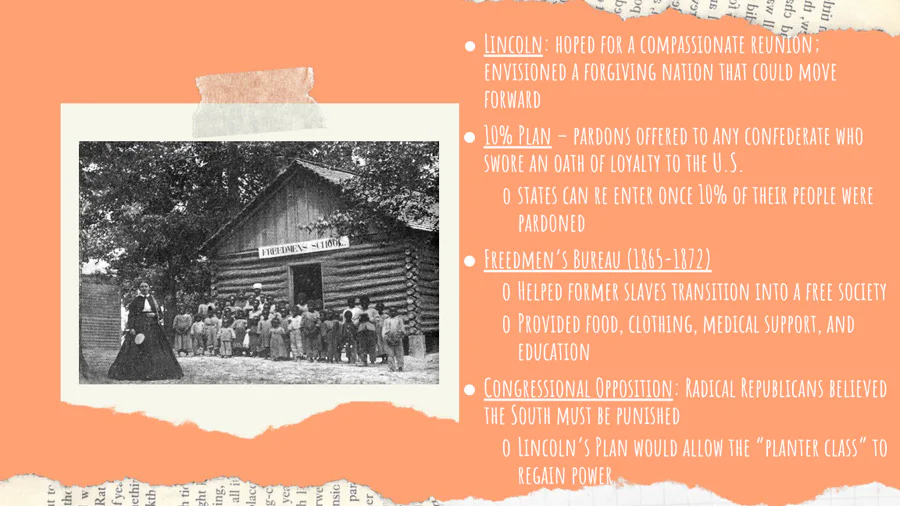
What was a key difference between Lincoln’s 10% Plan and the Radical Republicans’ approach to Reconstruction?
Lincoln wanted to punish the South, while the Radical Republicans sought a quick reunification
Lincoln wanted a more lenient process, while the Radical Republicans wanted stricter requirements for reentry
Lincoln required all former Confederate leaders to be imprisoned, while Radical Republicans pardoned them
Lincoln opposed the 13th Amendment, while Radical Republicans supported it
11
Multiple Choice
What was one major purpose of the Freedmen’s Bureau?
To provide financial compensation to former Confederate soldiers
To help newly freed African Americans adjust to life after slavery
To deport freedmen to Africa
To create new laws that restricted African American voting rights
12
Multiple Choice
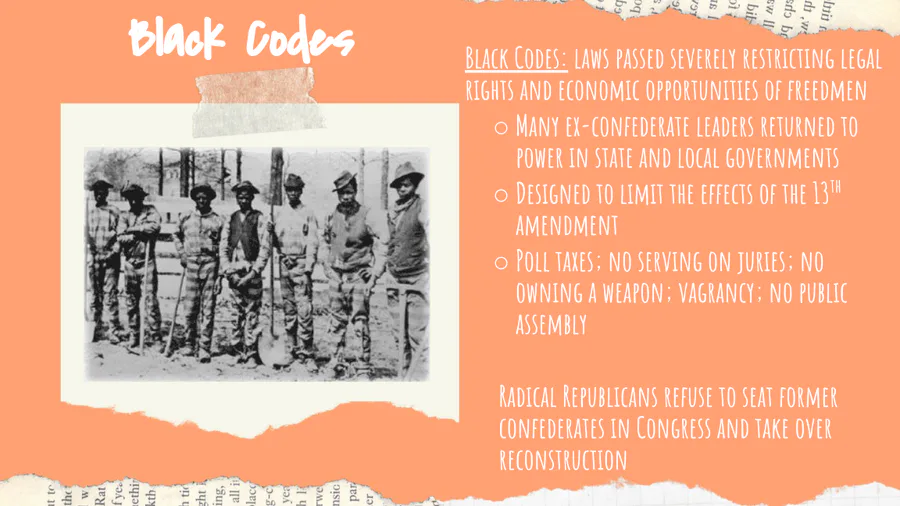
How did Black Codes impact freed African Americans in the South?
They guaranteed full equality and voting rights
They limited economic and political opportunities for African Americans
They provided financial aid to African American families
They encouraged freedmen to run for public office
13
14

15
16
17
18
Multiple Choice
What was the main goal of the 14th Amendment?
To establish slavery in new western territories
To grant citizenship and equal protection under the law
To return former slaves to their owners
To provide land to Native Americans
19
Multiple Choice
Why was President Andrew Johnson impeached?
He refused to ratify the 13th Amendment
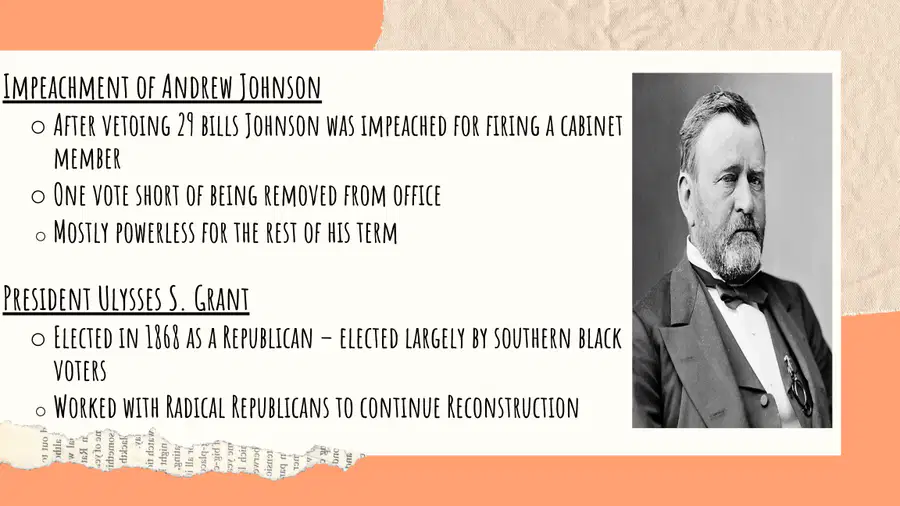
He fired a cabinet member, violating the Tenure of Office Act
He supported racial equality in the South
He attempted to abolish the U.S. Congress
20
Multiple Choice
What was one effect of the Military Reconstruction Act?
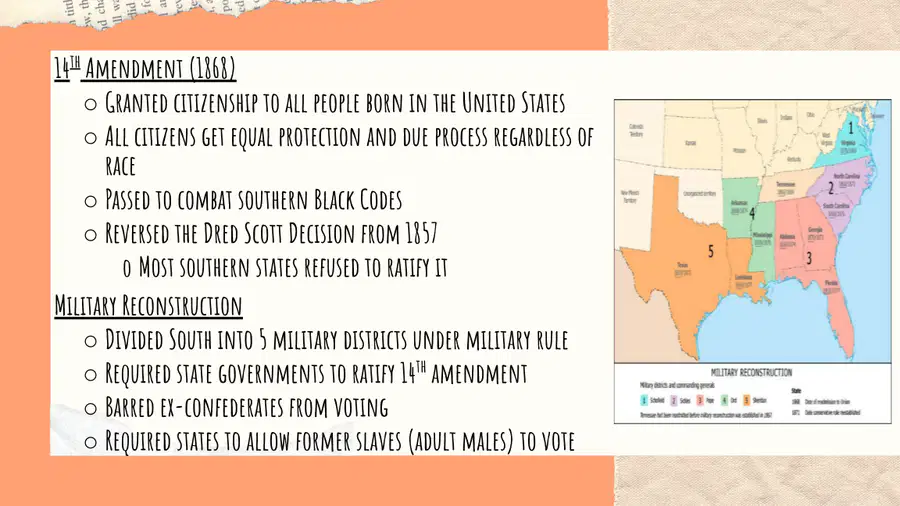
The South was divided into military districts to enforce Reconstruction laws
Former Confederate leaders were allowed to serve in Congress
All Southern states were immediately readmitted to the Union
The Freedmen’s Bureau was abolished
21
Multiple Choice
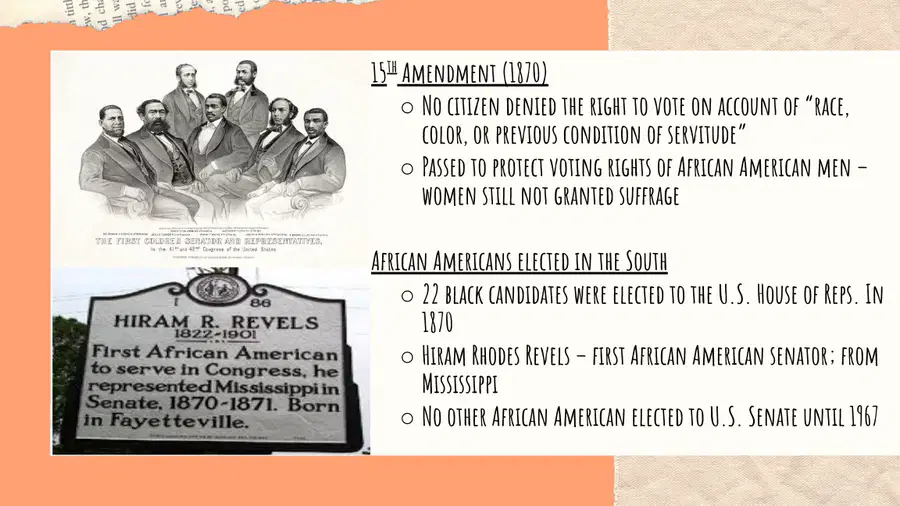
What was the purpose of the 15th Amendment?
To grant women the right to vote
To ensure voting rights for African American men
To abolish slavery in the United States
To establish the Electoral College
22
23
24
25
Multiple Choice
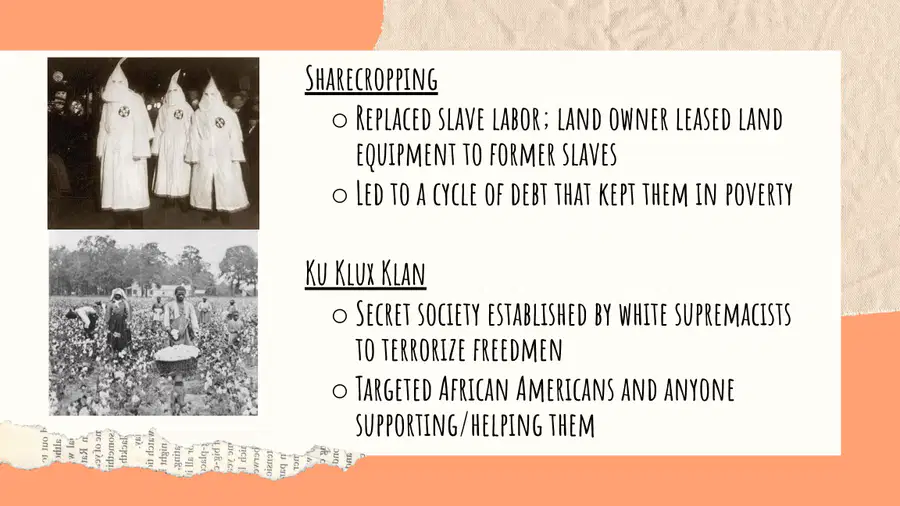
What was a common effect of sharecropping on African American farmers?
It provided them with economic independence and land ownership
It trapped them in a cycle of debt and poverty
It allowed African Americans to own large plantations
It was only practiced in the Northern states
26
27
28
29
Multiple Choice
How did the Compromise of 1877 impact Reconstruction?
It resulted in the removal of federal troops from the South, effectively ending Reconstruction
It granted equal rights to all African Americans in the South
It strengthened the enforcement of Reconstruction laws
It allowed former Confederate leaders to be imprisoned
30
31
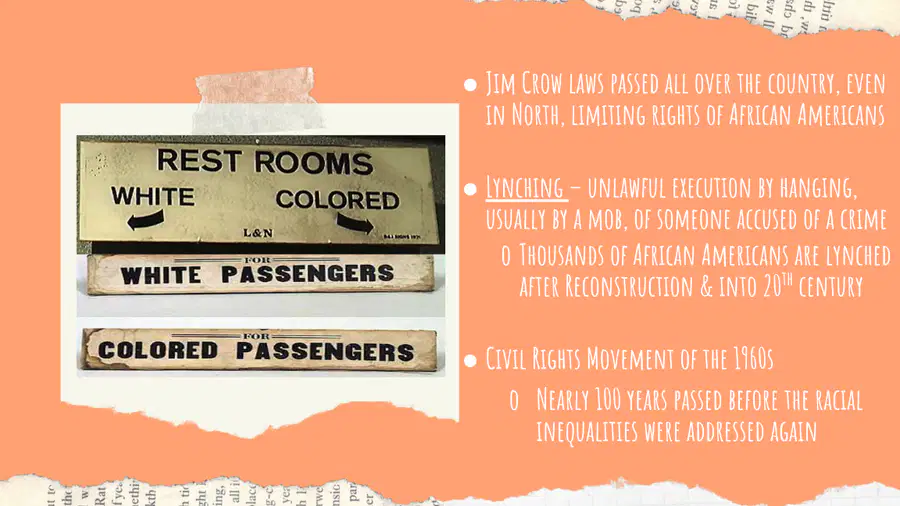
32
Multiple Choice
What were Jim Crow laws designed to do?
Promote racial equality in the South
Provide free education for all citizens
Enforce racial segregation and limit African American rights
Prevent women from voting
33
Plessy v. Ferguson (1896) was a Supreme Court case that upheld racial segregation under the doctrine of "separate but equal."
Homer Plessy, who was part African American, sat in a whites-only train car in Louisiana and was arrested for violating segregation laws.
The Court ruled that separate facilities for Black and white people were legal as long as they were "equal."
This decision made segregation legal across the U.S. and led to Jim Crow laws that enforced racial separation.
34
35
Dropdown
36
The correct choice is the 13th amendment, which stated slavery was illegal after the Civil War.
37
Fill in the Blanks
Which amendment to the US Constitution granted full citizenship to all people born in the United States?
38
The 15th Amendment to the US Constitution prohibited the state and federal governments from denying the right to vote to any male citizen because of 'race.' Therefore, the correct choice is 15th.
39
Drag and Drop
12th
13th
14th
40
Multiple Choice

F
G
H
J
41
Multiple Choice

F
G
H
J
42
Categorize
Harsh punishment for Southerners
Loose punishment on the South
10% must support emancipation
Establish Freedmen's Bureau to assist former slaves
Military districts to enforce civil rights
States must declare secession illegal
10% of Southern voters must swear allegiance
50% oath of allegiance
Organize these options into the right categories into the different plans for Reconstructing the Union.
43
Hotspot
Which location on the map was the turning point of the Civil War?
44
Hotspot
This is considered the low point of the Civil War for the South. The Anaconda Plan is now complete.
45
Categorize
Worked for a wage
Could vote
Discriminated against
Were not paid for their labor
Could own their own business
Could travel without restrictions
No control over their life
Were citizens
Organize these options into the right categories for characteristics of Free and Enslaved Black people prior to the Civil War.
46
Match
Match the following people to their significance
Hiram Rhodes Revels
Abraham Lincoln
Andrew Johnson
Rutherford B. Hayes
First Black U.S. Senator
Assassinated before reconstruction
Impeached during Reconstruction
Ended Reconstruction
First Black U.S. Senator
Assassinated before reconstruction
Impeached during Reconstruction
Ended Reconstruction
Show answer
Auto Play
Slide 1 / 46
SLIDE
Similar Resources on Wayground

41 questions
The Enlightenment Review
Presentation
•
7th Grade
41 questions
อริยสัจ4 ม.2
Presentation
•
8th Grade
41 questions
Civics VA SOL Review
Presentation
•
8th Grade
41 questions
Dorchester2_01/27/2025-Congruence REview
Presentation
•
8th Grade
39 questions
ARSA 7th Texas Studies CA #1 Review
Presentation
•
7th Grade
42 questions
Ancient Greece Review
Presentation
•
7th Grade
37 questions
Neolithic Revolution
Presentation
•
9th Grade
39 questions
12.1 Politics of the People
Presentation
•
8th Grade
Popular Resources on Wayground
10 questions
Safety Day 2026 – Student Review

Quiz
•
9th Grade
21 questions
Continents and Oceans
Quiz
•
6th Grade
20 questions
Parts of Speech
Quiz
•
5th Grade
16 questions
Subject & Predicate
Quiz
•
5th Grade
25 questions
Multiplication Facts
Quiz
•
5th Grade
12 questions
Map Skills
Quiz
•
3rd Grade
22 questions
Continents and Oceans
Quiz
•
5th Grade
15 questions
Rounding Decimals
Quiz
•
5th Grade
Discover more resources for Social Studies
19 questions
Foundations of America
Quiz
•
6th - 8th Grade
10 questions
Exploring the Age of Exploration: Key Events and Figures

Interactive video
•
6th - 10th Grade
20 questions
Articles of Confederation
Quiz
•
8th Grade
15 questions
Middle Ages of the Middle East Vocab List (CFA #2)
Quiz
•
6th - 8th Grade
13 questions
American Revolution Review
Quiz
•
8th Grade
18 questions
American Revolution Unit 3
Quiz
•
8th Grade
10 questions
Indigenous Peoples' Day Quiz
Quiz
•
8th Grade
5 questions
American Revolutionary War
Interactive video
•
8th Grade