

AP Lang 9.1.4 MCQ "Of Studies" Bacon

Presentation
•
English
•
11th Grade
•
Hard
+32
Standards-aligned

Beth Miller
Used 6+ times
FREE Resource
6 Slides • 27 Questions
1
9.1.4 Assignment: MCQ Practice
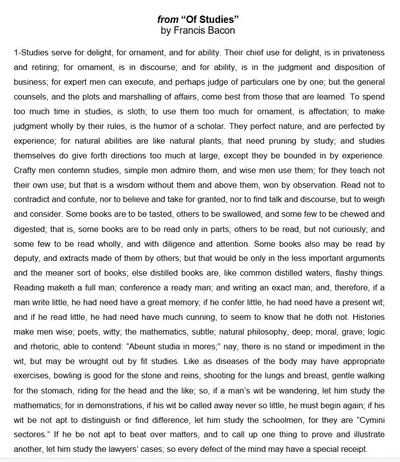
excerpt from "Of Studies" by Francis Bacon
AP English Language and Composition
2
Audio (3:25) of Francis Bacon's "On Studies"
Francis Bacon's "Of Studies"
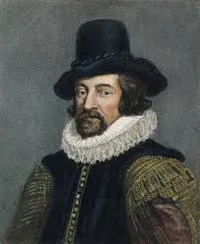
1561-1626, English philosopher and statesman who served under King James I
3
Multiple Choice
1. Which of the following best summarizes Bacon’s observation in the opening of his essay about learning?
Learning has equal results for all.
Learning only benefits those who have a natural ability.
Learning is not beneficial for everyone.
Learning is personal and unique to the learner.
4
Multiple Choice
2. In the sentence below, Bacon employs all the following except _____.
Some books are to be tasted, others to be swallowed, and some few to be chewed and digested; that is, some books are to be read only in parts; others to be read, but not curiously; and some few to be read wholly, and with diligence and attention.
parallel syntax
allusion
C
didactic language
metaphor
5
Multiple Choice
3.In context, the word “deputy” in the sentence below is best interpreted to mean _____.
Some books also may be read by deputy, and extracts made of them by others; but that would be only in the less important arguments, and the meaner sort of books, else distilled books are like common distilled waters, flashy things.
substitute
expedience
default
assumption
6
Multiple Choice
4.In the following sentence, which of the following rhetorical devices is most evident?
Read not to contradict and confute; nor to believe and take for granted; nor to find talk and discourse; but to weigh and consider.
anecdote
sarcasm
aphorism
asyndeton
7
Multiple Choice
5.Bacon’s tone in the passage as a whole is best described as _____.
superficial and capricious
informal and analytical
direct and concise
enthusiastic and optimistic
8
Multiple Choice
6.In the last section of his essay given in the paragraph below, Bacon employs an analogy to demonstrate his belief that learning is comparable to _____.
Like as diseases of the body may have appropriate exercises, bowling is good for the stone and reins, shooting for the lungs and breast, gentle walking for the stomach, riding for the head and the like; so, if a man’s wit be wandering, let him study the mathematics; for in demonstrations, if his wit be called away never so little, he must begin again; if his wit be not apt to distinguish or find difference, let him study the schoolmen, for they are “Cymini sectores.” If he be not apt to beat over matters, and to call up one thing to prove and illustrate another, let him study the lawyers’ cases; so every defect of the mind may have a special receipt.
exercise
a disease
a cure
philosophy
9
Multiple Choice
7.In the sentence below, which of the following words is parallel in function to “condemn”?
Crafty men condemn studies, simple men admire them, and wise men use them; for they teach not their own use; but that is a wisdom without them, and above them, won by observation.
“crafty”
“wisdom”
“above”
“use”
10
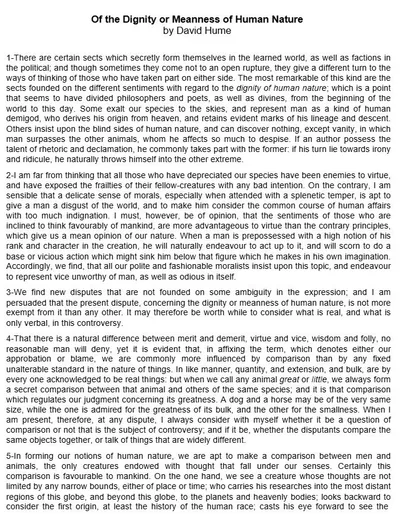
Of the Dignity or Meanness of Human Nature
by David Hume
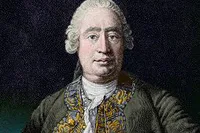
Scottish philospher, historian, economist, and essayist 1711-1776
11
12
13
Multiple Choice
8.On the basis of the first paragraph, Hume describes the two “sects” as _____.
There are certain sects which secretly form themselves in the learned world, as well as factions in the political; and though sometimes they come not to an open rupture, they give a different turn to the ways of thinking of those who have taken part on either side. The most remarkable of this kind are the sects founded on the different sentiments with regard to the dignity of human nature; which is a point that seems to have divided philosophers and poets, as well as divines, from the beginning of the world to this day. Some exalt our species to the skies, and represent man as a kind of human demigod, who derives his origin from heaven, and retains evident marks of his lineage and descent. Others insist upon the blind sides of human nature, and can discover nothing, except vanity, in which man surpasses the other animals, whom he affects so much to despise. If an author possess the talent of rhetoric and declamation, he commonly takes part with the former: if his turn lie towards irony and ridicule, he naturally throws himself into the other extreme.
people who believe humans are perfect, and people who believe humans are evil
people who hold strong opinions about human nature, and people who have no real opinions about human nature
people who believe humans are naturally ignorant, and people who believe humans are naturally intelligent
people who believe humans are naturally ignorant, and people who believe humans are naturally intelligent
14
Multiple Choice
9.In the fourth paragraph, what is Hume’s argument about making comparisons?
That there is a natural difference between merit and demerit, virtue and vice, wisdom and folly, no reasonable man will deny, yet it is evident that, in affixing the term, which denotes either our approbation or blame, we are commonly more influenced by comparison than by any fixed unalterable standard in the nature of things. In like manner, quantity, and extension, and bulk, are by every one acknowledged to be real things: but when we call any animal great or little, we always form a secret comparison between that animal and others of the same species; and it is that comparison which regulates our judgment concerning its greatness. A dog and a horse may be of the very same size, while the one is admired for the greatness of its bulk, and the other for the smallness. When I am present, therefore, at any dispute, I always consider with myself whether it be a question of comparison or not that is the subject of controversy; and if it be, whether the disputants compare the same objects together, or talk of things that are widely different.
Comparisons are dangerous because humans are more likely to be influenced by them than they are of standard facts.
Comparisons are useful when determining how the nature of two things are similar.
Comparisons are helpful when explaining difficult philosophies because humans relate more to comparisons.
Comparisons are dangerous if the two things being compared are not actually similar.
15
Multiple Choice
10. Hume develops the passage primarily through _____.
accumulation of detail
pro-and-con argument
assertion supported by evidence
analysis of the ideas of others
16
Multiple Choice
11.The author of the piece, David Hume, is best described as _____.
a person of resounding moral character
a person who struggles with being virtuous
a person who believes in the goodness of humankind
a person who hates all self-righteous behavior
17
Multiple Choice
12.What does the overall text, "Of the Dignity or Meanness of Human Nature," by David Hume imply?
It is inconsequential to compare humans to one another because all humans are fallible and cannot judge each other without bias.
It is necessary to compare humans to one another because it is how humans learn about what traits are desirable.
It is pointless to compare humans to one another because one will inevitably remark on a specific trait’s uncommonness rather than its absolute virtue.
It is unavoidable to compare humans to one another because in our human frailty we strive for connection with each other.
18
Multiple Choice
13.The excerpted passage from "Of the Dignity or Meanness of Human Nature" ends on a note of _____.
genuine relief
catastrophic destructiveness
ominous warning
definitive conclusion
19
Multiple Choice
14.Read an excerpt from the second paragraph of Hume's text below. In context, the word “splenetic” in this paragraph is best interpreted to mean _____.
I am far from thinking that all those who have depreciated our species have been enemies to virtue, and have exposed the frailties of their fellow-creatures with any bad intention. On the contrary, I am sensible that a delicate sense of morals, especially when attended with a splenetic temper, is apt to give a man a disgust of the world, and to make him consider the common course of human affairs with too much indignation. I must, however, be of opinion, that the sentiments of those who are inclined to think favourably of mankind, are more advantageous to virtue than the contrary principles, which give us a mean opinion of our nature.
optimistic
cynical
illusive
deranged
20
Multiple Choice
15.The possessive adjective “his” (in “casts his eye”) refers to which of the following entities?
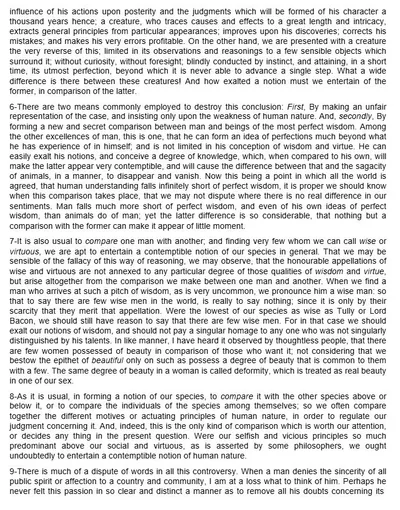
On the one hand, we see a creature whose thoughts are not limited by any narrow bounds, either of place or time; who carries his researches into the most distant regions of this globe, and beyond this globe, to the planets and heavenly bodies; looks backward to consider the first origin, at least the history of the human race; casts his eye forward to see the influence of his actions upon posterity and the judgments which will be formed of his character a thousand years hence; a creature, who traces causes and effects to a great length and intricacy, extracts general principles from particular appearances; improves upon his discoveries; corrects his mistakes; and makes his very errors profitable.
“human race”
“heavenly bodies”
"this globe"
“a creature”
21
Multiple Choice
16.What rhetorical device does Hume primarily use in the given paragraph?
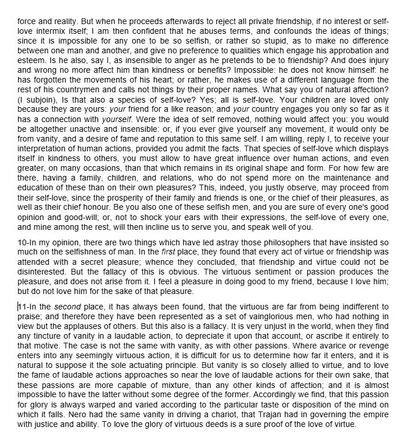
There is much of a dispute of words in all this controversy. When a man denies the sincerity of all public spirit or affection to a country and community, I am at a loss what to think of him. Perhaps he never felt this passion in so clear and distinct a manner as to remove all his doubts concerning its force and reality. But when he proceeds afterwards to reject all private friendship, if no interest or self-love intermix itself; I am then confident that he abuses terms, and confounds the ideas of things; since it is impossible for any one to be so selfish, or rather so stupid, as to make no difference between one man and another, and give no preference to qualities which engage his approbation and esteem. Is he also, say I, as insensible to anger as he pretends to be to friendship? And does injury and wrong no more affect him than kindness or benefits? Impossible: he does not know himself: he has forgotten the movements of his heart; or rather, he makes use of a different language from the rest of his countrymen and calls not things by their proper names. What say you of natural affection? (I subjoin), Is that also a species of self-love? Yes; all is self-love. Your children are loved only because they are yours: your friend for a like reason; and your country engages you only so far as it has a connection with yourself. Were the idea of self removed, nothing would affect you: you would be altogether unactive and insensible: or, if you ever give yourself any movement, it would only be from vanity, and a desire of fame and reputation to this same self. I am willing, reply I, to receive your interpretation of human actions, provided you admit the facts. That species of self-love which displays itself in kindness to others, you must allow to have great influence over human actions, and even greater, on many occasions, than that which remains in its original shape and form. For how few are there, having a family, children, and relations, who do not spend more on the maintenance and education of these than on their own pleasures? This, indeed, you justly observe, may proceed from their self-love, since the prosperity of their family and friends is one, or the chief of their pleasures, as well as their chief honour. Be you also one of these selfish men, and you are sure of every one's good opinion and good-will; or, not to shock your ears with their expressions, the self-love of every one, and mine among the rest, will then incline us to serve you, and speak well of you.
anaphora
rhetorical question
ethos
alliteration
22
Multiple Choice
17.The tone of Hume's writing can best be described as _____.
disbelieving
uncertain
objective
determined
23
Multiple Choice
18.The sentence structure and diction of the following sentence suggests that the situation is viewed by Hume as ______.
But when he proceeds afterwards to reject all private friendship, if no interest or self-love intermix itself; I am then confident that he abuses terms, and confounds the ideas of things; since it is impossible for any one to be so selfish, or rather so stupid, as to make no difference between one man and another, and give no preference to qualities, which engage his approbation and esteem.
ridiculous
truthful
corrupt
mysterious
24
Multiple Choice
19.The following sentence from the passage employs all the following to convey Hume’s opinion except _____.
But vanity is so closely allied to virtue, and to love the fame of laudable actions approaches so near the love of laudable actions for their own sake, that these passions are more capable of mixture, than any other kinds of affection; and it is almost impossible to have the latter without some degree of the former.
use of a logical fallacy
use of abstract diction
use of parallel structure
use of an assertive tone
25
Multiple Choice
20.Which of the following is used in the given sentence?
Be you also one of these selfish men, and you are sure of every one's good opinion and good will; or not to shock your ears with these expressions, the self-love of every one, and mine among the rest, will then incline us to serve you, and speak well of you.
elaborate metaphor
a single, cumulative (loose) sentence
a compound subject
subordinate clauses
26
Audio (3:05) of Francis Bacon's "Of Revenge
Francis Bacon's "Of Revenge"
1561-1626, English philosopher and statesman who served under King James I
27
Multiple Choice
39.What message is relayed in the second paragraph of Francis Bacon's essay, "Of Revenge"?
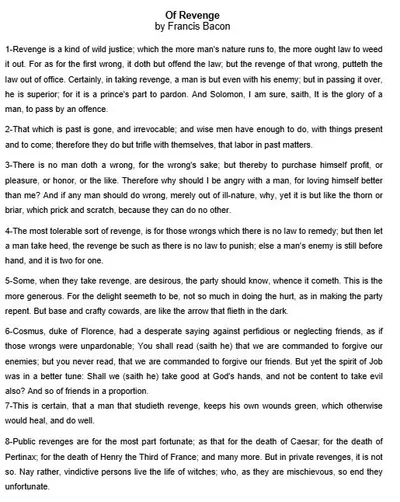
That which is past is gone, and irrevocable; and wise men have enough to do, with things present and to come; therefore they do but trifle with themselves, that labor in past matters.
It is easier to deal with things from the past than things in the present.
It is better to think of forgiveness than to think of revenge.
It is preferred to pass on revenge rather than to take revenge.
It is simpler to forgive and forget than to desire revenge.
28
Multiple Choice
40.According to Bacon, doing something wrong _____.
is unavoidable because it is part of human nature since all men are evil
derives from one's desire to harm someone
means one should confess and repent
comes from being selfish and cannot be resisted
29
Multiple Choice
41.Based on the essay "Of Revenge," what happens to a person who holds on to a desire for revenge?
They end up causing themselves more pain and unhappiness.
They eventually can heal and become emotionally healthy.
They eventually can heal and become emotionally healthy.
They can never move on because they keep trying to get revenge.
30
Multiple Choice
42. Paragraph 3 of the essay "Of Revenge" contains all of the following rhetorical devices except _____.
There is no man doth a wrong, for the wrong's sake; but thereby to purchase himself profit, or pleasure, or honor, or the like. Therefore why should I be angry with a man, for loving himself better than me? And if any man should do wrong, merely out of ill-nature, why, yet it is but like the thorn or briar, which prick and scratch, because they can do no other.
rhetorical question
simile
anaphora
appeal to logos
31
Multiple Choice
43.What is the purpose of the allusions in the final paragraph of Bacon's essay "Of Revenge"?
Public revenges are for the most part fortunate; as that for the death of Caesar; for the death of Pertinax; for the death of Henry the Third of France; and many more. But in private revenges, it is not so. Nay rather, vindictive persons live the life of witches; who, as they are mischievous, so end they unfortunate.
to disclaim any opposing viewpoints to the successfulness of revenge
to provide evidence for the fallacy of public revenge
to supply an example of how revenge can destroy someone
to include a comparison of public and private revenge
32
Multiple Choice
44.Based on the essay "Of Revenge," Bacon would most likely agree with which of the following statements?
It is important to accept both the good and the bad in everyone’s personality.
Giving a second chance to a tyrant is the right action to take.
Never forget the wrong someone has done to you.
Revenge only turns people into witches and leads to unpardonable acts.
33
Multiple Choice
45.Which rhetorical device does Bacon use in the following sentence from "Of Revenge"?
For the delight seemeth to be not so much in doing the hurt as in making the party repent: but base and crafty cowards are like the arrow that flieth in the dark.
parallel syntax
simile
euphemism
metaphor
9.1.4 Assignment: MCQ Practice
excerpt from "Of Studies" by Francis Bacon
AP English Language and Composition
Show answer
Auto Play
Slide 1 / 33
SLIDE
Similar Resources on Wayground

25 questions
Electron Configuration, Orbital Notation, & Dot diagrams
Presentation
•
9th - 12th Grade
26 questions
Trật tự tính từ - The order of adjectives
Presentation
•
10th Grade
25 questions
Analytical Exposition
Presentation
•
11th Grade
25 questions
IMPERATIVE SENTENCE
Presentation
•
11th Grade
21 questions
Claims
Presentation
•
11th Grade
26 questions
English III 3rd Quarter Grammar Review
Presentation
•
11th Grade
27 questions
Author's Intent Lesson
Presentation
•
10th - 11th Grade
25 questions
Persuasive Writing: Introductions
Presentation
•
10th Grade
Popular Resources on Wayground
10 questions
HCS SCI 03 Summer School Review 4

Quiz
•
3rd Grade
11 questions
HSMS - Standard Response Protocol
Quiz
•
6th - 8th Grade
16 questions
1.1-1.2 Quiz Review
Quiz
•
9th - 12th Grade
12 questions
Exponent Expressions
Quiz
•
6th Grade
20 questions
Adding and Subtracting Integers
Quiz
•
6th - 7th Grade
11 questions
Northeast States
Quiz
•
3rd - 4th Grade
10 questions
Characterization
Quiz
•
3rd - 7th Grade
10 questions
Common Denominators
Quiz
•
5th Grade