

1.2.2 Astronomy Becomes a Science

Presentation
•
Other
•
11th Grade
•
Practice Problem
•
Easy

Caitlin Ford
Used 3+ times
FREE Resource
13 Slides • 5 Questions
1
Astronomy Becomes a Science
1.2.2
2
Objectives
- discuss the Copernican model of the solar system
- explain Kepler's laws of planetary motion
- list Galileo's observations of the solar system
- describe Newton's law of gravity
3
The Medieval Era
Astronomers were respected in many royal courts because of their connection with astrology and mysticism.
Each celestial object carried a different meaning and tracking the movements and positions was very important.
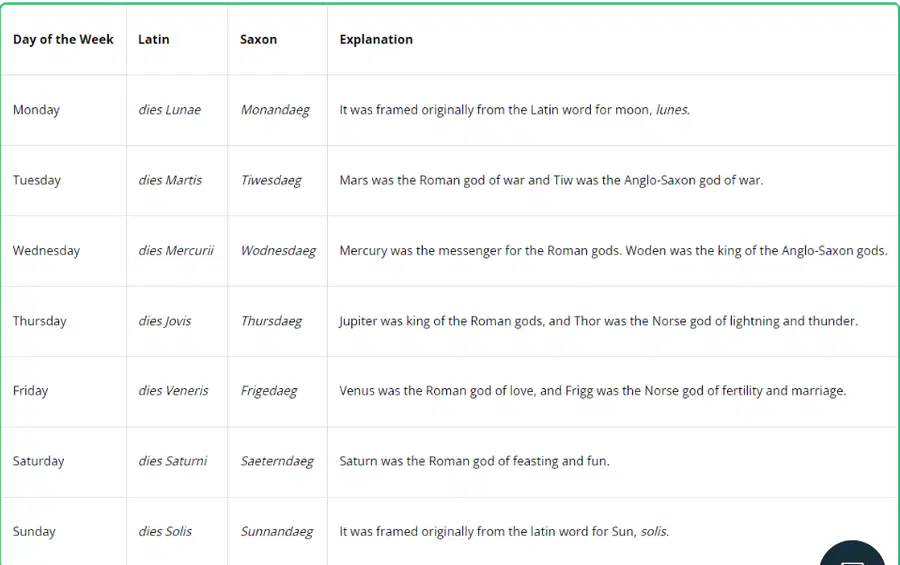
The names of the days of the week originally came from the important of celestial objects.
4
5
Influences of Astronomy
Celestial Objects and Music - there was a belief that the movement of the planets made music and this persisted for centuries.
Fear of Comets - the ancients didn't know comets had orbital periods and their sudden appearance sparked fear and dread. It was said comets brought fire and floods.
Fear of Solar Eclipses - the movement of the moon in front of the sun scared many uneducated people.
6
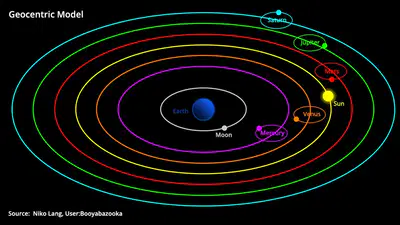
Questioning the Geocentric Model
7
View Across the Globe
European Astronomers - Sometimes the planets moved backwards. They had to keep adding new circles into the model.
Muslim Astronomers - Proposed rotation; the Earth is not stationary, but moves like a top! Later, proposed that while the Earth rotates, it also revolves around the Sun.
8
Drag and Drop
9
Renaissance Astronomy
Nicolaus Copernicus - introduced a new model of the solar system that accounted for the motion of the planets. This explained the changing brightness of the planets and the retrograde motion.
Heliocentric model - the sun is the center of the solar system and all the planets, including the Earth, revolve around it in circular orbits
10
Labelling
Label the two models.
Geocentric Model
Heliocentric Model
11
Tycho Brahe
Developed a new model after studying the motion of the planets and hundreds of stars.
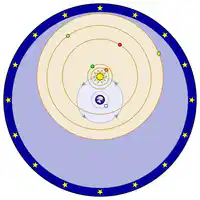
The model was a combo of the geocentric and heliocentric models - the Earth is the center, the Moon orbits it, the planets orbit the Sun, the Sun orbits earth, and there are fixed stars revolving around the Earth.
12
Kepler's Laws of Planetary Motion
Kepler was Brahe's assistant, and after his death, he spent 15 years developing these laws.
First Law - The planets' orbits are ellipses (not circles) and the Sun is not at the center, but on one side of the ellipse.
Second Law - the planets don't move at a constant speed, they move faster closer to the sun and slower farther away.
Third Law - planets closer to the sun orbit faster than more distant planets.

13
Multiple Choice
Compared to a nearby planet, which of the following best describes how a more distant planet orbits the Sun?
at the same speed
slower
faster
14
Galileo
Galileo was the first known person to point a telescope at celestial objects. He revolutionized astronomy!
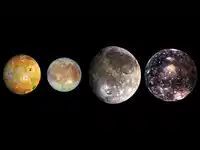
He observed: Venus has phases like the moon, four of Jupiter's moons (today these are called the Galilean moons), the Milky Way is made of stars, the Moon's surface is rough, with mountains.
15
Isaac Newton
He discovered gravity, which is what keeps celestial objects in their orbits!
Proposed ALL objects have gravity, but the more mass an object has, the more gravity it has.
16
Match
Match the following astronomers with their contributions to astronomy.
Galileo Galilei
Isaac Newton
Johannes Kepler
Nicolaus Copernicus
four moons of Jupiter
gravity
elliptical motion of the planets
heliocentric model
four moons of Jupiter
gravity
elliptical motion of the planets
heliocentric model
17
Draw
You Choose! Either draw the heliocentric model OR the geocentric model. Be sure to label your model.
18
Good Job!
Today, you learned:
- the struggle of Copernicus to propose a heliocentric model of the solar system
- Kepler's three laws of planetary motion
- how the invention of the telescope helped Galileo to support Copernicus's heliocentric solar system
- Newton's law of gravity
Astronomy Becomes a Science
1.2.2
Show answer
Auto Play
Slide 1 / 18
SLIDE
Similar Resources on Wayground

12 questions
FFA Emblem
Presentation
•
12th Grade
14 questions
Personal Letter
Presentation
•
11th Grade
14 questions
Writing in Standard Form
Presentation
•
11th Grade
12 questions
Living Things
Presentation
•
KG
14 questions
be going to
Presentation
•
11th Grade
11 questions
Teenager 5 Session 24: Pronunciation & Speaking
Presentation
•
KG
11 questions
Anticipation Guide "A Rose for Emily"
Presentation
•
11th Grade
15 questions
2-12 Solving Linear-Quadratic Systems
Presentation
•
11th Grade
Popular Resources on Wayground
16 questions
Grade 3 Simulation Assessment 2

Quiz
•
3rd Grade
19 questions
HCS Grade 5 Simulation Assessment_1 2526sy
Quiz
•
5th Grade
10 questions
Cinco de Mayo Trivia Questions

Interactive video
•
3rd - 5th Grade
17 questions
HCS Grade 4 Simulation Assessment_2 2526sy
Quiz
•
4th Grade
24 questions
HCS Grade 5 Simulation Assessment_2 2526sy
Quiz
•
5th Grade
13 questions
Cinco de mayo
Interactive video
•
6th - 8th Grade
20 questions
Math Review
Quiz
•
3rd Grade
30 questions
GVMS House Trivia 2026
Quiz
•
6th - 8th Grade
Discover more resources for Other
5 questions
A.EI.1-3 Quizizz Day 1
Quiz
•
9th - 12th Grade
210 questions
Unit 1 - 4 AP Bio Review
Quiz
•
9th - 12th Grade
100 questions
Biology EOC Review
Quiz
•
9th - 12th Grade
5 questions
A.EI.1-3 Quizizz Day 2
Quiz
•
9th - 12th Grade
5 questions
A.EI.1-3 Quizizz Day 4
Quiz
•
9th - 12th Grade
16 questions
AP Biology: Unit 1 Review (CED)
Quiz
•
9th - 12th Grade
5 questions
G.PC/DF Quizizz Day 2
Quiz
•
9th - 12th Grade
20 questions
verbos reflexivos en español
Quiz
•
9th - 12th Grade