

ISLAM IN WEST AFRICA

Presentation
•
History
•
11th Grade
•
Easy

olusegun owolabi
Used 2+ times
FREE Resource
15 Slides • 6 Questions
1
ISLAM IN WESST AFRICA
2
Open Ended
You are a merchant crossing a vast desert.
You hear about a powerful new religion with strange customs.
How do you feel?"
3
LESSON OBJECTIVES
Describe the origin of Islam in West Africa
Explain the early routes and contacts
Identify key early Islamic centers.
4
EXPLANATION
slam started in Arabia in the 7th century
Spread across North Africa
Entered West Africa mainly through trade
5
ORIGIN AND GROWTH OF ISLAM IN WEST AFRICA
Islam first reached West Africa not by sword but by sand-blown caravans carrying salt, gold and ideas. Born in seventh-century Arabia with the teachings of Prophet Muhammad, Islam swept across North Africa through trade and the missionary work of Berber scholars. As Muslim merchants and emissaries moved westward, they introduced their faith at desert oases and caravanserais, building personal ties with local rulers and communities rather than conquering them by force.
These early contacts followed the great Trans-Saharan routes, ancient tracks etched into the Sahara by generations of camel caravans. From oasis towns like Sijilmasa and Taghaza in the north, Berber and Arab traders crossed vast stretches of sand to exchange North African salt for West African gold. Along the way, they married into local families, demonstrated the practical benefits of Islamic law and literacy, and forged diplomatic alliances that made conversion attractive to chiefs seeking new sources of prestige and stable trade networks.
Before long, a handful of towns blossomed into true centers of Islamic culture. Gao, on the Niger’s middle bend, was among the first to adopt Islam at its royal court. Farther downstream, Timbuktu earned fame as a seat of learning, its mud-brick mosques and libraries drawing scholars from across the Sahara. To the east, the Kanem-Bornu kingdom around Lake Chad embraced Islam under Sefawa rulers, while the mighty Mali Empire under Mansa Musa elevated cities like Djenné into hubs of Arabic scholarship and pilgrimage. These interconnected centers would shape West Africa’s spiritual and intellectual landscape for centuries to come.
6
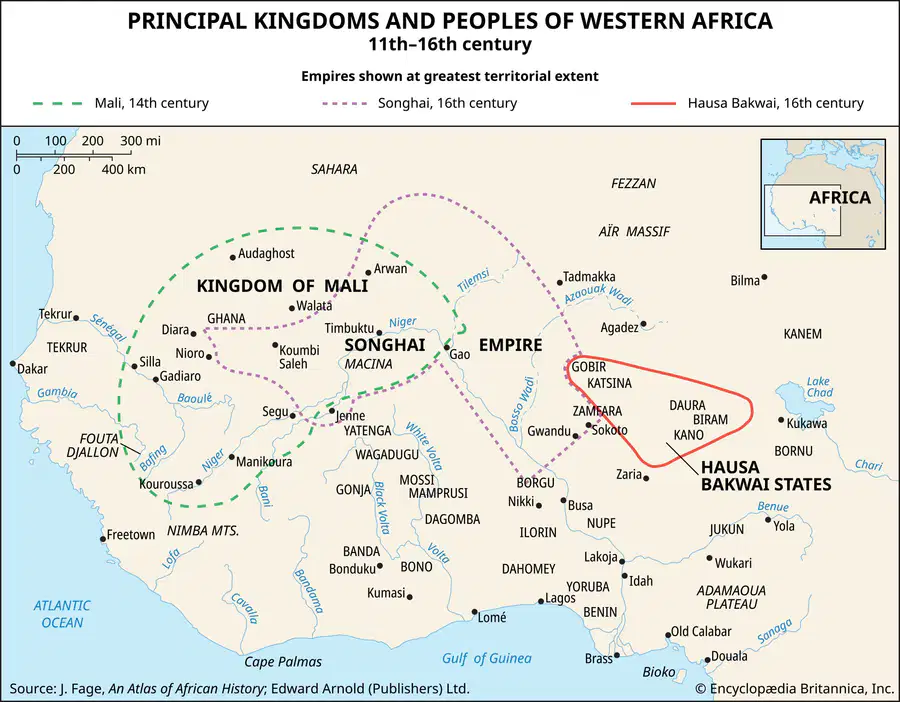
TRADE ROUTES OF ISLAM
: Map Activity
Title: Trade Routes and Islam
Show map of Trans-Saharan trade routes
Question: From the above routes, which path do you think Islam traveled?"
7
Open Ended
From the above routes, which path do you think Islam traveled?
8
My response
Taghaza Trail (Sijilmasa → Taghaza → Walata → Gao/Timbuktu)
Caravans carrying salt from the Taghaza mines in the central Sahara headed north to Sijilmasa (Morocco) and south to the Niger bend, linking with Gao and Timbuktu
Walata Road (Sénégal River region → Oualata → Walata)
This western spur ran from the Sénégal River through Oualata and Walata, connecting southern Sahelian zones to North African markets
Ghadames Road (Gao → Ghat → Ghadames → Tripoli)
Starting at Gao, caravans travelled north via Ghat and the oasis of Ghadames before reaching Tripoli on the Mediterranean
Garamantean Road / Bilma Trail (Tripoli → Murzuk → Kawar → Bilma → Lake Chad)
From Tripoli through Murzuk and Kawar, this shorter route passed the Bilma salt pits into the Kanem-Bornu region around Lake Chad.
Benghazi–Kufra–Wadai Route
Linking Benghazi and the Kufra oasis to the Wadai kingdom (between Lake Chad and Darfur), this eastern corridor also carried Islam southward
9
KEY EARLY CENTRES OF ISLAM IN WEST AFRICA
Gao
Timbuktu
Kanem-Borno
10
Open Ended
How did Islam spread?
11
Agents and Methods of Islamization
Merchants
Scholars
Political leaders
Sufi mystics
METHODS OF ISLAMIZATION
Peaceful preaching
Intermarriages
Trade relationships
Political alliances
12
AGENTS OF ISLAMIZATION OF WEST AFRICA
Merchants
Trans-Saharan traders were the first to carry Islam into the region. As they criss-crossed the desert with salt, gold and textiles, they shared their faith alongside their wares. By praying in caravan camps, reciting the Qur’an at rest stops, and setting up small mosques in trading towns, they introduced Islamic beliefs and practices directly into local marketplaces.
Scholars
Islamic scholars—often trained in North African centers like Cairo or Fez—traveled south to set up madrasas (schools) in emerging Islamic towns. They taught Arabic literacy, Qur’anic studies, and Islamic law, creating a learned class that could read and interpret religious texts. Their reputations for knowledge made conversion to Islam desirable for anyone seeking education or judicial authority.
Political Leaders
Many West African rulers adopted Islam to boost their prestige, legitimize their rule, and strengthen ties with wealthy Muslim states. Once a king or emir converted—and sometimes after making the pilgrimage to Mecca—Islamic law and court practices followed. Subjects often embraced the ruler’s faith out of loyalty or for economic advantage, which in turn deepened Islam’s roots in society.
13
Sufi Mystics
Sufi orders—mystical brotherhoods such as the Qadiriyya and Tijaniyya—sent charismatic spiritual leaders into West Africa. Their emphasis on personal piety, devotional music (qawwali), and communal gatherings (dhikr) appealed to many. Through their networks of zawiyas (lodges), they built a grassroots following that blended Islamic ritual with local customs.
14
Open Ended
1.What economic and social factors in both North and West Africa made the Trans-Saharan trade routes the ideal “vector” for introducing Islam, rather than conquest or mass migration?
2.How might the existing political structures and belief systems of early Sahelian kingdoms have facilitated—or resisted—the initial reception of Islamic ideas?
15
METHODS OF ISLAMIZATION
Peaceful Preaching
Imams and missionaries delivered sermons (khutbas) in mosques and open squares, explaining Islamic tenets in vernacular languages. Without force, they won converts by emphasizing moral teachings, community solidarity, and the benefits of a faith that encouraged trade honesty and legal fairness.
Intermarriages
Marriages between Muslim traders or scholars and local families helped Islam take root in households. When a Muslim son-in-law settled in a town and raised children who worshipped in a mosque or spoke Arabic, Islamic customs naturally wove into daily life and local culture.
Trade Relationships
Commercial partnerships created mutual dependency: local merchants wanted the economic advantages of dealing with northern traders, who in turn preferred to do business with those who shared their faith. Over time, adopting Islam smoothed transaction trust and widened one’s trading network.
Political Alliances
Conversion pacts between Muslim states and West African kingdoms often began as treaties or tributary arrangements. By embracing Islam, a ruler could secure military support or favorable trade terms, and the introduction of Islamic administration—such as courts based on Sharia—followed these diplomatic ties.
16
Open Ended
What are the impact of Islam in West Africa?
17
THE IMPACT OF ISLAM IN WEST AFRICA
Literacy in Arabic
Growth of education (Timbuktu)
Sharia law
Architectural styles (mosques)
Political structures
18
Literacy in Arabic
The spread of Islam brought Arabic script to West Africa, first through Qur’anic instruction in mosques and informal learning circles. As students memorized and copied Qur’ans, Arabic literacy became a mark of prestige, enabling communication with North African scholars and access to wider Islamic scholarship. Over time, local scribes produced manuscripts on theology, law and astronomy, embedding Arabic literacy into elite and clerical classes.
Growth of Education (Timbuktu)
By the 14th century, Timbuktu had become a major seat of learning with three renowned madrasas—Sankoré, Djinguereber and Sidi Yahya—attached to its grand mosques. Wealthy patrons and rulers endowed these institutions with libraries holding thousands of manuscripts. Scholars from across the Sahara flocked there to study theology, grammar, mathematics and law, turning the city into the “Athens of Africa.”
Sharia Law
Adoption of Sharia introduced a codified legal framework grounded in the Qur’an and Hadith. Qadis (Islamic judges) settled disputes over contracts, inheritance and personal status according to these principles, providing more consistency than customary courts. While adapted to local contexts, Sharia underpinned governance and helped integrate diverse communities under a shared system of justice.
Architectural Styles (Mosques)
West African mosques blended Sahelian building techniques with Islamic design elements. Mud-brick (or banco) construction, wooden toron beams for scaffolding and flat roofs characterized the Sudano-Sahelian style. Iconic examples include the Djinguereber Mosque in Timbuktu and the Great Mosque of Djenné, whose annual replastering celebrates both faith and communal craftsmanship.
19
Political Structures
Islamic governance introduced administrative offices such as viziers and chancery clerks who used Arabic for record-keeping and correspondence. Rulers adopted titles like “sultan” or “caliph,” aligning themselves with the broader Muslim world. While traditional councils of chiefs remained influential, these Islamic institutions centralized authority, standardized taxation, and facilitated diplomatic ties with North African and Middle Eastern states.
o4-mini
20
Open Ended
What are the influence of Islam in Hausaland?
21
THE IMPACT OF ISLAM IN HAUSALAND
1. It usually started as a religion of the ruling classes
2. It changed the religious attitude of the Hausa people
3. Arabic schools were established to educate the converts and teach them arabic language
4.Muslim scholars ministered to the needs of common people
5. It enable kings of Hausa states to have strong political control over their subjects
6. It brought the spread of Arabic culture
7. the Hausa states adopted system of taxation bearing in mind the islamic rule that ruler should not impose unjust taxes on the subjects
ISLAM IN WESST AFRICA
Show answer
Auto Play
Slide 1 / 21
SLIDE
Similar Resources on Wayground

14 questions
Nixon Foreign Policy
Presentation
•
11th Grade
15 questions
Haitian Declares Independence
Presentation
•
11th Grade
14 questions
Parts of an Essay Review
Presentation
•
11th Grade
14 questions
Los mandatos y las recetas
Presentation
•
11th Grade
15 questions
Political Machines - SS.912.A.3.11
Presentation
•
11th Grade
17 questions
Imperialism in India
Presentation
•
10th Grade
16 questions
PRESENT SIMPLE
Presentation
•
11th Grade
16 questions
Political Parties CC
Presentation
•
11th Grade
Popular Resources on Wayground
11 questions
Hallway & Bathroom Expectations

Quiz
•
6th - 8th Grade
10 questions
HCS SCI 03 Summer School Assessment 2
Quiz
•
3rd Grade
11 questions
Home Scope
Quiz
•
7th - 8th Grade
12 questions
2026 TAP Technology in the Classroom
Presentation
•
Professional Development
15 questions
HCS SCI 05 Summer School Assessment 2 Review
Quiz
•
5th Grade
15 questions
HCS SCI 04 Summer School Review 2
Quiz
•
4th Grade
59 questions
Geometry Unit 3 Review
Quiz
•
9th - 12th Grade
14 questions
FAST ELA READING SMAPLE TEST MATERIALS

Passage
•
3rd Grade