Unit 7 EOC Review Notes and Key
Presentation
•
Biology
•
9th - 12th Grade
•
Easy
+1
Standards-aligned
Mrs. Murray
Used 6+ times
FREE Resource
38 Slides • 32 Questions
1
Go through the slides to review back over Unit 7 - our Ecology Unit. Slides that are marked with "This is on your Review Sheet" contain the answers to the questions on the review sheet in your packet. Make sure you answer the Quizizz questions embedded throughout. There will be some information that is not covered on your review sheet that is covered and reviewed in this Quizizz. Work all the way to the end of the Quizizz.
Unit 7 - Ecology Review Notes and Answers
2
Producers (Autotrophs) - make their own food (glucose) and turn it into energy (ATP). Plants, algae, etc.
Consumers (Heterotrophs) - need to eat in order to get energy.
Herbivores - eat plants
Carnivores - eat meat
Omnivores - eat both plants and meat
Decomposers - break down dead/decaying
organisms and return nutrients to the soil.
Producers and Consumers
3
Primary Consumer - Eat producers. They are the first consumer in a food chain. Can be an herbivore or an omnivore
Secondary Consumer - Eat primary consumers. They are the 2nd consumer in a food chain. Can be an omnivore or a carnivore.
Tertiary Consumer - Eat secondary consumers. They are the 3rd consumer in a food chain. Can be an omnivore or a carnivore.
**Organisms can be more than one type of consumer. If the snake eats the grasshopper, then it is a secondary consumer as well as a tertiary consumer.
Producers and Consumers
4
This is on your review sheet.
5
Multiple Choice
6
Match
Match the following
Carnivore
Herbivore
Ominvore
Autotroph
Heterotroph
Eats only meat
Eats only plants
Eats both plants and animals
Can make their own food/glucose
Cannot make own food/glucose. Must eat.
Eats only meat
Eats only plants
Eats both plants and animals
Can make their own food/glucose
Cannot make own food/glucose. Must eat.
7
Multiple Choice
8
9
10
This is on your review sheet
11
Categorize
Relationship where both organisms benefit
Example: Bee and flower relationship
One organism benefits while the other is unaffected
Example: Barnacles on a whale
Relationship where one organism benefits and the other is harmed
Example: Tick feeding on a host's blood
Both benefit (+, +)
One benefits, the other is not affected (+, 0)
One benefits, the other is harmed (+, -)
Pollination of flowers by bees (+, +)
Humans cultivating crops that provide food for animals (+, +)
Birds nesting in the branches of trees without harming them (+, 0)
Barnacles attaching to whales without harming them (+, 0)
Tapeworms living in the intestines of hosts (+, -)
Leeches attaching to fish and humans (+, -)
Match the following
12
13
Multiple Choice
14
15
Multiple Choice
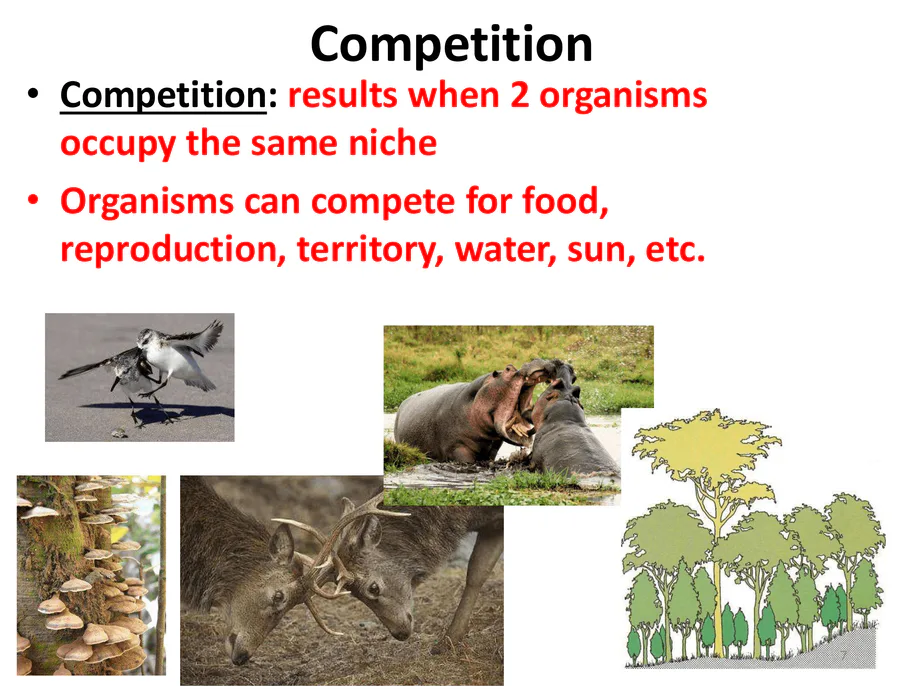
If multiple organisms share the same niche, what will happen?
All the populations will grow in size.
All the populations will decrease in size
There will be an increase in competition between the organisms for resources
There will be a decrease in competition between the organisms for resources
16
17
Multiple Choice
As the population of rabbits increases, what happens to the population of wolves?
The population of wolves decreases
The population of wolves stays the same
The population of wolves increases
18
Multiple Choice
Which statement about predator-prey relationships is true?
The predator population is NOT dependent on the prey population. Both will change independent of each other.
The predator population is dependent on the prey population. As one changes, the other will change.
The predator population will only increase and the prey population will only decrease.
19
20
21
22
Multiple Choice
23
Multiple Choice
24
Multiple Choice
25
This is on your review sheet
26
This is on your review sheet
27
This is on your review sheet
28
Multiple Choice
29
Multiple Choice
It's hunting season for wolves which drives the population of wolves down. What will happen to the population of rats?
The population of rats will decrease
The population of rats will increase
Nothing will happen to the population of rats, it will stay the same
30
31
32
This is on your review sheet
33
Multiple Choice
34
Multiple Choice
In the energy pyramid here, which organisms have the most energy available?
Producers
Carnivores
Herbivores
Top Predator
35
Multiple Choice
In terms of energy flow, why is the amount of energy transferred from one trophic level to the next higher level typically only about 10%?
Because the rest is used for the organism's life processes
Because most of the energy is lost as heat
Because the rest is stored and not used
Both A and B are correct
36
Multiple Choice
In general, why does the population sizes of consumers decrease as you go up the pyramid? (ex: the population sizes of primary consumers (grasshoppers) are larger than the population sizes of secondary consumers)
There is way too much energy available to maintain populations
There is not enough energy available to sustain large populations
The pyramid is wrong. The population sizes are the same all throughout
37
38
39
This is on your review sheet
40
Reorder
Reorder the following levels: (smallest on the left, largest on the right)
Organism
Population
Community
Ecosystem
Biome
41
Match
Match the following
A group of monkeys
Monkeys, trees, snakes, and frogs in an area
Monkeys, trees, snakes, water, dirt, and sun in an area
Areas such as deserts, rainforests, ocean, tundra
All the areas of earth where living things are
population
community
ecosystem
biome
biosphere
population
community
ecosystem
biome
biosphere
42
43
44
45
46
47
48
This is on your review sheet
49
Match
Density dependent factor
Density independent factor
carrying capacity
A virus depends upon other organisms to be there to spread
Examples are floods, tornadoes, they do not depend on a population to happen
the amount of food, water, and shelter that the environment can provide to support the population
A virus depends upon other organisms to be there to spread
Examples are floods, tornadoes, they do not depend on a population to happen
the amount of food, water, and shelter that the environment can provide to support the population
50
Multiple Choice
51
Multiple Choice
Which of the following is NOT a factor that affects carrying capacity?
Amount of available food
Space for territories
Number of predators
The color of the organisms
52
Multiple Choice
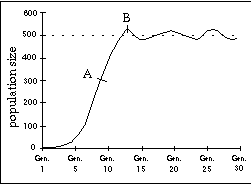
What is the carrying capacity of the graph?
around 500
more than 800
less than 300
around 700
53
Multiple Choice
Something that regulates the size of a population is called...
a limiting measure
a limiting factor
carrying capacity
biodiversity
54
Multiple Choice
55
Multiple Choice
Which is NOT an example of a density-dependent factor?
Communicable disease
The average rainfall of a region
Predation
Parasitism
56
Multiple Choice
Which are two ways a population can decrease in size? (immigration = coming into an area; emigration = leaving an area)
increased death rate and emigration
emigration and increased birth rate
immigration and emigration
increased death rate and immigration
57
58
59
60
61
This is on your review sheet
62
Drag and Drop
63
Multiple Choice
Which resources are non-renewable?
Wind, Solar, Hydroelectric
Coal, oil, natural gas
Trees and algae
64
Multiple Choice
What is biodiversity?
The variety of different species living in an ecosystem
The number of organisms in a particular area
The different color variations of a single species
The various biome locations on Earth
65
66
67
Categorize
Nonliving factors in an ecosystem
Sunlight, water, dirt, climate, oxygen, etc.
Living factors in an ecosystem
Animals, plants, bacteria, fungi, etc.
Organize these options into the right categories
68
69
70
Multiple Choice
Which statement is an example of how carbon moves through a food chain as part of the cycle?
Producers release carbon dioxide, and consumers take it it.
Producers take in carbon dioxide, and consumers release it.
Producers take in carbon from the soil, and they release it when they decompose.
Producers release carbon into the soil, and consumers take it in from the soil.
Go through the slides to review back over Unit 7 - our Ecology Unit. Slides that are marked with "This is on your Review Sheet" contain the answers to the questions on the review sheet in your packet. Make sure you answer the Quizizz questions embedded throughout. There will be some information that is not covered on your review sheet that is covered and reviewed in this Quizizz. Work all the way to the end of the Quizizz.
Unit 7 - Ecology Review Notes and Answers
Show answer
Auto Play
Slide 1 / 70
SLIDE

Similar Resources on Wayground
65 questions
Present Simple and Present Continuous
Presentation
•
9th - 12th Grade
65 questions
Bonds Formulas & Reactions
Presentation
•
9th - 12th Grade
63 questions
Tree of Life Activity
Presentation
•
9th - 12th Grade
65 questions
Man-Made Global Climate Change
Presentation
•
9th - 12th Grade
64 questions
presentasi keanekaragaman hayati
Presentation
•
KG - University
67 questions
Vocabulario 2A
Presentation
•
9th - 12th Grade
65 questions
Clauses of Reason, Purpose, Contrast, and Manner
Presentation
•
9th - 12th Grade
Popular Resources on Wayground
20 questions
"What is the question asking??" Grades 3-5
Quiz
•
1st - 5th Grade
20 questions
“What is the question asking??” Grades 6-8
Quiz
•
6th - 8th Grade
10 questions
Fire Safety Quiz
Quiz
•
12th Grade
20 questions
Equivalent Fractions
Quiz
•
3rd Grade
34 questions
STAAR Review 6th - 8th grade Reading Part 1
Quiz
•
6th - 8th Grade
20 questions
“What is the question asking??” English I-II
Quiz
•
9th - 12th Grade
20 questions
Main Idea and Details
Quiz
•
5th Grade
47 questions
8th Grade Reading STAAR Ultimate Review!
Quiz
•
8th Grade
Discover more resources for Biology
24 questions
BIOLOGY STAAR REVIEW
Quiz
•
9th Grade
30 questions
Biology STAAR Review #3
Quiz
•
9th Grade
16 questions
AP Biology: Unit 1 Review (CED)
Quiz
•
9th - 12th Grade
50 questions
Biology EOC Review
Quiz
•
9th Grade
25 questions
photosynthesis and cellular respiration
Quiz
•
9th Grade
20 questions
AP Biology: Unit 3 Review (CED)
Quiz
•
9th - 12th Grade
20 questions
Enzymes
Quiz
•
9th Grade
20 questions
Food Chains and Food Webs
Quiz
•
7th - 12th Grade