Inferences and Using Sample Data
Presentation
•
Mathematics
•
7th Grade
•
Practice Problem
•
Easy
Audra Bothers
Used 2+ times
FREE Resource
13 Slides • 22 Questions
1
Lesson:
using models to make inferences & analyzing and using sample data
By Audra Bothers
2
Lesson #1:
using models to make inferences
By Audra Bothers
3
LEARNING TARGET:
I can compare and draw informal inferences about two populations using measures of center (median, mean) and measures of variation (range, quartiles, interquartile range) for data from random samples. (7.PR.6.6)
4
2) What is the typical height of a player on the soccer team? Which measure of center did you use to determine this?
The heights of 10 players from a local basketball team and 10 players from a local soccer team are organized in the table.
1) What is the typical height of a player on the basketball team? Which measure of center did you use to determine this?
5
Fill in the Blank
Type answer...
6
Fill in the Blank
Type answer...
7
The heights of 10 players from a local basketball team and 10 players from a local soccer team are organized in the table.
3) Plot the heights in dot plots on your paper.
8
Multiple Select
4) How do the distributions of the heights of each team compare? Choose all that apply.
Heights of the soccer team have more variability.
Both data sets have 2 peaks/modes.
The soccer team has a high outlier.
Most of the basketball heights are clustered together.
9
The heights of 10 players from a local basketball team and 10 players from a local soccer team are organized in the table.
5) Create box plots on your paper.
10
Fill in the Blank
Type answer...
11
Fill in the Blank
Type answer...
12
Multiple Choice
8) Consider that the 10 players used for each team sample are only a portion of the players for each team.
a. Look at your box plots. What is the probability that a player on the basketball team is between 72 inches and 74 inches?
25%
50%
75%
100%
0%
13
Multiple Choice
8) Consider that the 10 players used for each team sample are only a portion of the players for each team.
b. Look at your box plots. What is the probability that a player on the soccer team will be shorter than 63 inches?
25%
50%
75%
100%
0%
14
Multiple Choice
8) Consider that the 10 players used for each team sample are only a portion of the players for each team.
c. Look at your box plots. Based on the sample data, what is the probability that a player on the basketball team has a height between 68 inches and 77 inches?
25%
50%
75%
100%
0%
15
Poll
How do you feel about making inferences about multiple sets of data?
(Including comparing measures of center and variability.)
It's soooooo easy!
I mostly understand.
I need a lot more practice/help.
16
Lesson #2:
ANALYZING AND USING SAMPLE DATA
By Audra Bothers
17
LEARNING TARGETs:
I can predict characteristics of a population by examining the characteristics of a representative sample. (7.PAR.4.10)
I can recognize the potential limitations and scope of the sample to the population. (7.PAR.4.10)
I can analyze sampling methods and conclude that random sampling produces and supports valid inferences. (7.PAR.4.11)
18
Task 1:
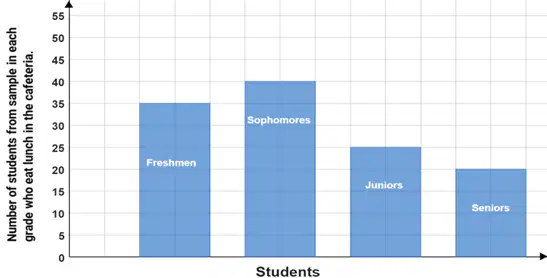
A high school has a freshman, sophomore, junior, and senior class. A sample of students from each class was taken to see if they eat lunch in the school cafeteria or somewhere else, such as off campus or in their classroom. The bar graph displays the sample of students from each class that eat lunch in the cafeteria.
You will answer questions 1a, 1b, 1c, and 2 on the next few slides.
19
Match
1) There are 1080 students at the high school.
a. From the sample, find the number of students in each class that eat lunch in the cafeteria.
Freshmen
Sophomores
Juniors
Seniors
35
40
25
20
35
40
25
20
20
Multiple Choice
1) There are 1080 students at the high school.
b. How many total students from the sample eat lunch in the cafeteria?
20
50
100
120
21
The first ratio involves ONLY the sample. Write the ratio of seniors to total.
The second ratio involves the actual students. Again, write the ratio of seniors (x, since that's our unknown) to total students.
There are 1080 students at the high school.
To approximate how many total seniors there are, you can use a proportion.
22
Fill in the Blank
23
Multiple Select
2) Would it be appropriate to use the proportion of students that eat lunch in the cafeteria that are freshmen from the sample to determine the total number of students at the high school that eat lunch in the cafeteria? Choose all that apply.
No, because only choosing freshmen is NOT a random sample.
Yes, because only choosing freshmen IS a random sample.
No, because freshmen are NOT representative of the entire school.
Yes, because freshmen ARE representative of the entire school.
24
Poll
How do you feel about predicting characteristics of a population?
(Including using proportions to make predictions about totals.)
It's soooooo easy!
I mostly understand.
I need a lot more practice/help.
25
Draw
BRAIN BREAK!
Draw yourself (or a picture that represents what you'd like to be doing) a month from now!
(June 15th)
26
The next six questions will ask you to consider whether the surveyors' techniques were biased or unbiased, and why. You will consider the types of bias in the table above.
TASK 2:
A survey is conducted in a town of 15,000 people to determine the number of people that had been in some type of accident over the past year. Six people gather the data for the survey using different methods.
27
TYPES OF BIAS:
INSUFFICIENT SAMPLE SIZE:
A GOOD sample size is usually at least 10 - 20% of the population.
OBSERVATIONAL BIAS:
When perspectives or expectations of a sample influences their data. (asking a swim team about their favorite sport)
RESPONSE TO A QUESTION:
When a question leads the sample to a specific answer or includes obvious opinions.
28
UNBIASED TECHNIQUES:
SYSTEMATIC:
Following a random pattern
STRATIFIED:
When the sample is broken into subpopulations and data is collected from each group.
SIMPLE RANDOM SAMPLE:
The whole population has an equal chance
29
Multiple Choice
The first person randomly chooses 2000 people from a list of people that live in the town and finds that 125 of them have had some type of accident over the past year.
Unbiased;
Simple Random Sample
Unbiased;
Systematic
Biased;
Observational
Biased;
Insufficient Sample Size
30
Multiple Choice
The second person surveys 1500 people that are leaving the ER (emergency room) of a hospital and finds that 750 of them have had some type of accident over the past year.
Unbiased;
Simple Random Sample
Unbiased;
Stratified
Biased;
Observational
Biased;
Response to a Question
31
Multiple Choice
The third person randomly selects a person entering a shopping mall, then chooses every 10th person afterwards that enters the mall, and finds that only 50 of the 1700 people sampled have had some type of accident.
Unbiased;
Systematic
Unbiased;
Stratified
Biased;
Insufficient Sample Size
Biased;
Observational
32
Multiple Choice
The fourth person selects 1600 people from the town and asks them how serious of an injury they incurred when they had their accident.
Unbiased;
Systematic
Unbiased;
Simple Random Sample
Biased;
Observational
Biased;
Response to a Question
33
Multiple Choice
The fifth person selects every 10th person to leave the town's grocery store, and surveys a total of 228 people.
Unbiased;
Systematic
Unbiased;
Simple Random Sample
Biased;
Insufficient Sample Size
Biased;
Observational
34
Multiple Choice
The sixth person groups people by age, gender, and race. Then, they randomly select people from each subgroup so that the numbers are proportional to the population. They survey a total of 2,000 people.
Unbiased;
Systematic
Unbiased;
Stratified
Biased;
Insufficient Sample Size
Biased;
Observational
35
Poll
How do you feel about recognizing potential limitations of surveying techniques and analyzing sampling methods?
(Including types of bias.)
It's soooooo easy!
I mostly understand.
I need a lot more practice/help.
Lesson:
using models to make inferences & analyzing and using sample data
By Audra Bothers
Show answer
Auto Play
Slide 1 / 35
SLIDE

Similar Resources on Wayground
25 questions
Discounts and Markups
Presentation
•
7th Grade
27 questions
Simple Interest
Presentation
•
7th Grade
30 questions
Angle Relationships
Presentation
•
7th Grade
26 questions
Area and Perimeter with Expressions
Presentation
•
7th Grade
26 questions
Circles
Presentation
•
7th Grade
28 questions
Graphing Inequalities
Presentation
•
6th - 7th Grade
25 questions
operations with scientific notation
Presentation
•
7th Grade
27 questions
Commission and Interest - Math 7
Presentation
•
7th Grade
Popular Resources on Wayground
10 questions
5.P.1.3 Distance/Time Graphs
Quiz
•
5th Grade
10 questions
Fire Drill
Quiz
•
2nd - 5th Grade
20 questions
Equivalent Fractions
Quiz
•
3rd Grade
22 questions
School Wide Vocab Group 1 Master
Quiz
•
6th - 8th Grade
20 questions
Main Idea and Details
Quiz
•
5th Grade
20 questions
Context Clues
Quiz
•
6th Grade
20 questions
Inferences
Quiz
•
4th Grade
12 questions
What makes Nebraska's government unique?
Quiz
•
4th - 5th Grade
Discover more resources for Mathematics
10 questions
Box Plots
Quiz
•
6th - 7th Grade
14 questions
Volume of rectangular prisms
Quiz
•
7th Grade
22 questions
Simple Probability
Quiz
•
7th Grade
20 questions
Graphing Inequalities on a Number Line
Quiz
•
6th - 9th Grade
13 questions
Area of Composite Figures
Quiz
•
7th Grade
20 questions
Theoretical and Experimental Probability
Quiz
•
7th Grade
20 questions
Complementary, Supplementary, and Vertical Angles
Quiz
•
7th Grade
10 questions
One Step Equations (Addition and Subtraction)
Quiz
•
6th - 7th Grade