

Keystone Review 2: Carbon & Macromolecules

Presentation
•
Biology
•
9th Grade
•
Practice Problem
•
Medium
Standards-aligned

Julianna Schweinsburg
Used 1+ times
FREE Resource
7 Slides • 11 Questions
1
Carbon & Macromolecules (and water)
2
Carbon is a unique element because it is able to form 4 bonds with other elements
It can easily bond with itself, creating long, complex macromolecules
Organic compounds are made up of carbon

3
There are four main organic compounds:
Carbohydrates
Lipids
Proteins
Nucleic Acids

4
5

6
Match
Match the macromolecule with the correct monomer.
Carbohydrate
Lipid
Protein
Nucleic Acid
Monosaccharide
No true monomer-fatty acid and glycerol
Amino Acid
Nucleotide
Monosaccharide
No true monomer-fatty acid and glycerol
Amino Acid
Nucleotide
7
Match
Match the macromolecule with the correct function.
Carbohydrate
Lipid
Protein
Nucleic Acid
Immediate energy source
Store energy, forms cell membrane
Cell structure, Enzymes, Hormones
Contains genetic information
Immediate energy source
Store energy, forms cell membrane
Cell structure, Enzymes, Hormones
Contains genetic information
8
Enzymes are a type of protein that are essential for life.
They are catalysts that help to speed up chemical reactions in order to sustain life.
Enzymes are not consumed in the reaction
but are reused for other reactions.Various factors affect enzyme function
and cause it to denature:pH
temperature
concentration levels

9
Draw
Circle/highlight the following terms on the diagram below with the correct colors:
Substrate (green)
Active site (red)
Enzyme (blue)
Enzyme-substrate complex (yellow)
Reactants (orange)
Products (purple)
10

11
Multiple Choice
Which statement correctly describes how carbon’s ability to form four bonds makes it uniquely suited to form macromolecules?
It forms short, simple carbon chains.
It forms large, complex, and diverse molecules.
It forms covalent bonds that can only exist in a single plane.
It forms hydrogen bonds with other carbon atoms.
12
Multiple Choice
Substance A is converted to substance B in a metabolic reaction. Which statement best describes the role of an enzyme during this reaction?
It adjusts the pH of the reaction medium.
It provides carbon to carry out the reaction.
It dissolves substance A in the reaction medium.
It speeds up the reaction without being consumed.
13
Multiple Choice
Which statement best describes a function of the proteins embedded in the plasma membrane of cells?
They provide instructions for the processes in the cell.
They selectively allow certain particles into and out of the cell.
They attract charges in the cell's environment to give the cell a net charge.
They store the energy required by the rest of the membrane to perform its functions.
14
Multiple Choice
Which process best describes the assembly of proteins from amino acids?
Atoms are linked to form a compound.
Monomers are linked to form a polymer.
Atoms are added to a monomer until it becomes a polymer.
Molecules are added to a compound until it becomes a monomer.
15
Multiple Choice
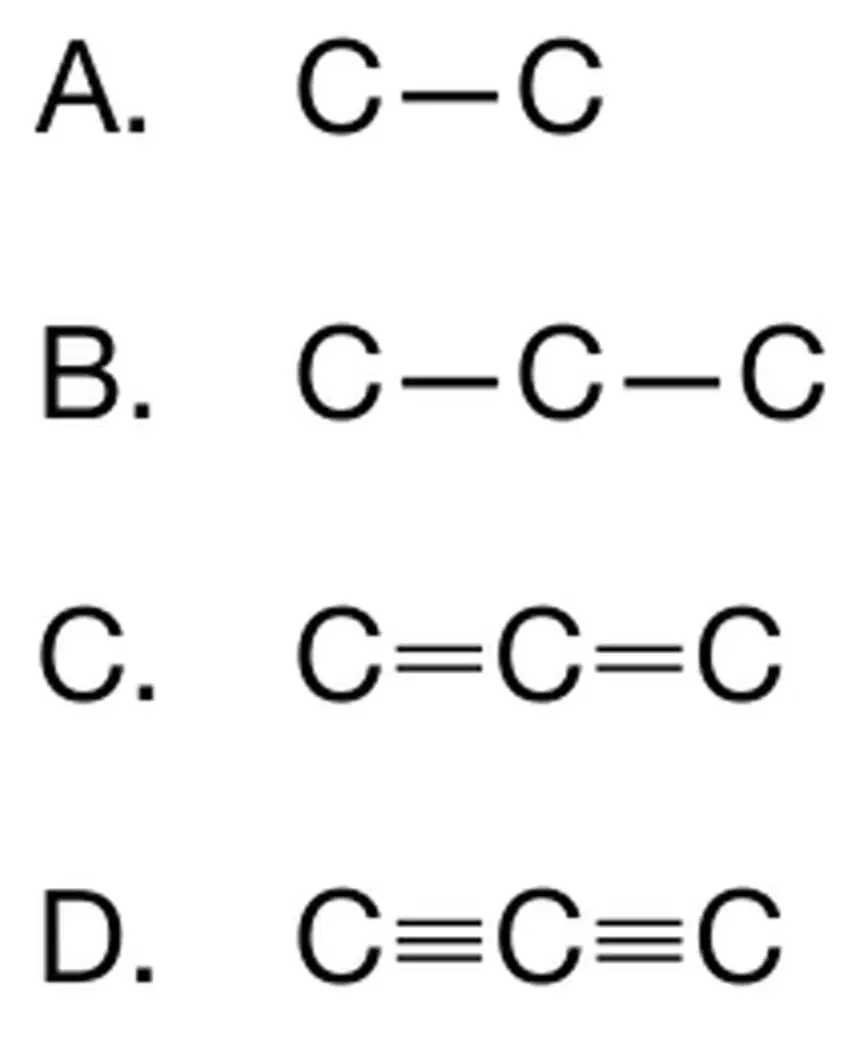
Refer to the picture. The element carbon has multiple bonding patterns. Which bonding pattern cannot be formed by carbon?
A
B
C
D
16
Multiple Choice
Plants are dependent on water. In most plants, water is absorbed by the roots and then moves
up the stem of the plant and into the leaves by capillary action. Which properties of water are
most responsible for the capillary action in plants?
adhesion and cohesion
low density and adhesion
polarity and high specific heat
high specific heat and cohesion
17
Multiple Choice
Each cell in the human body contains thousands of different enzymes responsible for regulating reactions within the cell. Which statement explains why a single enzyme is unable to regulate a variety of reactions?
The binding of a product and an enzyme is specific.
The enzyme is consumed by the products of the reactions.
The binding of a substrate and an enzyme is specific.
The enzyme is consumed by the substrates of the reactions.
18
Multiple Choice

Refer to the graph, which shows how the activity of an enzyme changes at different pH levels. Which statement best describes what happens to the enzyme when the pH goes above 10?
The enzyme is used up and the reaction stops.
The enzyme begins to decrease the rate of the reaction.
The enzyme continues to increase the rate of the reaction.
The enzyme denatures and can no longer speed up the reaction.
Carbon & Macromolecules (and water)
Show answer
Auto Play
Slide 1 / 18
SLIDE
Similar Resources on Wayground

11 questions
Incomplete dominance
Presentation
•
9th Grade
16 questions
Ecological Stability: Cause and Effect
Presentation
•
9th Grade
10 questions
non- mendelian inheritance
Presentation
•
9th Grade
13 questions
Cell Cycle
Presentation
•
9th - 10th Grade
16 questions
9th Grade Biology
Presentation
•
9th Grade
11 questions
Human Impact
Presentation
•
9th Grade
17 questions
Renewable & Non-Renewable Resources
Presentation
•
9th Grade
12 questions
Cell Biology
Presentation
•
9th Grade
Popular Resources on Wayground
10 questions
How much do you know about our Portrait of an Eagle?

Quiz
•
10th Grade
10 questions
Fast Food Slogans
Quiz
•
6th - 8th Grade
21 questions
Continents and Oceans
Quiz
•
6th Grade
20 questions
Parts of Speech
Quiz
•
5th Grade
16 questions
Subject & Predicate
Quiz
•
5th Grade
25 questions
Multiplication Facts
Quiz
•
5th Grade
12 questions
Map Skills
Quiz
•
3rd Grade
22 questions
Continents and Oceans
Quiz
•
5th Grade
Discover more resources for Biology
20 questions
Characteristics of Life
Quiz
•
9th - 10th Grade
10 questions
Exploring the 4 Major Macromolecules and Their Functions

Interactive video
•
9th - 12th Grade
20 questions
Cell Transport
Quiz
•
9th - 12th Grade
25 questions
photosynthesis and cellular respiration
Quiz
•
9th Grade
16 questions
Population Ecology
Quiz
•
9th - 12th Grade
20 questions
Cell Organelles
Quiz
•
9th Grade
18 questions
Water Properties
Quiz
•
9th Grade
36 questions
U3 Review Cell Cycle and Specialization Quiz
Quiz
•
9th Grade