
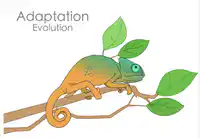
Adaptations

Presentation
•
Biology
•
9th Grade
•
Practice Problem
•
Easy

Katrina Conway-Mortimer
Used 1+ times
FREE Resource
19 Slides • 19 Questions
1

2

3
Open Ended
Describe some ways in which organisms can adapt to their environment. Provide examples if possible.
4
Multiple Choice
Why is it important for organisms to adapt to their environment?
To survive and reproduce successfully
To become extinct
To avoid all changes
To remain the same forever
5

6
Multiple Choice
Which of the following best describes natural selection?
The process by which organisms with advantageous traits are more likely to survive and reproduce.
The process of organisms choosing their environment.
The process by which all organisms become identical over time.
The process by which organisms lose traits over generations.
7

8
Open Ended
Describe how the environment can influence the adaptations seen in organisms, using the pond and desert images as references.
9

10
Fill in the Blanks
Changes that help an organism survive in its environment are called
Type answer...
11
Open Ended
Explain how adaptations help organisms survive in their environment, using examples from the images provided.
12

13
Multiple Select
Which of the following are types of adaptations?
Structural
Behavioral
Physiological
Nutritional
14

15

16
Multiple Choice
What is an example of a structural adaptation shown in the images?
A cactus having spines to reduce being eaten by animals.
A bird migrating to a warmer climate.
A bear hibernating during winter.
A chameleon changing color to blend in.
17

18
Multiple Choice
Which of the following is an example of a physical adaptation that helps an animal get food?
Sharks have sharp teeth to hunt and eat food.
Lizards lay in the sun to get warm.
Armadillos curl up into a ball when threatened.
Daisies follow the sun during the day.
19

20
Multiple Choice
Why do giraffes have long necks?
To help them reach the tallest leaves.
To help them run faster.
To help them swim.
To help them dig holes.
21

22
Open Ended
Explain the difference between a physical adaptation and a behavioural adaptation, using examples from the images.
23

24
Fill in the Blanks
Lizards lay in the sun to get
Type answer...
25

26

27
Open Ended
Describe how plants and animals use adaptations to survive in their environments, using at least two examples from the images.
28
Multiple Select
Which of the following are examples of behavioural adaptations?
Lizards hiding in the shade to keep cool.
Armadillos curling into a ball when threatened.
Giraffes having long necks.
Daisies following the sun during the day.
29

30

31
Multiple Choice
Which of the following is an example of a physiological (functional) adaptation?
A chameleon changing its color to blend with its environment
A penguin huddling with others for warmth
A cactus having spines instead of leaves
A bird migrating to a warmer climate
32

33
Open Ended
Explain how penguins are able to survive in extremely cold environments based on their physiological adaptations.
34

35
Multiple Choice
Which of the following adaptations help xerophytes survive in dry conditions?
Reducing transpiration rate
Having thin leaves
Increasing water loss
Growing in shaded areas
36

37
Fill in the Blanks
The whale's blubber acts as a thermal
Type answer...
38
Multiple Choice
Which of the following is NOT a way organisms adapt to their environment as described in the definition?
Structure
Physiology
Color preference
Genetics
Show answer
Auto Play
Slide 1 / 38
SLIDE
Similar Resources on Wayground

32 questions
Acids, Bases, and the pH Scale
Presentation
•
9th - 10th Grade
31 questions
Properties of Water
Presentation
•
9th - 10th Grade
37 questions
Photosynthesis/Cellular Respiration
Presentation
•
9th Grade
28 questions
Intro to Viruses
Presentation
•
9th Grade
28 questions
Cell Organelles
Presentation
•
9th Grade
31 questions
G9 Chap 6.4 - Building Blocks of Life
Presentation
•
9th Grade
31 questions
MODERN BIOTECHNOLOGY
Presentation
•
9th Grade
32 questions
Cellular Respiration
Presentation
•
9th - 10th Grade
Popular Resources on Wayground
10 questions
How much do you know about our Portrait of an Eagle?

Quiz
•
10th Grade
10 questions
Fast Food Slogans
Quiz
•
6th - 8th Grade
21 questions
Continents and Oceans
Quiz
•
6th Grade
20 questions
Parts of Speech
Quiz
•
5th Grade
16 questions
Subject & Predicate
Quiz
•
5th Grade
25 questions
Multiplication Facts
Quiz
•
5th Grade
12 questions
Map Skills
Quiz
•
3rd Grade
22 questions
Continents and Oceans
Quiz
•
5th Grade
Discover more resources for Biology
20 questions
Characteristics of Life
Quiz
•
9th - 10th Grade
10 questions
Exploring the 4 Major Macromolecules and Their Functions

Interactive video
•
9th - 12th Grade
20 questions
Cell Transport
Quiz
•
9th - 12th Grade
25 questions
photosynthesis and cellular respiration
Quiz
•
9th Grade
16 questions
Population Ecology
Quiz
•
9th - 12th Grade
20 questions
Cell Organelles
Quiz
•
9th Grade
18 questions
Water Properties
Quiz
•
9th Grade
36 questions
U3 Review Cell Cycle and Specialization Quiz
Quiz
•
9th Grade