

Unit 1: Citizenship

Presentation
•
Social Studies
•
10th Grade
•
Practice Problem
•
Medium

Beth Eldridge
Used 1+ times
FREE Resource
30 Slides • 24 Questions
1

2
Multiple Choice
Why is citizenship important in a democratic society?
It allows individuals to participate in decision-making processes such as voting.
It gives people the right to travel freely without restrictions.
It ensures everyone has the same job opportunities.
It guarantees wealth and success.
3

4
Open Ended
In what ways can individuals actively engage in their community to demonstrate good citizenship?
5

6
Open Ended
What are the responsibilities of a citizen?
7

8
Open Ended
What does good citizenship mean?
9

10
Multiple Select
Which of the following are key aspects of Canadian citizenship?
Freedom, democracy, and respect for diversity
Commitment to peace and social justice
Active participation in government and community
Owning property in Canada
11

12
Multiple Choice
Which of the following is NOT a core Canadian value?
Equality
Respect for Cultural Differences
Freedom
Wealth accumulation
13

14
Fill in the Blanks
As a citizen, you should uphold the values of Canadian citizenship and engage in your
15

16
Open Ended
Why is decision making important in a political community?
17

18
Open Ended
What do you know about democracy? Brainstorm a list of ideas that are related to democracy.
19
20
Multiple Choice
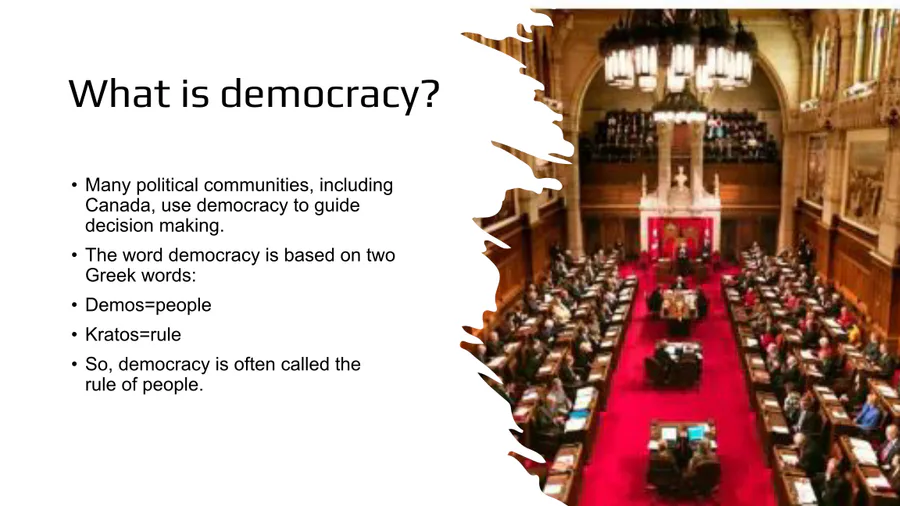
Which of the following best describes the origin of the word 'democracy'?
It comes from two Greek words meaning 'people' and 'rule'.
It is a Latin word meaning 'freedom'.
It is derived from a French word meaning 'government'.
It comes from an ancient Roman term for 'citizen'.
21

22
Multiple Select
Based on the information about democracy at work, which of the following are strengths of democracy?
It is a peaceful way to make decisions.
Democracies rely on fundamental beliefs and values.
Many people don’t vote.
Elected representatives do not always reflect the population accurately.
23

24
Fill in the Blanks
Fill in the blank: The condition achieved when all people are treated in a way that is fair, just, and inclusive is called
25

26

27

28

29
Multiple Choice
Which of the following are examples of active citizenship?
Volunteering
Peacefully protesting
Voting
All of the above
30

31

32
Fill in the Blanks
How do students participate in decision-making at school?
Type answer...
33

34
Open Ended
Does student council represent the perspectives of all students?
35

36
Fill in the Blanks
List two ways students can get involved to improve their communities, based on the information provided.
Type answer...
37

38
Multiple Choice
Which of the following is a primary goal of civic action?
To improve communities
To increase personal wealth
To avoid responsibilities
To limit voting rights
39

40
Multiple Select
Which of the following are ways to contribute to your community?
Starting a petition
Helping at community centers
Supporting local charities
Ignoring local issues
41

42
Fill in the Blanks
Equality is achieved when all people are treated the
43

44
Open Ended
Explain why people might engage in civic action when there is a threat to their community. Provide an example.
45

46
Multiple Choice
Which of the following is NOT a method of civic action?
Online discussions
Signing petitions
Community involvement
Ignoring community issues
47
48
Multiple Choice
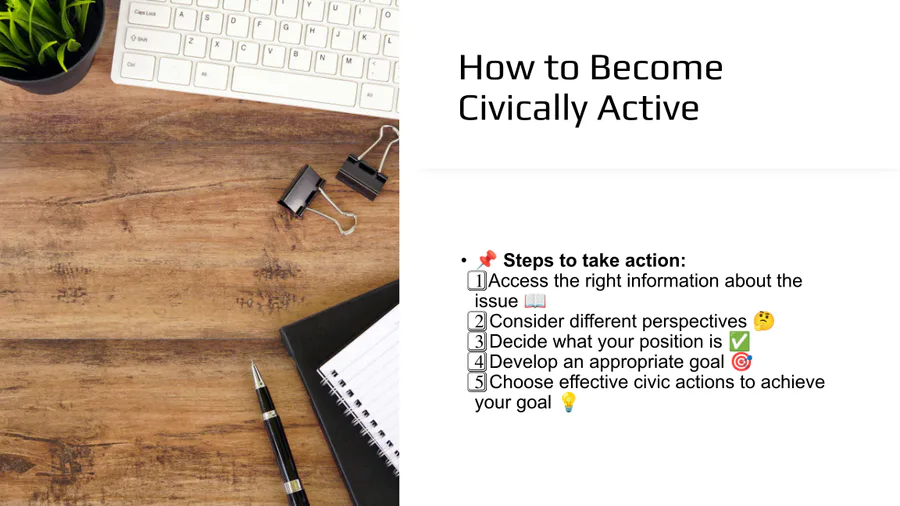
What is the first step to becoming civically active according to the slide?
Consider different perspectives
Access the right information about the issue
Develop an appropriate goal
Choose effective civic actions
49

50

51

52

53
Multiple Choice
Which of the following is a strength of democracy?
It allows citizens to participate in decision-making.
It limits freedom of speech.
It discourages community involvement.
It gives all power to one leader.
54
Open Ended
After learning about citizenship and democracy, what is one way you think you can actively engage in your community?
Show answer
Auto Play
Slide 1 / 54
SLIDE
Similar Resources on Wayground

50 questions
Industrial Revolution 7.1 and 7.2
Presentation
•
8th - 10th Grade
45 questions
3-1 Inequalities and Their Graphs
Presentation
•
10th Grade
49 questions
Right Triangle Unit Review
Presentation
•
10th Grade
47 questions
Systems of Linear Equations: Solve by Graph and Substitution
Presentation
•
9th - 11th Grade
47 questions
Polynomials-Characteristics and Operations
Presentation
•
9th - 11th Grade
50 questions
Unit 3.2 - Marshall's Court
Presentation
•
11th Grade
50 questions
Renaissance and Reformation
Presentation
•
10th Grade
52 questions
Lesson #22: From Neutrality to War
Presentation
•
10th Grade
Popular Resources on Wayground
10 questions
How much do you know about our Portrait of an Eagle?

Quiz
•
10th Grade
10 questions
Fast Food Slogans
Quiz
•
6th - 8th Grade
21 questions
Continents and Oceans
Quiz
•
6th Grade
20 questions
Parts of Speech
Quiz
•
5th Grade
16 questions
Subject & Predicate
Quiz
•
5th Grade
25 questions
Multiplication Facts
Quiz
•
5th Grade
12 questions
Map Skills
Quiz
•
3rd Grade
22 questions
Continents and Oceans
Quiz
•
5th Grade
Discover more resources for Social Studies
10 questions
Exploring the Age of Exploration: Key Events and Figures

Interactive video
•
6th - 10th Grade
10 questions
Exploring the 13 Colonies Regions
Interactive video
•
6th - 10th Grade
46 questions
Unit 1 Test REVIEW Ancient Greece and Rome
Quiz
•
9th - 12th Grade
10 questions
Exploring Ancient Mesopotamia Through Song
Interactive video
•
6th - 10th Grade
12 questions
supply and demand shifters
Quiz
•
9th - 12th Grade
9 questions
Exploring Ancient Mesopotamia and Its Civilizations
Interactive video
•
10th Grade
16 questions
Unit 3 Personal Finance Guided Notes
Presentation
•
9th - 12th Grade
16 questions
Enlightenment Review
Quiz
•
10th Grade