

Pre- Exam Course National Board Examination 2025

Presentation
•
Health Sciences
•
University
•
Practice Problem
•
Easy

wahyu Tri
Used 1+ times
FREE Resource
43 Slides • 11 Questions
1
NATIONAL BOARD EXAMINATION
INDONESIAN ORTHOPAEDIC ASSOCIATION
2
COMUNICATION SKILL
3
4
The patient has hypocalcemia (4.8 mg/dL)
The patient also has a history of seizures due to an endocrine problem, which is being treated by a pediatrician.
His parents are unwilling for the patient to wear a POP (Plaster of Paris cast).
Boy, 12 Y.O He slipped and fell while walking 3 months ago

5
The patient underwent surgery at another hospital performed by an orthopedic surgeon.
The patient had two follow-up appointments in the outpatient clinic, and there were no problems reported after the surgery.
Boy, 12 Y.O

6
Open Ended

Boy, 12 Y.O
3 months after surgery
His parents require an explanation regarding the deformity of his left lower arm.
Please educate his parents about his current condition and your recommended solution.
7
The candidate should be able to explain calcium metabolism and the possible abnormal conditions that caused their child's bone deformity.
Answer: Osteomalacia


8
9
presented with pain and swelling in both thighs that began one week ago and has progressively worsened. There is no history of fever, cough, or injury. The patient also has gum bleeding and refuses to walk due to pain. He had previous treatment at another facility and has now been referred to your hospital.
Boy 3 Y.O


Clinical picture
Gum Bleeding
10
Laboratory finding
Both femur x-ray AP & Lateral


11
Open Ended
His parents are asking you to explain precisely
Doctor, can you explain to us what kind of disease our child has? How do you know?
12
1. Your child is suffering from Scurvy!
Pathognomonic Signs on X-ray Findings


13
Open Ended
What will you do? Will he need surgery?
Is there a chance it will happen again?
14
Answer
A nutritious diet with supplemental ascorbic acid is recommended. In scurvy, therapeutic doses of ascorbic acid restore vitamin C functions within a few days. Symptoms and signs typically disappear over 1 to 2 weeks, although chronic gingivitis with extensive subcutaneous hemorrhage may persist longer.
A daily oral intake of 75 mg of vitamin C for women and 90 mg for men prevents deficiency. Five daily servings of most fruits and vegetables (as recommended) provide > 200 mg of vitamin C.
15
16
BOY 12 Y.O
Chief complaint: unable to fully extend his knees while walking.
First child.
Premature delivery.
Sat at 12 months, walked at 4 years old.
Reports spasms in both legs throughout the day.
Clonus: positive bilaterally (+).
Babinski sign: positive bilaterally (+/+).
The patient requires assistance for easier ambulation.
17


Gait Pattern: Spastic gait
Thomas Test: Positive
Popliteal Angle: 20 degrees bilaterally (both knees).
SILVERSKIOLD TEST
Duncan – Ely Test
18
Open Ended
The parents require an explanation regarding their child's abnormal condition.
The parents also need your suggestion regarding the patient's complaints.
Do you recommend physiotherapy? If so, why?
19
Cerebral palsy (CP) is a group of permanent disorders of the development of movement and posture, causing activity limitation (abnormalities of movement and posture), that are attributed to non-progressive disturbances that occurred in the developing fetal or infant brain (brain damage during early development).
CP affects muscle growth leading to a discrepancy between muscle growth and bone growth. This in turn may lead to deformities of bones and joints, a loss of function, pain, and make care more difficult.
20
Optimize gait efficiency (correct biomechanics) for energy conservation:
(a) Preserve or improve physical function, e.g., walk longer distances, walk faster, decrease fatigue, improve stability (reduced tripping and fewer falls), keep up with friends.;
(b) Achieve pain relief or prevention and increased endurance;
(c) Preserve or increase activities and participation, e.g., be more physically active, achieve greater independence, participate more in sports/recreational activities.
21
The patient requires physiotherapy to prevent secondary impairments.


22
23
BOY, 8 Y.O
Chief complaint : Tottering and tip-toe gait
The parents noticed the patient has had difficulty standing up since 4 years ago.
The patient has to use his hands and arms to "walk" up his own body.
There is no history of significant trauma prior to this.
There is no history of fever or convulsion before this.


24
BOY, 8 Y.O
Chief complaint : Tottering gait
Posture: Hyperlordotic.
Muscle Assessment:
Muscle wasting: Gluteus (+), Quadriceps (+).
Calf muscles: Pseudohypertrophy (+).
Gower's Sign: Positive (+).
Electromyography (EMG) & Nerve Conduction Velocity (NCV): Within normal limits.
Creatine Phosphokinase (CPK): 1245 (very high).
Gower's sign: Positive.
Calf muscle pseudohypertrophy: Present.
25
Open Ended
The parents require an explanation regarding their child's abnormal condition. What kind of disease is it? How could their child have gotten this disease?
Is there an optimal treatment for their child?
What is your recommended plan?
26
Answer
Patient suffered from DMP ( Dystrophic Muscular Progressive ), or Duchenne Muscular Dystrophy (DMD)
Mutations in the dystrophin gene lead to progressive muscle fiber degeneration and weakness. This weakness may present initially with difficulty in ambulation but progressively advances to such an extent that affected patients are unable to carry out activities of daily living and must use wheelchairs. Cardiac and orthopaedic complications are common, and death usually occurs in the twenties due to respiratory muscle weakness or cardiomyopathy.
27
Answer
No medical cure exists for this congenital dystrophy, and the disease has a poor prognosis. Treatment is centered on glucocorticoid therapy, prevention of contractures, and medical care of cardiomyopathy and respiratory compromise.
Physiotherapy to prevent contractures is the mainstay of the orthopedic interventions. Based upon patient requirements, passive stretching exercises, plastic ankle-foot orthosis during sleep, and long leg braces to assist in ambulation may be used. Surgery to release contractures may be required for advanced disease. Surgery to correct scoliosis may improve pulmonary function.
28
29
BOY, 13 Y.O
Chief complaint : unable to fully extend his right leg due to a flexion contracture of the right hip.
The patient had untreated chronic cough due to pulmonary tuberculosis (TB).
There was a sinus tract on the right hip with necrotic tissue draining from it.
The hip pain began 10 months ago and has progressively worsened over time.
For the past 3 months, the patient has been unable to walk.


30
Open Ended
The parents need information about the disease, especially the contracture of their child's right hip.
The parents asked what you will do for their child.
Are there any potential sequelae following the infection?
31
Answer


32
Answer
Debridement with or without arthroplasty.
Anti-tuberculosis (anti-TB) drugs.Hip joint ankylosed

33
34
BOY, 12 Y.O
Chief complaint : ulcer with exposed bone on his left lower arm.
He developed a fever and swelling of his left lower arm a year ago. The patient was treated by a traditional bone setter.
One month after the bone setter's treatment, the patient developed a sinus tract with pus draining from it.


35
Open Ended
The parents asked: "What is this disease? Is it caused by the bone setter's treatment?“
What is your suggestion to solve their child's problem?
36
Answer


1
37
Answer


Kanakaris NK, Tosounidis TH, Giannoudis PV. Surgical management of infected non-unions: an update. Injury. 2015 Nov 1;46:S25-32.
38
39
Female, 12 Y.O
Suffered injuries in a motorcycle accident one week ago
The parents require your opinion regarding their daughter's right knee problem. Their relatives suggested they take their daughter to the most famous traditional bone setter.
However, her older brother suggested bringing her to your hospital.

Courtesy of Dr Anung B S
40
Open Ended
Please give her parents your best advice not to take her to a bone setter.
Please explain your next plan for their daughter to them.
41
Answer


42
Answer
The fracture usually require open reduction and internal fixation (avoiding crossing the physis).
A reexamination in seven to ten days is necessary to monitor proper reduction and healing. This is also important to determine whether any complications, such as growth arrest, have occurred. If clinically indicated, an additional follow-up radiograph may be obtained at six and 12 months to reassess for any growth arrest.
43
44
GIRL 6 Y.O: presents with unequal leg length, which her parents noticed since she began walking.

45
Open Ended

Parents require your expert treatment recommendation. Please explain the diagnosis and the optimal treatment for her.
What are the potential risks and complications during and after surgery?
46
Answer
The diagnosis is Developmental Dysplasia of the Hip. The recommended treatment is open reduction, acetabuloplasty, and potentially a femoral shortening osteotomy (VDO) if deemed necessary for optimal outcome.
Intraoperative risks and complications: Lateral femoral cutaneous nerve injury, injury to the medial and lateral circumflex arteries.
Postoperative risks and complications: Infection, avascular necrosis (AVN) of the femoral head, re-dislocation.
47
48
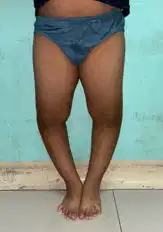
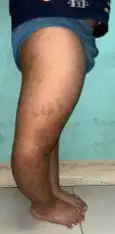
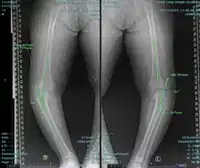
BOY. 6 Y.O
Chief complaint: Bilateral bow legs.
His parents report that he started walking at 10 months old.


49
Open Ended

The parents require your recommendations to address their child's knee problem.
Is there any possibility of recurrence?
50
Answer
Diagnosis and Planned Treatment: The patient requires a bilateral proximal tibia valgus de-rotation osteotomy.
Risk of Recurrence: There is a high risk of recurrence due to fragmentation of the postero-medial physis.
51
52
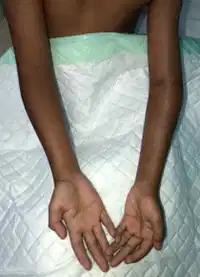
BOY, 5 Y.O
Inability to fully flex and extend his left elbow, following a fall 10 months ago.

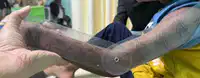
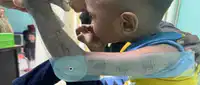
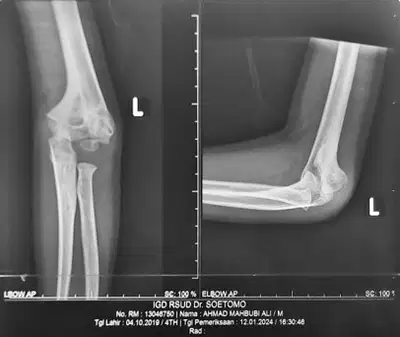
53
Open Ended
The parents are requesting a greater degree of flexion than extension in his left elbow. This would allow the patient to reach his shirt buttons and still be able to reach his buttocks. Can you help meet their expectations? If so, how would you achieve this?
Supposing this limitation occurred on the right side (for a right-handed individual), what would your approach be?
54
Answer
Yes, I can help meet their expectations by performing a Modified French Osteotomy (Distal Humeral Osteotomy).
If this limitation occurred on the right side (for a right-handed individual), the aim of surgery would be to achieve greater elbow flexion to enable him to reach his mouth and hair, while still allowing the patient to hold a pencil for writing.
NATIONAL BOARD EXAMINATION
INDONESIAN ORTHOPAEDIC ASSOCIATION
Show answer
Auto Play
Slide 1 / 54
SLIDE
Similar Resources on Wayground

46 questions
1. fase I PGYD
Presentation
•
University
51 questions
L21 Inflation and the Federal Reserve
Presentation
•
University
48 questions
Ch 15 part 2
Presentation
•
University
48 questions
H-L5U4: Future Simple and Continuous
Presentation
•
University
49 questions
BIO111 Chp 16 Gene Expression
Presentation
•
University
49 questions
PRESENT PERFECT VS PAST SIMPLE2
Presentation
•
University
51 questions
Nouns
Presentation
•
University
52 questions
SPANISH EXPLORATION LESSON AND ASSIGNMENT
Presentation
•
KG - University
Popular Resources on Wayground
10 questions
Safety Day 2026 – Student Review

Quiz
•
9th Grade
21 questions
Continents and Oceans
Quiz
•
6th Grade
20 questions
Parts of Speech
Quiz
•
5th Grade
16 questions
Subject & Predicate
Quiz
•
5th Grade
25 questions
Multiplication Facts
Quiz
•
5th Grade
12 questions
Map Skills
Quiz
•
3rd Grade
22 questions
Continents and Oceans
Quiz
•
5th Grade
15 questions
Rounding Decimals
Quiz
•
5th Grade
Discover more resources for Health Sciences
20 questions
Disney Trivia
Quiz
•
University
10 questions
Spanish Greetings and Goodbyes!
Presentation
•
6th Grade - University
20 questions
Physical or Chemical Change/Phases
Quiz
•
8th Grade - University
39 questions
Unit 7 Key Terms
Quiz
•
11th Grade - University
25 questions
SER and Subject Pronouns
Quiz
•
8th Grade - University
38 questions
Unit 6 Key Terms
Quiz
•
11th Grade - University
19 questions
Key Concepts in Buddhism
Quiz
•
University
0 questions
Cell Domain Basic Review (Biology)
Quiz
•
University