
1.4 - Forms Of Attack

Presentation
•
Computers
•
9th - 10th Grade
•
Practice Problem
•
Medium

Ayomikun J Sodipe
Used 1+ times
FREE Resource
25 Slides • 40 Questions
1

2

3

4

5

6

7

8

9
Multiple Choice
What is social engineering?
A network security protocol
A type of malware designed to disrupt systems
The manipulation of individuals by hackers to obtain confidential and personal information
A method of encrypting data
10

11

12
Multiple Choice
Which of the following is NOT a form of cyber attack listed in the slides?
Malware
Phishing
Firewall
SQL Injection
13
Open Ended
List the forms of attacks mentioned
14

15

16

17

18

19

20
Multiple Select
Which of the following are forms of attack on computer systems and networks?
Malware
Phishing
Encryption
Brute-force attacks
21
Multiple Choice
Which of the following is a common goal of phishing attacks?
To trick users into revealing personal information
To overload a server with traffic
To crack password encryption
To use software to automate attacks
22
Fill in the Blanks
Malicious software is also known as
23
Multiple Select
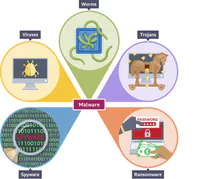
Which of the following are types of malware?
Viruses
Trojans
Phishing
Ransomware
24
Fill in the Blanks
A brute force attack tries all possible
Type answer...
25
Open Ended
Explain how brute force attacks and phishing differ in their approach to obtaining sensitive information.
26
Open Ended
Explain how malware can be used to commit fraud and identity theft, using information from the slides.
27
Multiple Select
Which of the following are key characteristics of a brute force attack?
Trial and error method
Using a computer program to automate attempts
Flooding a server with traffic
Decoding encrypted passwords
28
Open Ended
Explain how phishing attacks trick users into revealing personal information. Use details from the images to support your answer.
29
Multiple Choice
Which of the following could be considered a form of attack on computer systems and networks?
Phishing
Regular software updates
Data backup
Strong password usage
30
Multiple Choice
What is the main goal of a phishing attack?
To steal sensitive information through deception
To damage hardware
To speed up computer processes
To update software automatically
31
Multiple Choice
Which of the following types of information are commonly targeted by phishing forms?
Usernames, passwords, and credit/debit card details
Only usernames
Only passwords
Only credit/debit card details
32
Open Ended
Compare and contrast malware and phishing as forms of cyber attack. What are their main differences and similarities?
33

34

35

36

37
Multiple Select
Which of the following are characteristics of a brute force attack?
Trial and error method
Use of computer programs to automate attempts
Flooding a server with excessive traffic
Decoding encrypted passwords
38
Fill in the Blanks
A brute force attack is a hacking method where an attacker tries all possible
Type answer...
39
Open Ended
Describe the main steps involved in a denial of service (DoS/DDoS) attack as shown in the image.
40
Open Ended
What are the main steps involved in a Denial of Service (DoS) attack as shown in the diagram?
41
Multiple Choice
What is the main goal of a Denial of Service (DoS) attack?
To overload a server and make it unavailable
To steal sensitive data from a server
To encrypt files and demand ransom
To guess passwords using brute force
42
Multiple Choice
Which of the following statements best describes a Denial of Service (DoS) attack?
It floods a server with fake traffic, causing it to become overloaded and unavailable.
It tricks users into revealing their passwords.
It uses trial and error to decode encrypted data.
It disguises as a trusted company to steal information.
43
Fill in the Blanks
A technique known as
44
Multiple Select
Which of the following are steps involved in data interception and theft?
Monitoring data streams
Flooding a server with fake traffic
Gathering sensitive information
Exploiting vulnerabilities in databases
45

46

47

48

49
Open Ended
Explain how an attacker can use SQL injection to gain unauthorized access to data in a database.
50
Multiple Choice
Which vulnerability does SQL injection exploit?
Poorly coded database applications
Weak passwords
Unencrypted network traffic
Outdated operating systems
51
Multiple Choice
Which of the following best describes phishing?
Sending emails pretending to be from reputable companies to trick individuals into revealing personal information
Flooding a server with useless traffic
Monitoring network traffic to steal passwords
Inserting code into text boxes to manipulate databases
52
Open Ended
Explain how network sniffing can be used by attackers to obtain sensitive information from a target.
53
Multiple Choice
Which of the following is NOT a typical form of attack on network security?
Phishing
Malware
Firewall
Denial of Service
54
Open Ended
What are some common threats to computer systems and networks that you learned about in this lesson?
55

56
Multiple Choice
Which of the following best describes the process of data interception and theft?
An attacker monitors data streams to gather sensitive information.
A user encrypts their data before sending it over the network.
A server blocks all incoming connections.
A firewall scans outgoing emails for viruses.
57
Open Ended
Evaluate the potential impact of cyber attacks such as malware, phishing, and brute force on organisations and networks.
58
Multiple Choice
Which of the following is NOT a form of cyber attack mentioned in the lesson objectives?
Malware
Phishing
Brute Force
Firewall
59
Multiple Select
Which of the following are characteristics of SQL injection attacks?
They exploit vulnerabilities in database applications.
They require code to be entered into text boxes.
They only affect encrypted data streams.
They are used to attack data-driven applications.
60
Open Ended
Why is network security important for individuals and organizations in today's digital world?
61
Fill in the Blanks
SQL injection exploits vulnerabilities in poorly coded
Type answer...
62
Multiple Choice
What is the main goal of a brute-force attack?
To guess passwords or PIN numbers by trying many combinations.
To monitor network traffic for sensitive data.
To flood a server with useless traffic.
To insert malicious code into a database.
63
Open Ended
Compare and contrast malware and phishing as forms of cyber attack. How do their methods and targets differ?
64
Multiple Choice
Which of the following is NOT a form of attack on network security?
Phishing
Malware
Firewall
Denial of Service
65
Open Ended
What are some common threats to computer systems and networks discussed in this lesson?
Show answer
Auto Play
Slide 1 / 65
SLIDE
Similar Resources on Wayground

59 questions
Spanish 1: 2.4 & 2.5
Presentation
•
10th Grade
58 questions
Invertebrates and Vertebrates
Presentation
•
9th Grade
58 questions
Chapter 29: Nervous and Endocrine system
Presentation
•
10th Grade
61 questions
Sec 4 SS CH10 - Cultural Impacts of Globalisation
Presentation
•
10th Grade
62 questions
February 8th: Places in Town vocabulary
Presentation
•
9th - 10th Grade
59 questions
revolutions
Presentation
•
10th Grade
55 questions
Science 9 - Unit A Review Slides
Presentation
•
9th Grade
60 questions
Surface Area of Geometric Shapes
Presentation
•
10th Grade
Popular Resources on Wayground
10 questions
Safety Day 2026 – Student Review

Quiz
•
9th Grade
21 questions
Continents and Oceans
Quiz
•
6th Grade
20 questions
Parts of Speech
Quiz
•
5th Grade
16 questions
Subject & Predicate
Quiz
•
5th Grade
25 questions
Multiplication Facts
Quiz
•
5th Grade
12 questions
Map Skills
Quiz
•
3rd Grade
22 questions
Continents and Oceans
Quiz
•
5th Grade
15 questions
Rounding Decimals
Quiz
•
5th Grade