

Electricity ISTE

Presentation
•
Physics
•
6th - 8th Grade
•
Practice Problem
•
Hard

Sanidhya Singh
FREE Resource
14 Slides • 9 Questions
1

2
Define Voltage, Current, and Resistance and their relationship using Ohm’s Law.
Apply Ohm's Law to calculate values in simple circuits.
Differentiate between series and parallel circuits.
Distinguish between Alternating Current (AC) and Direct Current (DC).


3
Key Vocabulary

Voltage (V)
The energy per unit charge from a power source. Measured in volts (V).

Current (I)
The flow of electric charge through a conductor. Measured in amperes (A).

Resistance (R)
The opposition to the flow of electric current. Measured in ohms (Ω).

Ohm’s Law
Current is proportional to voltage and inversely proportional to resistance.

Series Circuit
A circuit where components form a single path for current flow.

Parallel Circuit
A circuit providing multiple paths for current, with components on different branches.
4
Key Vocabulary

Direct Current (DC)
Electric charge that flows in a single, constant direction.

Alternating Current (AC)
Electric charge that periodically reverses direction.

Electromagnet
A magnet created by running an electric current through a coil of wire.

Motor
A device that converts electrical energy into mechanical energy.

Generator
A device that converts mechanical energy into electrical energy.
5
Understanding Ohm's Law


6
Multiple Choice
According to Ohm's Law, if the voltage in a circuit is increased while the resistance remains constant, what happens to the current?
It increases
It decreases
It stays the same
It becomes zero
7
Using the Ohm's Law Formula
8
Multiple Choice
What is the correct formula to find the resistance in a circuit if you know the voltage and current?
R=V∗I
R=I/V
R=V/I
R=V+I
9
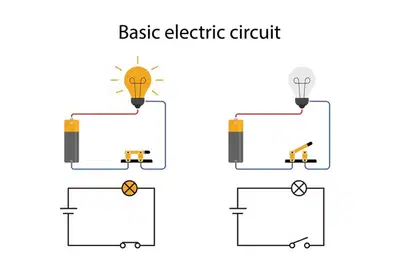
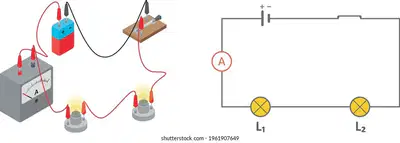
Circuit Diagrams and Symbols
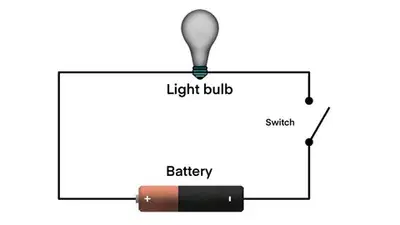
These diagrams are like blueprints for electrical circuits.
A battery is a long (+) and a short (-) line.
A resistor is a zigzag line; a switch is a lever.
Wires are straight lines connecting all the parts.


10
Multiple Choice
In a circuit diagram, what does a zigzag line typically represent?
A battery
A switch
A wire
A resistor
11
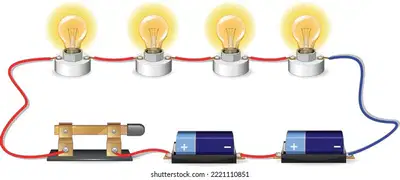
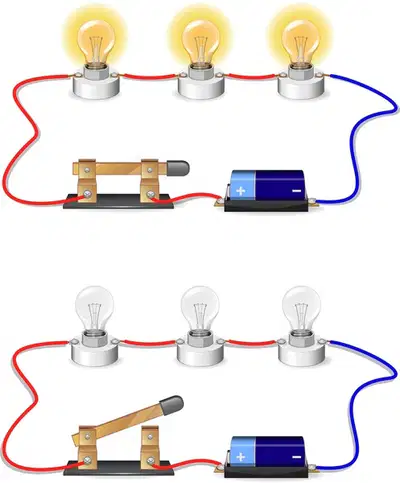
What are Series Circuits?


12
Multiple Choice
What happens to the other light bulbs in a simple string of Christmas lights if one bulb fails?
They all go out
They get brighter
They stay lit
They get dimmer
13
Parallel Circuits
Current has multiple paths to flow in a parallel circuit.
The voltage is the same across all branches of the circuit.
If one part fails, the other branches keep working.
14
Multiple Choice
Which of the following is a key advantage of parallel circuits, making them suitable for household wiring?
The total resistance is very high.
If one appliance fails, the others continue to work.
They use less wire than series circuits.
The current is the same through every appliance.
15
Series Circuit
Current is the same, but voltage divides across components.
Total resistance is the sum of all resistances.
A failure in one part stops the entire circuit.
Parallel Circuit
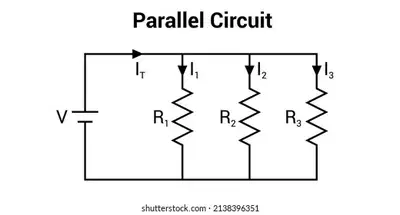
Voltage is the same, but current divides among branches.
Total resistance is less than the smallest resistor.
If one branch fails, the others keep working.


16
Multiple Choice
In which type of circuit does the total resistance increase when you add more resistors?
Series Circuit
Parallel Circuit
Both types of circuits
Neither type of circuit
17
AC vs. DC
In Direct Current (DC), charge flows in just one direction.
Alternating Current (AC) periodically reverses its direction.
DC is from batteries, while AC powers our homes.
18
Multiple Choice
Which type of current is supplied by a standard battery?
Alternating Current (AC)
Direct Current (DC)
Both AC and DC
Neither AC nor DC
19
Electromagnetism: Motors and Generators
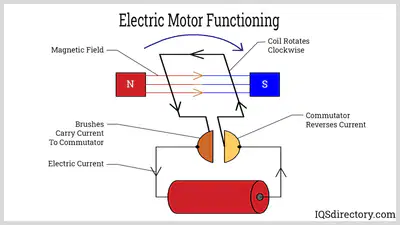
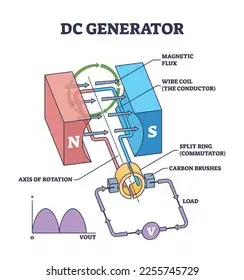
An electric current in a wire coil creates a controllable magnet.
Electric motors use this magnet to create motion from electricity.
Generators do the reverse, using motion to make electricity.
Motors convert electrical to mechanical energy; generators do the opposite!


20
Multiple Choice
What is a device that converts mechanical energy into electrical energy called?
A motor
An electromagnet
A generator
A resistor
21
Misconception
Voltage and current are the same thing.
Higher resistance means more power.
Batteries push out a constant current.
Correction
Voltage is the pressure that causes current to flow.
Higher resistance reduces current, which can limit power.
Batteries provide constant voltage, not constant current.


22


23
Poll
On a scale of 1-4, how confident are you about the concepts covered in today's review?
1
2
3
4
Show answer
Auto Play
Slide 1 / 23
SLIDE
Similar Resources on Wayground

18 questions
South America
Presentation
•
6th - 8th Grade
18 questions
Seasons and Earth's Tilt
Presentation
•
6th - 8th Grade
18 questions
Continental Drift
Presentation
•
6th - 8th Grade
18 questions
Tides
Presentation
•
6th - 8th Grade
16 questions
One dimensional motion - Distance and displacement
Presentation
•
6th - 8th Grade
18 questions
Ratios, Rate and Unit Rate Lesson and Practice
Presentation
•
6th - 8th Grade
18 questions
Wave Interactions
Presentation
•
6th - 8th Grade
18 questions
Solving Multi-Step Equations
Presentation
•
6th - 8th Grade
Popular Resources on Wayground
10 questions
Safety Day 2026 – Student Review

Quiz
•
9th Grade
21 questions
Continents and Oceans
Quiz
•
6th Grade
20 questions
Parts of Speech
Quiz
•
5th Grade
16 questions
Subject & Predicate
Quiz
•
5th Grade
25 questions
Multiplication Facts
Quiz
•
5th Grade
12 questions
Map Skills
Quiz
•
3rd Grade
22 questions
Continents and Oceans
Quiz
•
5th Grade
15 questions
Rounding Decimals
Quiz
•
5th Grade
Discover more resources for Physics
20 questions
Force and Motion
Quiz
•
6th Grade
22 questions
Physical Properties of Matter
Quiz
•
8th Grade
26 questions
Net Force
Quiz
•
6th Grade
15 questions
Waves, Parts of Waves and Wave Properties
Quiz
•
5th - 7th Grade
87 questions
25-26 Unit 1.2 Review - Radioactivity & Earth's Age
Quiz
•
8th - 10th Grade
21 questions
Calculating Speed Distance and Time
Quiz
•
6th - 8th Grade
23 questions
Forces and motion
Quiz
•
7th Grade
20 questions
Forces
Quiz
•
6th Grade