

Wave Interactions

Presentation
•
Science
•
7th Grade
•
Practice Problem
•
Medium
+3
Standards-aligned

Barbara White
Used 60+ times
FREE Resource
12 Slides • 19 Questions
1

Middle School

2
Describe how waves are reflected, absorbed, or transmitted through different materials.
Differentiate between mechanical waves that need a medium and light waves that do not.
Explain how light bends or refracts when passing through different transparent materials.
Compare and contrast constructive and destructive wave interference.


3
Key Vocabulary

Reflection
Reflection is the bouncing back of a wave when it hits a surface or boundary.

Refraction
Refraction is the bending of a wave as it passes from one medium to another.

Absorption
Absorption happens when a material takes in the energy from a wave, converting it to heat.

Transmission
Transmission is the process of a wave passing through a material or medium to the other side.

Mechanical Wave
A mechanical wave is a disturbance in matter that requires a medium to transfer its energy.

Light Wave
A light wave is an electromagnetic wave that can travel through the vacuum of empty space.
4
Key Vocabulary

Amplitude
The amplitude of a wave measures its intensity, which determines the brightness for light waves.

Frequency
Frequency describes how many waves pass a point per second, determining a light's color or sound's pitch.
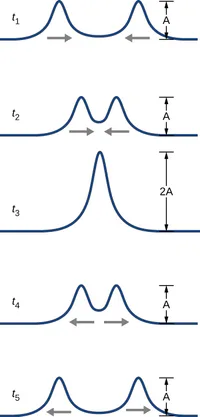
Interference
Interference occurs when two or more waves meet and their individual amplitudes combine to form a new wave.

Resonance
Resonance is the amplification of a vibration that occurs when external input matches an object's natural frequency.

Standing Wave
A standing wave is a special type of wave that appears to be stationary, not moving through space.
5
Wave Interactions: Reflection, Absorption, and Transmission

Reflection
A wave bounces off a surface it cannot pass through.
The angle of the incoming wave equals the reflected wave's angle.
An echo is a common example of sound wave reflection.

Absorption
This process transfers a wave's energy to a material.
The energy from the wave gets "soaked up" by the object.
Dark clothes absorb more light, making you feel warmer.

Transmission
This happens when a wave successfully passes through a material.
The wave continues to travel, though it might lose some energy.
An example is light easily passing through a clear glass window.
6
Multiple Choice
Which statement correctly defines a type of wave interaction?
Reflection occurs when a wave bounces off a surface it cannot pass through.
Absorption happens when a wave passes through a material.
Transmission is the process of a wave's energy being soaked up by an object.
An echo is a common example of wave absorption.
7
Multiple Choice
Based on the principles of wave interactions, why do dark clothes make you feel warmer in the sun?
The dark clothes absorb more of the light's energy, which is converted to heat.
The dark clothes reflect the light waves back, creating warmth.
The dark clothes allow the light waves to pass through them completely.
The angle of the incoming light is changed, which generates heat.
8
Multiple Choice
A person shouts toward a large, solid cliff face and hears a distinct echo a moment later. Which statement provides the most complete explanation for this phenomenon?
The sound wave is mostly reflected off the cliff, and the angle of the incoming wave equals the angle of the reflected wave.
The sound wave is mostly absorbed by the cliff, which soaks up the sound energy.
The sound wave is mostly transmitted through the cliff, which is why it can be heard far away.
The sound wave is both absorbed and transmitted equally by the cliff.
9
Mechanical Waves
Mechanical waves such as sound and water waves must travel through a substance called a medium.
They transfer energy by making the tiny particles of the medium vibrate back and forth.
These waves cannot travel through the vacuum of space because there is no medium to carry them.

Light Waves

Light waves are a type of energy known as electromagnetic radiation, which can travel through space.
Unlike mechanical waves, light does not need a medium and can travel through the vacuum of space.
This is the reason we can see distant objects like the Sun, Moon, and other stars.
10
Multiple Choice
What is the primary difference between mechanical waves and light waves?
Mechanical waves require a medium to travel, while light waves do not.
Mechanical waves are a form of energy, while light waves are not.
Light waves transfer energy by vibrating particles, while mechanical waves do not.
Light waves can only travel through water, while mechanical waves travel through space.
11
Multiple Choice
How do mechanical waves, such as sound, transfer energy from one place to another?
By traveling through the vacuum of space.
By causing the particles of the medium to vibrate back and forth.
By reflecting off of distant objects like the Moon and stars.
By converting energy into electromagnetic radiation.
12
Multiple Choice
Imagine a large explosion occurs in the vacuum of space. If you were observing from a distance, what would you be able to detect?
You would hear the explosion's sound but would not see any light.
You would see the explosion's light but would not hear any sound.
You would both see the light and hear the sound of the explosion.
You would neither see the light nor hear the sound of the explosion.
13
The Bending of Waves: Refraction
Refraction is the bending of a wave when it passes from one medium to another.
This change in direction is caused by a change in the wave's speed.
Light rays bend when they pass from air into water at an angle.
This is why a straw in a glass of water looks bent or broken.


14
Multiple Choice
What is refraction?
The bending of a wave as it passes from one medium to another.
The bouncing of a wave off of a surface.
The combining of two waves to create a new wave.
The changing of a wave's height or amplitude.
15
Multiple Choice
What causes a wave to bend when it enters a new medium?
A change in the wave's frequency.
A change in the wave's speed.
The wave's reflection off the new medium.
The wave's interaction with another wave.
16
Multiple Choice
Why does a straw in a glass of water appear to be bent at the water's surface?
The water magnifies the straw, making it look larger.
The glass of the cup distorts the image of the straw.
Light from the straw bends as it passes from the water to the air.
The straw absorbs water, causing it to physically bend.
17
Wave Interference: Constructive vs. Destructive
Constructive interference makes a wave with a larger amplitude.
Destructive interference makes a wave with a smaller amplitude.
Sometimes, waves can completely cancel each other out.
18
Multiple Choice
What is the effect of constructive interference on a wave?
It makes the wave's amplitude larger.
It makes the wave's amplitude smaller.
It causes the wave to change direction.
It has no effect on the wave's amplitude.
19
Multiple Choice
How does constructive interference differ from destructive interference?
Constructive interference increases amplitude, while destructive interference decreases it.
Constructive interference decreases amplitude, while destructive interference increases it.
Both types of interference cause the amplitude to increase.
Both types of interference cause the amplitude to decrease.
20
Multiple Choice
If two interacting waves result in a wave with zero amplitude, what conclusion can be drawn?
Constructive interference occurred, creating a much larger wave.
Destructive interference occurred, and the waves completely canceled each other out.
The waves were not strong enough to have any effect on each other.
The waves merged into a single wave with an average amplitude.
21
Standing Waves and Resonance
Standing waves are fixed patterns created by interfering waves.
They have nodes (no motion) and antinodes (maximum motion).
Resonance occurs when vibrations match an object's natural frequency.
22
Multiple Choice
What is a standing wave?
A fixed pattern of vibration created by interfering waves.
A single wave that travels long distances without stopping.
The highest point of a wave's motion.
The transfer of energy from one object to another.
23
Multiple Choice
What is the relationship between nodes and antinodes in a standing wave?
Nodes are points of maximum motion, while antinodes are points of no motion.
Nodes are points of no motion, while antinodes are points of maximum motion.
Nodes and antinodes are both points where waves are destroyed.
Nodes are the start of the wave, and antinodes are the end.
24
Multiple Choice
What condition is required for vibrations to cause resonance and create a stable standing wave in an object?
The vibrations must match the object's natural frequency.
The object must have more nodes than antinodes.
The interfering waves must be moving in the same direction.
The object must be completely silent before vibrating.
25
Application: Structure and Function
Lenses use refraction to bend light; mirrors use reflection to create images.
Concert halls use materials that absorb sound to prevent echoes and improve acoustics.
Sound barriers on highways are designed to reflect or absorb unwanted traffic noise.
26
Multiple Choice
How do lenses and mirrors manipulate light to perform their functions?
Lenses use refraction to bend light, while mirrors use reflection to create images.
Lenses use reflection to create images, while mirrors use refraction to bend light.
Both lenses and mirrors absorb light to prevent images from forming.
Both lenses and mirrors use sound waves to create images and bend light.
27
Multiple Choice
What is the primary reason for using special materials on the walls of concert halls?
To absorb sound waves, which helps prevent echoes and improves sound quality.
To reflect sound waves, making the music louder throughout the hall.
To refract light from the stage, making the performers more visible.
To make the structure stronger and more resistant to vibrations.
28
Multiple Choice
A community wants to build a structure to reduce noise from a busy highway. Which design would be the most effective solution based on the principles of sound management?
A solid barrier made of materials designed to both reflect and absorb sound waves.
A series of large mirrors designed to reflect the sound back towards the highway.
A wall of lenses designed to bend the sound waves upwards into the sky.
An open fence that allows air and sound to pass through freely.
29
Misconception | Correction |
|---|---|
Light is a matter wave, just like sound. | Light is an electromagnetic wave; sound is a mechanical wave. |
When two waves interfere, they are permanently destroyed. | After interference, waves continue along their original paths. |
All wave interference results in bigger waves. | Destructive interference can result in smaller waves. |
30
Waves can be reflected, absorbed, or transmitted by a material.
Light waves can travel through a vacuum, but mechanical waves like sound require a medium.
Refraction is the bending of light, while interference is when waves combine.
Resonance increases a wave's amplitude by matching a natural frequency.
31
Poll
On a scale of 1-4, how confident are you about the concepts covered in today's review?
1
2
3
4
Middle School
Show answer
Auto Play
Slide 1 / 31
SLIDE
Similar Resources on Wayground

23 questions
The Inner Planets
Presentation
•
7th - 8th Grade
23 questions
Body Systems: The Muscular System
Presentation
•
7th Grade
23 questions
Circulatory system
Presentation
•
7th Grade
23 questions
Mitosis Review
Presentation
•
7th Grade
27 questions
Living Things and the Environment
Presentation
•
7th Grade
21 questions
Carbon Cycle
Presentation
•
7th Grade
21 questions
Human Body System Review
Presentation
•
7th Grade
23 questions
Quiz Recovery - Periodic Table of Elements
Presentation
•
7th - 8th Grade
Popular Resources on Wayground
21 questions
Continents and Oceans

Quiz
•
6th Grade
20 questions
Parts of Speech
Quiz
•
5th Grade
16 questions
Subject & Predicate
Quiz
•
5th Grade
25 questions
Multiplication Facts
Quiz
•
5th Grade
12 questions
Map Skills
Quiz
•
3rd Grade
22 questions
Continents and Oceans
Quiz
•
5th Grade
15 questions
Rounding Decimals
Quiz
•
5th Grade
20 questions
Brand Labels
Quiz
•
5th - 12th Grade
Discover more resources for Science
17 questions
7.6D Aqueous Solutions
Quiz
•
7th Grade
20 questions
Claim, Evidence and Reasoning (CER)
Quiz
•
6th - 8th Grade
10 questions
Exploring Chemical and Physical Changes

Interactive video
•
6th - 10th Grade
16 questions
Photosynthesis and Cellular Respiration Review
Quiz
•
7th Grade
20 questions
Food Webs + Energy Pyramids
Quiz
•
7th Grade
24 questions
Cell Organelles
Quiz
•
7th Grade
20 questions
Human Body Systems
Quiz
•
7th Grade
10 questions
Exploring the Periodic Table
Interactive video
•
6th - 10th Grade