Ecological Succession
Presentation
•
Science
•
7th Grade
•
Medium
+2
Standards-aligned
Karina Lazcano
Used 162+ times
FREE Resource
13 Slides • 15 Questions
1
Ecological Succession
Asynchronous 5/5/2021
○Complete your warm-up
○Complete this lesson
2
Ecological Succession
Eco = Environment
Logical = Concerning
Succession = To come next inline
Ecological succession is a series of PREDICTABLE CHANGES that occur in an ecosystem over a period of time.
○ There are TWO types of succession (primary & secondary)
○ Ecosystems typically start with just a few smaller species
○ Ecosystems are stable when there is a climax community of mature and diverse species
3
ECOLOGICAL SUCCESSION
4
Multiple Choice
What is ecological succession?
A slow change in an environment
A sudden change in an environment
No change in an environment
A fast change in the environment
5
Succession begins with pioneer species and ends with a climax community
Pioneer species are the FIRST plants to arrive and are small and grow quickly.
A climax community is reached when the largest organisms are present and the ecosystem is stable (no longer changing)
6
Multiple Choice
Stable, final stage of succession:
adaptation
pioneer species
niche
climax community
7
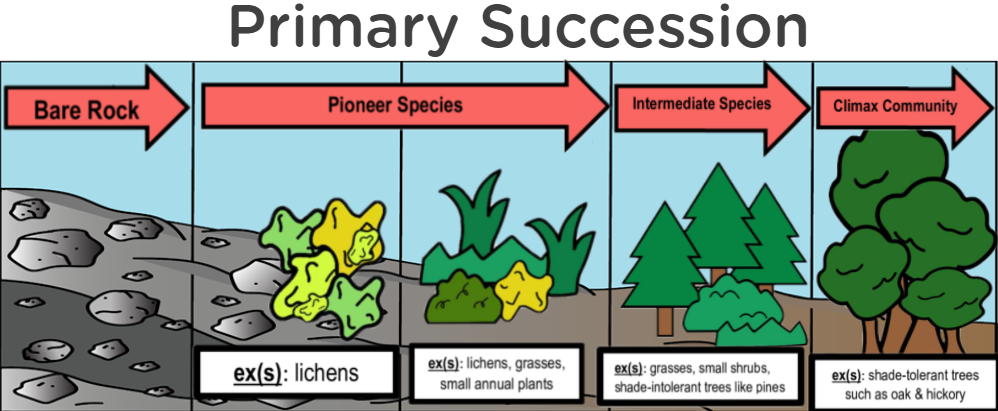
Primary Succession
Starts on bare ROCK
Takes hundreds of years (centuries) for a mature forest to form and reach a climax community.
Primary succession begins with either the eruption of a volcano that takes away all the soil or a glacier retreats and leaves behind bare rock
8
Glacier retreating exposing bare rock A in western Greenland
9
Lava flows from an eruption of a volcano on the Reykjanes Peninsula in southwestern Iceland on Monday, March 29, 2021.
10
Multiple Choice
What is an example of primary succession?
Growth in area where a field has been abandoned
Growth in an area where a surface mine is no longer used
Growth in an area where a forest has been cleared
Growth in an area where a glacier has receded (retreats)
11
Steps to Primary Succession:
1) Pioneer species such as lichen and mosses break down exposed rock forming soil
2) Grasses, wildflowers, and weeds grow in the soil
3) Small trees and shrubs (bushes) appear
4) Bird and small mammals move in
5) Fast-growing trees, like pines emerge
6) Slower growing trees such as maples, birch, and oak grow forming a mature forest/climax community
Climax community: means "the end" and is where a community is stable and has maximum biodiversity.
12
FIX PAGE 4 IN YOUR JOURNAL IF INCORRECT!
13
Multiple Choice
Lichen, grasses, and small annual plants are examples of -
climax species
native species
pioneer species in primary succession
pioneer species in secondary succession
14
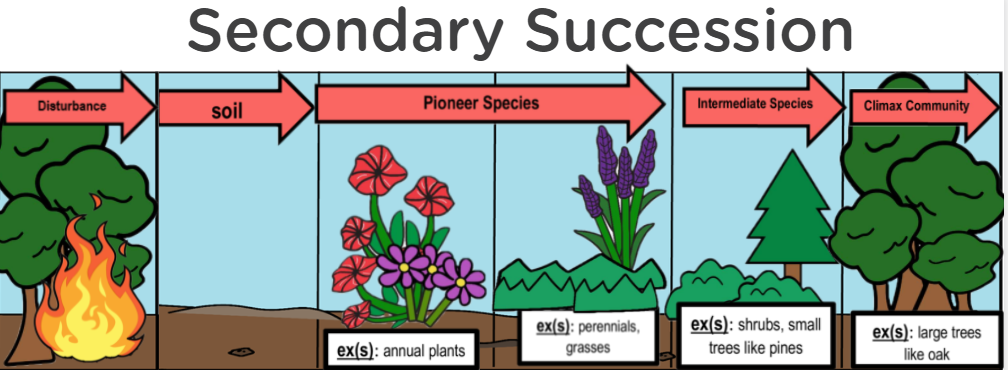
Secondary Succession
Secondary succession occurs after a natural disturbance or human activities.
Takes a few years (decades) for a mature forest to form and reach a climax community.
Events that lead to secondary succession are: floods, hurricanes, tornadoes, wildfires, clear-cutting trees, or mining (human impact)
15
Forest cleared for cultivation (farming)
16
FIX PAGE 5 IN YOUR JOURNAL IF INCORRECT
17
Multiple Choice
Annual plants, perennials and grasses are examples of -
pioneer species in primary succession
pioneer species in secondary succession
climax species
native species
18
Same area after a wildfire
19
Multiple Choice
A fire partially destroys a temperate deciduous forest. The following spring, grasses and low growing shrubs are observed amongst the burned trees. This is an example of -
secondary succession
primary succession
biodiversity
climax community
20
Multiple Choice
The picture shows what type of succession?
primary
secondary
tertiary
quaternary
21
Multiple Choice
________________ reaches a climax community quicker because soil is already present.
Primary Succession
Secondary Succession
Both types of succession
22
Multiple Choice
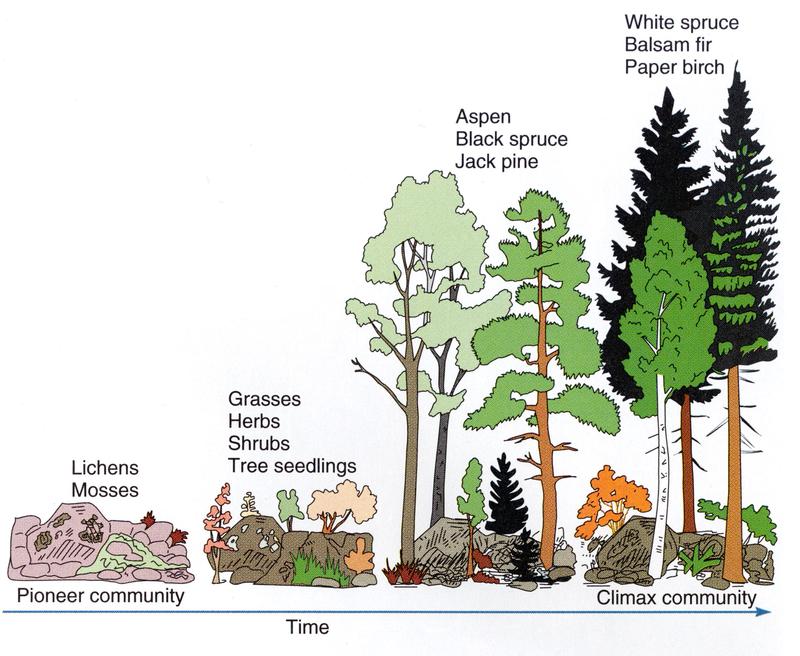
What is the order of succession shown in this figure?
A, B, C, D
B, A, D, C
C, D, A, B
D, A, B, C
23
Multiple Choice
After a volcanic eruption, lava covers the land. What is the order that plants grow to repopulate the area?
Lichens → Shrubs → Grasses → Trees
Lichens → tree → shrubs→Grasses
Grasses → Lichens → Shrubs → Trees
Lichens → Grasses → Shrubs → Trees
24
Multiple Choice
What is the main difference between primary and secondary ecological succession?
Primary begins without soil and Secondary begins with soil
Primary is the first stage and secondary is the second stage of succession
Primary builds plant communities and secondary builds animal communities.
Primary begins with soil and Secondary begins without soil
25
Multiple Choice
What is an example of a disturbance that could bring about secondary succession?
26
Multiple Choice
Which is faster: Primary or Secondary Succession?
Primary Succession
Secondary Succession
Both take the same amount of time
27
Multiple Choice
Ecological succession is a series of predictable _______ that occur in an environment.
changes
series
communities
populations
28
Multiple Choice
What is a pioneer species in SECONDARY succession?
lichens and mosses
small trees and shrubs
grasses and perennials
mature trees
Ecological Succession
Asynchronous 5/5/2021
○Complete your warm-up
○Complete this lesson
Show answer
Auto Play
Slide 1 / 28
SLIDE

Similar Resources on Wayground
22 questions
Adaptations & Variations LT 5
Presentation
•
6th - 8th Grade
22 questions
2.18 Connecting Cellular Respiration and Photosynthesis
Presentation
•
8th Grade
22 questions
Earth, Moon, and Sun System
Presentation
•
6th - 8th Grade
21 questions
Homeostasis and Behavior Interactive Lesson
Presentation
•
7th Grade
24 questions
Food Webs and Ecosystems
Presentation
•
7th Grade
21 questions
Energy Flow in the Ecosystem
Presentation
•
6th Grade
20 questions
Ecology Lesson
Presentation
•
7th Grade
22 questions
Types of Living Things
Presentation
•
6th - 8th Grade
Popular Resources on Wayground
10 questions
5.P.1.3 Distance/Time Graphs
Quiz
•
5th Grade
10 questions
Fire Drill
Quiz
•
2nd - 5th Grade
20 questions
Equivalent Fractions
Quiz
•
3rd Grade
22 questions
School Wide Vocab Group 1 Master
Quiz
•
6th - 8th Grade
20 questions
Main Idea and Details
Quiz
•
5th Grade
20 questions
Context Clues
Quiz
•
6th Grade
20 questions
Inferences
Quiz
•
4th Grade
12 questions
What makes Nebraska's government unique?
Quiz
•
4th - 5th Grade
Discover more resources for Science
19 questions
Introduction to Properties of Waves
Presentation
•
6th - 8th Grade
16 questions
Interactions within Ecosystems
Presentation
•
6th - 8th Grade
10 questions
Exploring the Layers of the Earth
Interactive video
•
6th - 10th Grade
16 questions
Photosynthesis and Cellular Respiration Review
Quiz
•
7th Grade
20 questions
Abiotic & Biotic Factors
Quiz
•
7th Grade
10 questions
Exploring the Evolution of Cell Theory
Interactive video
•
7th Grade
17 questions
Human body systems
Quiz
•
7th Grade
20 questions
Energy Transformations
Quiz
•
6th - 8th Grade