

Changes in Force and Motion

Presentation
•
Science
•
6th - 8th Grade
•
Practice Problem
•
Medium
+3
Standards-aligned

Barbara White
Used 130+ times
FREE Resource
12 Slides • 19 Questions
1

Middle School

2


3
Key Vocabulary

Force
A push or pull that can cause an object to change its motion or direction.

Motion
The change in an object's position with respect to time and other reference points.

Speed
The rate of change in an object's position or the distance traveled over time.

Velocity
The measure of an object's speed combined with its specific direction of motion.

Acceleration
The rate of change in velocity, such as speeding up, slowing down, or changing direction.

Net Force
The sum of all forces acting on a body which determines its overall acceleration.
4
Key Vocabulary

Reference Frame
A system using coordinates or objects to establish position or measure a point's movement.
5
Force and Motion
A force is a push or a pull that can cause motion.
Force can change an object’s potential energy to kinetic energy.
Motion is a change in position compared to a reference point.
6
Multiple Choice
What is a force?
A push or a pull that can cause motion
A change in an object's position over time
The energy stored in an object at rest
A location used for comparison to see if something has moved
7
Multiple Choice
What is the relationship between applying a force to an object and the object's energy?
Its potential energy is converted into kinetic energy.
Its kinetic energy is converted into potential energy.
Its energy is completely lost.
Its energy does not change.
8
Multiple Choice
A person applies a force by pushing a book that was resting on a table. What evidence would confirm that the book is in motion?
The book's position changes compared to the table.
The person is no longer touching the book.
The book has more potential energy than before.
The table is perfectly flat.
9
Speed, Velocity, and Acceleration

Speed

Velocity
Velocity describes an object's speed and its specific direction of motion.
An example is a car traveling at 30 miles per hour north.
It is calculated the same way as speed but must include a direction.

Acceleration
Acceleration is defined as any change that occurs in an object's velocity.
An object is accelerating if it is speeding up or slowing down.
It also accelerates if it is simply changing its direction of motion.
10
Multiple Choice
What is the main difference between an object's speed and its velocity?
Velocity includes direction, while speed does not.
Speed is calculated using distance, while velocity is not.
Speed measures a change in position, while velocity does not.
Velocity is always a larger value than speed.
11
Multiple Choice
Under which condition is an object accelerating?
When it is moving at a constant speed in a straight line.
When its velocity is changing.
When it is not moving at all.
When its position has changed.
12
Multiple Choice
A car is driving in a circle at a constant speed of 40 miles per hour. Which statement best describes the car's motion?
The car is not accelerating because its speed is constant.
The car's velocity is constant because its speed is constant.
The car is accelerating because its direction is changing.
The car has a constant speed but no acceleration or velocity.
13
Newton's Second Law of Motion (F=ma)
14
Multiple Choice
What does Newton's Second Law of Motion describe?
The relationship between net force, mass, and acceleration.
An object at rest will stay at rest unless a force acts on it.
For every action, there is an equal and opposite reaction.
The force of gravity between two objects.
15
Multiple Choice
According to the relationship described by F=ma , what happens if the net force on an object is increased?
The object's acceleration will increase.
The object's acceleration will decrease.
The object's mass will increase.
The object's acceleration will not change.
16
Multiple Choice
If you push an empty shopping cart and a full shopping cart with the exact same amount of force, which statement correctly describes the result?
The empty cart will have a greater acceleration.
The full cart will have a greater acceleration.
Both carts will have the same acceleration.
Neither cart will accelerate.
17
Balanced and Unbalanced Forces
The net force is the sum of all forces acting on an object.
Balanced forces are equal and opposite, resulting in a net force of 0 N.
With balanced forces, there is no acceleration and the object’s motion stays unchanged.
Unbalanced forces cause acceleration; add or subtract forces to find the net force.

18
Multiple Choice
What happens to an object's motion when the forces acting on it are balanced?
The object will speed up.
The object will slow down.
The object's motion will not change.
The object will change direction.
19
Multiple Choice
What is the key difference in the net force between balanced and unbalanced forces?
Balanced forces cause an object to accelerate, while unbalanced forces do not.
Balanced forces result in a net force of zero, while unbalanced forces result in a non-zero net force.
Balanced forces only apply to objects at rest, while unbalanced forces apply to objects in motion.
Balanced forces are always in the same direction, while unbalanced forces are in opposite directions.
20
Multiple Choice
If a box is pushed with a force of 20 N to the right and another force of 10 N to the left, what is the resulting net force and its effect on the box?
The net force is 30 N to the right, and the object will accelerate.
The net force is 10 N to the right, and the object will accelerate.
The net force is 10 N to the left, and the object will accelerate.
The net force is 0 N, and the object's motion will not change.
21
Effects of Forces on Moving Objects
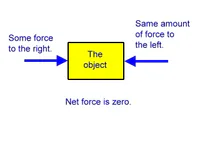
Zero Net Force
The net force on the moving object is zero.
The object does not accelerate and its velocity remains constant.
It continues moving at the same speed and direction.

Force in Same Direction
An unbalanced force acts on the object while in motion.
The force is applied in the same direction as movement.
This causes the object to accelerate and speed up.

Force in Opposite Direction
An unbalanced force acts on the object while in motion.
The force is applied opposite to the direction of movement.
This causes the object to decelerate and slow down.
22
Multiple Choice
What happens to a moving object if the net force acting on it is zero?
Its velocity remains constant.
It immediately stops moving.
It begins to speed up.
It begins to slow down.
23
Multiple Choice
What is the cause-and-effect relationship that results in a moving object accelerating?
An unbalanced force acts on the object, causing a change in its motion.
The object’s mass decreases, allowing it to move faster.
The object is moving at a constant speed in a straight line.
Friction and gravity cancel each other out, keeping the motion uniform.
24
Multiple Choice
A toy car is pushed across a carpeted floor and begins to slow down after it is released. Which statement best explains why the car is slowing down?
An unbalanced force from friction is acting in the opposite direction of its movement.
The net force on the car is zero, causing it to slow down.
A balanced force is acting in the same direction as its movement.
The car has run out of the force that was initially given to it.
25
Frames of Reference
To describe motion, you need a system called a frame of reference.
Measurements are taken from a stationary spot called a reference point.
An object’s motion can seem different depending on your frame of reference.
For example, a person on a train has a different speed relative to the ground.

26
Multiple Choice
What is a frame of reference?
A system for describing an object's motion
The force that an object is creating
The speed of an object in a vacuum
A measurement of an object's total mass
27
Multiple Choice
Why does an object’s motion appear different from different frames of reference?
Because the object’s mass changes depending on where you observe it.
Because gravity affects moving objects differently in each frame.
Because motion is measured relative to the chosen reference point.
Because the object always moves at the same speed for everyone.
28
Multiple Choice
Why might a person on a train and a person on the ground describe the train's motion differently?
Motion is relative and depends on the observer's frame of reference
Only one observer can be correct about an object's motion
Objects in motion always appear to be moving backward
Motion can only be accurately measured from a stationary point
29
Misconception | Correction |
|---|---|
Speed and velocity are the same thing. | Velocity includes both speed and direction. |
An object with zero net force is always at rest. | It can also move at a constant velocity. |
A force is always needed to keep an object moving. | A force is only needed to change an object's motion (accelerate). |
30
31
Poll
On a scale of 1-4, how confident are you about the concepts covered in today's review?
1
2
3
4
Middle School
Show answer
Auto Play
Slide 1 / 31
SLIDE
Similar Resources on Wayground

24 questions
Watersheds
Presentation
•
6th - 8th Grade
26 questions
Water Pollution
Presentation
•
6th - 8th Grade
24 questions
Climate Regions Review
Presentation
•
6th - 8th Grade
21 questions
Breathing/gas exchange
Presentation
•
6th - 8th Grade
21 questions
Energy
Presentation
•
6th - 8th Grade
21 questions
layers of the earth 6th
Presentation
•
6th - 8th Grade
23 questions
Natural Hazard Predictions
Presentation
•
6th - 8th Grade
26 questions
Intro to Waves
Presentation
•
5th - 8th Grade
Popular Resources on Wayground
10 questions
Safety Day 2026 – Student Review

Quiz
•
9th Grade
21 questions
Continents and Oceans
Quiz
•
6th Grade
20 questions
Parts of Speech
Quiz
•
5th Grade
16 questions
Subject & Predicate
Quiz
•
5th Grade
25 questions
Multiplication Facts
Quiz
•
5th Grade
12 questions
Map Skills
Quiz
•
3rd Grade
22 questions
Continents and Oceans
Quiz
•
5th Grade
15 questions
Rounding Decimals
Quiz
•
5th Grade
Discover more resources for Science
20 questions
Newton's Laws of Motion
Quiz
•
8th Grade
20 questions
Elements, compounds, and mixtures
Quiz
•
6th Grade
10 questions
6.6D - Relative Density Review
Quiz
•
6th Grade
15 questions
potential and kinetic energy
Quiz
•
8th Grade
21 questions
Newton's Laws of Motion
Quiz
•
8th Grade
20 questions
Elements, Compounds and Mixtures
Quiz
•
8th Grade
10 questions
Exploring Chemical and Physical Changes

Interactive video
•
6th - 10th Grade
20 questions
CONDUCTION,CONVECTION AND RADIATION
Quiz
•
6th Grade